
*the use of the cover art for this piece was generously permitted by John Kennedy: www jedika.com
A Funny Scene
There’s a funny scene I imagine sometimes in which I get to the afterlife and meet God after a life on earth.
And God tells me, “Sorry pal, you were wrong. I’m actually not quite as good as you thought I was. I’m a bit less merciful than you came to believe. And those folks who said I was a tad fussy were actually right. You overestimated me.”
That’s a funny little scene, but it’s one I’ve begun to try and come to terms with. Any god who turns out to be worse than I imagined is not a being I want to worship or spend eternity with. In the words of Brennan Manning,
“We make God in our own image and he winds up being as fussy, and rude, and narrow minded, judgmental and legalistic, and unloving and unforgiving as we are.”
Brennan Manning

A Sunday School
About seven years ago, I was part of a traveling group, and we played music in prisons. On Sundays we played at churches to raise support. One Sunday morning, I sat through a Sunday school class which made God out to be really petty and awful. After getting home from the trip, I spent thirty something dollars to mail a teaching series of CDs to the Sunday school superintendent which I felt would help correct the blaspheming – which is pretty hilarious when I think back to it. But right after that service was over, I wrote something which I’ll share part of – because I think I may have been wrong.
I will love and trust and you either way,
Me, circa 2017
But I hope to heaven you’re not the God
They spoke of yesterday,
A God to be appeased,
Who died to save us from himself,
There has to be a God whose love is untold fathoms,
And more than all your graven dragons
My instinct there was to “love and trust” either way – even if God turned out to be super petty and anal and looking like a pagan god who just wanted sacrifices. I’m not so sure that’s a good idea, because I have become more and more convinced that any conception which leaves me feeling hollow, which portrays God as annoying, ornery, and legalistic just isn’t worth any of our time.
A Film
There’s a scene in the film Women Talking where a group of women are deciding whether to stay in their extremely abusive conservative community or to leave. They are trying to figure out how it can be that God is good and also requiring of them the things the men of the church have commanded.
The monologue given by Salome (below) is a radical proclamation, and it reminds me of Daniel and his friends choosing to be burned alive rather than worship an idol. She is saying I will burn before I bow down to this idol they have given me and called God.
If God is a loving God then He will forgive us himself. If God is a vengeful God then He has created us in His image. If God is omnipotent, then why has He not protected the women and girls of this colony? I will destroy any living thing that harms my child. I will tear it limb from limb. I will desecrate its body and I will bury it alive. I will challenge God on the spot to strike me dead if I have sinned by protecting my child from evil, and by destroying that evil that it may not harm another! I will lie, I will hunt, I will kill. I will dance on graves and I will burn forever in hell before I allow another man to satisfy his violent urges with the body of my four-year-old child!
Salome: Women talking (film) adapted from novel by Miriam Toews
A Courage
There is a certain courage required to doubt in this way – it is to doubt one thing because you have faith there must be something better. A few months ago in a conversation with a friend, the question came up: is it better to believe in or to totally reject a version of God which is false? I think we must reject it – to doubt it with everything we have as it stands as a barrier to real communion with God. There is no amount of doubting which is too much when it comes to false gods. It is impossible to doubt too strongly that which is not true. When we are given pictures of God which make God out to be petty and legalistic – we must have the courage to doubt them.

I think this is what’s embedded into much of the current trend of deconstruction among my generation. We are faced with the dilemma of being handed a small, pathetic, petty god who is made in the image of those who are misogynistic [against women], racist [discriminating], reactive [unthoughtful], xenophobic [against immigrants] , homophobic [against gay folks], disregarders of the interests of the poor…) and who are people who claim to speak on God’s behalf from the front of many churches. So we choose between trying to stay in these places, where God is painted in these ways, and we either have a little sketchbook on the side where we try to quietly paint something a bit better, or we leave. And I, for one, have a lot of compassion for those who leave.
A lot of conversations I hear about deconstruction say something like yeah well you need to calm down. You just need to weed out some bad facts and then carry on from there – it’s unhelpful to go too far. Certainly it won’t look the same for everyone, but again I have a lot of empathy for those who find that the threads of a small God are woven through everything, and they have to pull it until it comes out. I think of the Israelites who constantly encountered (and worshipped) idols and who were never commanded to just take off the top layer and build back on top. It was always more a razing to the ground situation (2 Kings 23; Deut. 12:2-3, 7:5; Isaiah 2:17-18).
A Grasping or a Communion
A few months ago I wrote about the opposed ways in which our right and left brain view knowing: “The left hemisphere wants to gain knowledge by grasping it, that is, by holding it tightly and obtaining it. This is the kind of ‘knowing’ in which we memorize facts and hold them as though that were the truth itself. The right hemisphere way of knowing the truth is to draw near to it, almost as if we were sitting near to a wise person and experiencing wisdom through proximity to it.”
“Grasping things…won’t get us as far as we would like, because the most important things in life refuse to be grasped.”
McGilchrist, 2019
In Luke 10, a expert in the law comes to Jesus and asked what he must do to inherit eternal life. The answer, which he correctly gives, is to love God and love neighbor. Then he asks, who is my neighbor? And Jesus tells the story of the good Samaritan which culminates in a question:
“Which of these three do you think was a neighbor to the man who fell into the hands of robbers?” The expert in the law replies, “The one who had mercy on him.”
And so I ask, in light of the discussion above, when we meet two people: one a Christian who is misogynistic, racist, reactive, xenophobic, homophobic, who disregards the interests of the poor – and a second person who has heard of this sort of God and rejected it altogether (an atheist or agnostic) who meets women and minorities and immigrants and LGBTQ folks and the poor and all their neighbors with kindness and compassion.
Who is neighborly? Who would Jesus commend today as he did the Samaritan? Who is a better picture of the good news? Who communes with Jesus? I don’t think it’s a hard question. It’s the one who has mercy, says Jesus.
The African bishop, St. Augustine, said,
“Si comprehendis non est Deus”
[If you understand God, what you understand is not God] or [If you think you have grasped him, it is not God you have grasped].

A Divorce
I believe there is power in the gospel of Jesus and that his people have the capacity to heal the world in a real sense. And in my next piece I want to explore this further and ask what negates and compromises that power. One way I’m convinced the power of the church and the Christian is compromised is described by Hans Boersma who writes how “divine decisions” (what is right and wrong) has been divorced from “eternal truth” as the modern conception of God departed from the sacramental one.
When this happens, we lose our connection to the truth in a way that causes us to mistrust our bodies, our intuition, and our own sense of the world in a terrible way. It makes so that we may see Christians treating LGBTQ people terribly, and we have to wonder well that seems terrible and all, but isn’t this what the pastor told us the Bible said? Or we hear an elder laying down the straight and narrow telling us what to wear and how to speak and what to drive and who’s in and who’s out and it seems ridiculous, but maybe I can’t trust myself and he somehow knows. This modern divorce of the eternal truth, which is something we are built to intuit as people in God’s image, and the will of God, which we’ve been told is only interpreted through reading scripture and because God has said so, is a tragic divorce indeed.
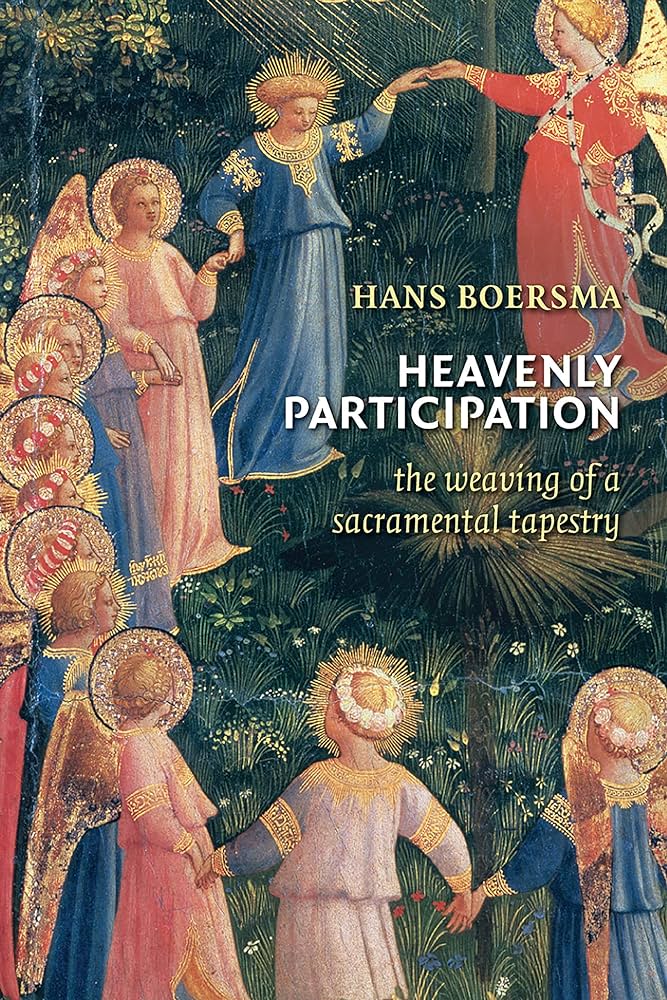
Boersma writes, “For Aquinas…divine decisions had always been in line with eternal truth. For example, when God condemned adultery, this was not an arbitrary divine decision, but it was in line with divine rationality…in line with the very truth of God’s character. [The modern approach] proffered a radical disjunction between goodness and truth…The consequences were close at hand: if something is good strictly because God wills it to be good, then couldn’t God declare anything, even the most horrible act, to be good?”
Nature, now separate from reason, became fundamentally unintelligible.
Hans Boersma, 2011, p. 79
A Funny Scene
In conclusion, I return to the funny scene in which I get to the afterlife and God turns out to be a bit of a disappointment. I really think that for my generation we are conflicted by the God we’ve been told about who is often constructed through certain narrow readings of scripture and thinly veiled attempts at gaining cultural power. And we are told this God can be grasped through an objective set of facts, propositions about ultimate truth, and certain interpretations of scripture. And we’ve felt in our bodies, in our soul, in our experience, in our watching, in our listening, that much of this is just an idol – a small God we’d be pretty bummed out to come face to face with in the great beyond. I fully expect to be shocked by God. God is without a doubt different than my conceptions. But God is better – always better.
It is my firm belief that I will not meet a God who is disappointing, and that as I meet God each day, he is not small or petty. And it is my commitment to doubt those small images of him wherever they appear and to do the work of deconstructing them. This is I think the work of my generation and of all who want to lay hold of the power of the gospel. If this seems too much, then perhaps you would at least be sympathetic and heed the words of St. Jude to “have mercy on those who doubt.”
 javen.bear.
I like the phrase, “It is my firm belief that I will not meet a God who is disappointing!”
LikeLiked by 1 person