Over the last few months, I’ve become interested in the reality that we have two needs as humans which are very central: the need for attachment and the need for authenticity. I think most of our pain and what makes life so difficult is that one must often be sacrificed for the other. At the best of times and in the best of places, we have them both. Let’s take a look.
Two Core Needs
Attachment: “a drive for closeness – proximity to others, in not only the physical but emotional sense as well.” The primary purpose is to facilitate either caretaking or being taken care of (Mate, p. 105)
It’s well known that baby ducks will follow around the first thing they see after they hatch. If it happens to be the pet dog they see, they’ll waddle after him. They’re wired for attachment. Babies also come into the world wired for attachment. They are built to need their parents and to develop a special bond with their caregivers. Toddlers too have a natural need to be attached – they need adult attention, love, and constant care. Our attachment need never disappears as we grow into children, adolescents, and adults. Kids want and need to be loved by their parents, friends, teachers, etc. and to form close relationships. Throughout our whole lives we go to great lengths to behave in ways that protect and nurture attachments. This is good – we’re created to do this.
Authenticity: “Knowing our gut feelings when they arise and honoring them…the quality of being true to oneself” (Mate, p. 106). Similarly, “the lack of authenticity makes itself known through tension or anxiety, irritability or regret, depression or fatigue” (Mate, p. 376). When we’re not authentic, we can ask “what fears, rationalizations, or familiar narratives kept me from being myself? Do I even know what my own values are?” (p. 376) This is not a “striving for some idealized self-image…[rather] being authentically who one is” (p. 375).
As the early Bebo Norman puts it, authenticity is “myself when I am real.” We are made in such a way that we experience feelings and sensations in our bodies as we move through life. I note here that I think this concept is unfortunately much much more difficult to work with if (like me) you grew up in a highly religious environment. If we bristle at the notion of having a need for authenticity, that’s likely tied to a suspicion we’ve inherited around any talk of authentic self or honoring how we are made. But whether or not we’re comfortable with it, God gave us bodies with gut reactions, and to live in a healthy manner is to honor that, to practice authenticity. It’s a core need we all share.
The Trouble
The trouble is that these two needs, attachment and authenticity, are sometimes put at odds by our life situations. Think about a girl who really loves football but knows that if she honors that feeling, she will face ridicule from her friends who have other expectations. Or a boy who is terrified of riding a bike whose father dreams he’ll be a professional cyclist. In order to save the attachment, the authenticity gets sacrificed. Gabor Mate says it this way, “This clash is ground zero for the most widespread form of trauma in our society: namely ‘small-t’ trauma expressed in a disconnection from the self even in the absence of abuse or overwhelming threat.”
In the early stages of life, attachment will almost always win. It has to. If the child is to survive, they have to have the attachment relationship. I remember paging through a Dr. Dobson parenting book and reading a story in which he recounts the manipulation of a child into obedience by putting them outside and shutting the door. Only when the child’s attitude had changed were they permitted to come back into the house. That’s the sort of situation that will remove every ounce of authenticity. If it’s a choice between expressing my true feelings or being put out of the home on my own, cut off from my attachment, I’ll just erase how I’m feeling to make my caregiver happy. In our early years, attachment usually has to win out when there’s a conflict.

“The seed of woe does not lie in our having these two needs, but in the fact that life too often orchestrates a face-off between them. The dilemma is this: what happens if our needs for attachment are imperiled by our authenticity, our connection to what we truly feel?” (Gabor Mate)
If we were put in terrible situations like this as a child, it’s natural that we’ll develop a habit of always burying our own feelings and needs whenever they conflict with someone else’s. This can make us into really “nice” and “helpful” and “selfless” people who are totally disconnected from our selves. We might lose touch with our values – what do I want in this situation – if our default has been programmed to making sure everyone else is happy so w can stay close to them.


There’s a scene in the movie Inside Out where Riley is deeply sad and starts to cry because her family has moved across the country and left all her friends in Minnesota behind. It’s a beautiful example of a child being given the “ok” to express her sadness.
Riley: I know you don’t want me to, but I miss home. I miss Minnesota. You need me to be happy, but I want my old friends and my hockey team. I want to go home. Please don’t be mad.
Dad: We’re not mad. You know what? I miss Minnesota too. I miss the woods when we took hikes.
Mom: And the backyard where you used to play.
Dad: Spring lake where you learned to skate. Come here [family hug].
This scene could be completely different! The parents could say, Aww, Riley, don’t be sad. There’s so much to be excited about! Don’t you know how much work we’ve done to give you a good life here? Why are you so ungrateful – you have it good! Back in my day my parents….
The Environment of Clash
Gabor Mate’s book from which I quote heavily here is called The Myth of Normal. The idea is that when you have 70% of people on a medication, when we are this anxious and depressed and lonely, when we need this much distraction to cope, this is no longer normal. Normal, medically speaking, is considered within the range of healthy function. The outcomes we’re seeing are evident that the place and the way we’re living, our environment, is no longer normal. However, these are the “normal” outcomes you would expect of an extremely toxic environment. Dr. Mate gives the example of a laboratory petri dish: if you studied specimens in a lab, and 70% of them became sick, it would be a pretty natural conclusion that something toxic was in the dish.

According to the New York Times, “In 2019, the Centers for Disease Control and Prevention estimated that 15.8 percent of American adults took prescription pills for mental health.” It goes without saying that many more people would qualify for prescription medication if they chose to seek a diagnosis. In 2024, this number is higher, and by all account, we are more anxious, depressed, and mentally unwell then we’ve ever been. One could write stacks of papers on the societal factors producing a toxic environment.
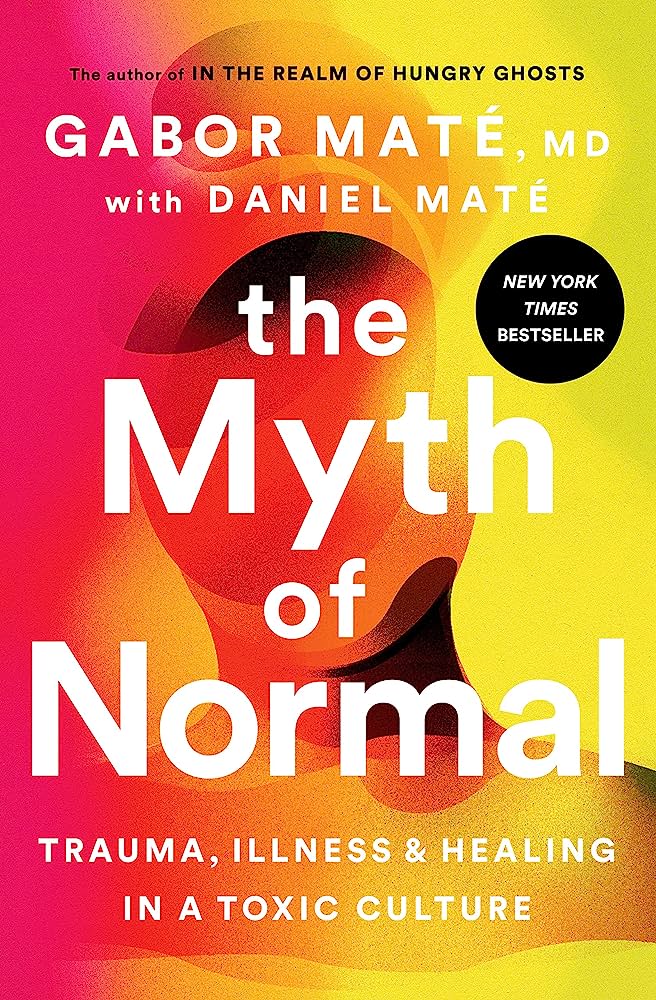
“Nearly 70 percent of Americans are on at least one prescription drug; more than half take two. In Canada, every fifth person has high blood pressure. In Europe, hypertension is diagnosed in more than 30 percent of the population. And everywhere, adolescent mental illness is on the rise. So what is really ‘normal’ when it comes to health?” (from The Myth of Normal – Gabor Mate)
And we adults who parent these sensitive, expectant infants do so in a world where we are constantly bombarded with advertisement crafted to make us buy products which promise an easier, less stressful life. Watch a 10 minute clip on YouTube and you’ll be interrupted at least several times and implored to buy something. We work to try and afford housing that many of us come home to and scroll on our phones for hours (4.8 hours per day for teens and around 2 hours for adults), a distraction and an escape, this too fraught with advertisements of a less stressful life. Suffice to say, the environment most of us live in is not one which encourages interpersonal connection, attunement, and meaningful interaction. What we know of up and coming generations suggests they aren’t faring very well either in terms of stress, anxiety, and loneliness.

What does it mean to foster healthy attachment, to our children and to each other, in a society which seems built for the opposite – which seems built for loneliness and distraction? And how are we to live authentically, to honor the feelings and warning signs in our body, when cultural and financial success often demand we devote our time and energy to feeding the corporate machine or getting other people to buy our stress-reducing or status elevating product?
The Particularly Predisposed
When I think about these two core needs of attachment and authenticity, I feel like modern life makes it hard for everyone, and yet there are some I see as being especially set up to fail.
First, I think about my friends who aren’t straight. They’re either gay, lesbian, or bi-sexual in the cases of people I know personally. What’s both hilarious and maddening to me is the folks who think they aren’t straight because of some choice they made to be this way. Far be it from me to pretend to be an LGBTQ spokesperson – I don’t know very much. But I watch friends and acquaintances who struggle with accepting who they are for years, and who may even deny it themselves for a long time, may even hope it will change, before acknowledging the fact they aren’t straight and telling other people. And then they brace themselves for how they’ll be treated. Attachment vs authenticity.
If this person hopes to keep their old friendships and continue to be accepted by their family, they may feel the need to deny or block out the truth about who they really are, what sexual attraction they really have. They keep acceptance only through rejecting authenticity. Or on the other hand, they choose to acknowledge the truth of who they are knowing they will be cut off from their friends and family – they’ll lose their attachment. For many, it’s an impossible situation that’s going to result in a lot of pain either way.
And I know (I absolutely know) there are folks reading this whose blood pressure will rise when they read those two paragraphs. They think that somehow gay people (which means someone attracted to the same sex) are an affront to the Bible and are making some immoral choice for this attraction. If this is you, I would ask you to consider: when did you make a conscious choice about which sex you are attracted to? How hard would it be for you to switch your attraction from what it is now to the other sex? Say you even wanted to do that so people would accept you, and you couldn’t – what would you want from your friends and your community? Wouldn’t you want a chance to be authentic and to keep your attachments? I certainly would.
I also think of people with conservative values who find themselves in very progressive environments (such as a liberal business or a church). It’s a bad feeling to know that to honestly express your values (to be authentic) will result in being cut off or judged. It’s also a bad feeling to pretend like you don’t have values which run against the grain to stay in the favor of those around you (to be attached). For some, there is mobility and the option to leave. For others, they’ll have to choose between attachment and authenticity, and the result may be loneliness or constant anxiety, both of which are great predictors of physical health problems later on.
Personality

“It is sobering to realize that many of the personality traits we have come to believe are us, and perhaps even take pride in, actually bear the scars of where we lost connection to ourselves way back when” – Gabor Mate
The Enneagram is a way of understanding personality which highlights a core fear and a core desire of nine different types of personalities (think archetype). I personally find the type 5 to be very resonate. The core fear is being depleted, being helpless or incompetent, and generally not having enough to survive. I can think of some key times in my youth when I felt like I didn’t have enough, or wouldn’t have enough, of whatever was required to succeed. I now have a tendency to compensate by trying to be extremely prepared by hoarding information, resources, etc.
It seems to me the Enneagram is a map of personality which is born out of pain. I’ve found it really helpful, but I also don’t want to be content to live my life perpetually driven by unhealed wounds and memories of being incompetent. And I wonder how much of my personality is an authentic expression of who I am and how much is a compensation, a survival mechanism I learned and now accept as normal. Of course, it’s not one or the other, but how might my personality change if I were to heal the wounds which taught me these behaviors and values. In They Myth of Normal Mate lists some other common ways which deprivation may manifest in personality traits.
Lack of unconditional attention > obsession with physical appearance
Lack of unconditional loveable > charming, funny, overly likeable
Lack of value and recognition > appetite for status and wealth
Lack of feeling important > compulsive helpers
In these ways and many others, life has a way of forcing us to compensate for a lack by adding something elsewhere. Personality functions as a survival mechanism as we do what we have to in order to get our needs met in the situations we face. Unfortunately, this may lead to disconnection from the self, lack of authenticity, and the suppression of our own values. And it’s not a question of if this has happened in each of our lives – it has of course. The question at hand is whether we can work to begin healing – whether we can find an environment (or work to build one) which allows for both our attachment and authenticity needs to get met.
Healing
I’m encouraged to know that healing isn’t a zero sum game. We are not “ill” or “healed” but rather on a path and experiencing these conditions to various degrees. And we don’t need to wait for special circumstances or professionals or snake oil before we decide to start healing. I think it begins with a curiosity toward oneself. It begins with compassion.
I think healing means listening to our bodies. When we feel anxious, are we able to ask why and listen for what our body is telling us? A few months ago I was driving towards a building where I spent many many hours as a teenager, and as I got closer, I felt more and more anxious. Even though I knew nothing bad would happen to me, it made me realize I probably have some work to do in listening and understanding why my body was signaling danger.

There is no shortage of research linking health conditions such as high blood pressure, obesity, inflammation, auto-immune diseases, and many many more to psychological anguish. When we ignore our bodies and our emotions, we’re fooling ourselves. They will get our our attention eventually as what begins as emotional discomfort often manifests in physical symptoms, diseases, and disorders. There is an alignment between the inner and outer world. I think that you can’t heal one without the other also moving just as you can’t suppress one and leave the other unaffected.
For modern Americans, how can we make sure there is a place for attachment and authenticity for us, our children, our neighbors? How do we resist the toxic norms of 21st century culture to create connected and healthy lives? How do we honor our bodies and respond when they tell us enough is enough? I think the answers to these questions are the way through the malaise and this myth of normal.
 javen.bear.