Introduction
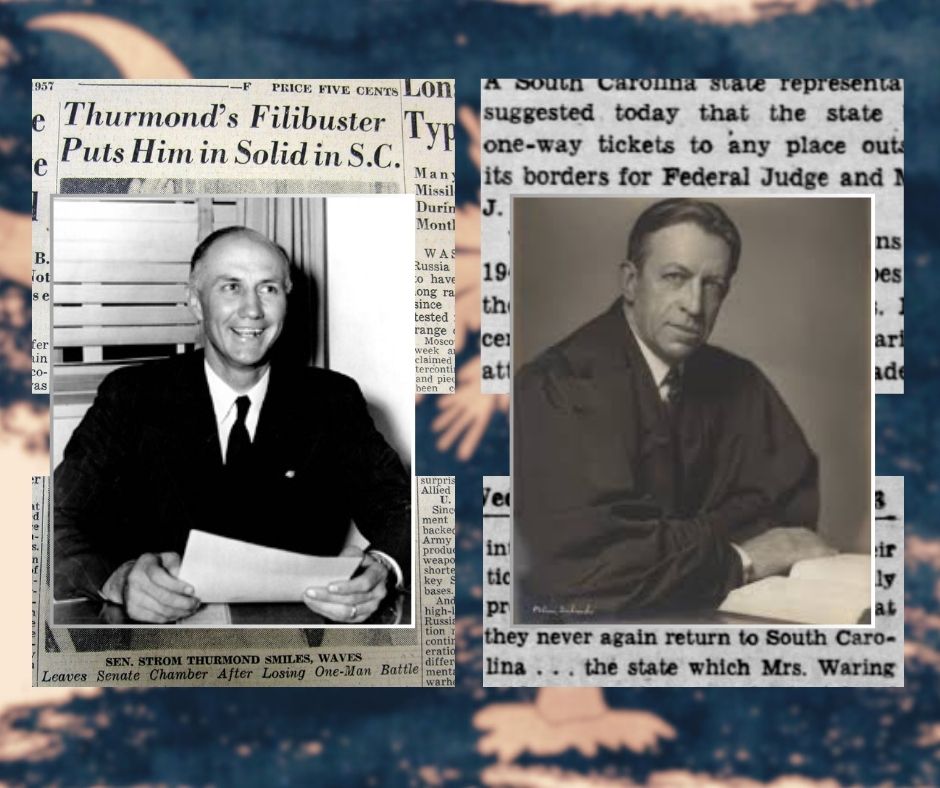
This essay looks at three figures from the 1940s, Strom Thurmond and Julius Waring. It examines both the culture and tradition of the south from this era and the stance of these two figures within it. Further, this essay will consider how white supremacist tactics have operated and evolved. Finally, it will argue a gestalt perspective is needed in understanding the white supremacist ideology of Thurmond as well as that of the contemporary MAGA movement and conclude that “One day everyone will have always been against this.”
Strom Thurmond
James Strom Thurmond was born in Edgefield, South Carolina in 1902. His father was a lawyer, and his family was wealthy. Strom began attending Clemson University in 1918, the same year its founder, Benjamin Tillman, died. (Tillman hall is named for him on the campus). As a young boy, Strom often visited Ben Tillman’s farm, and Tillman did much to shape both the political and social landscape which Strom would come of age in. Tillman was the new governor of South Carolina in 1890 when he declared at his inauguration, “The whites have absolute control of state government, and we intend at any and all hazards to retain it” (Cohodes, 1994).
Tillman advocated for lynching during his second term as governor. In 1895, as member of the United States Senate, he engineered a re-writing of the state constitution which forbade race mixing of blacks and whites in schools. It also creatively kept blacks from voting through poll taxes, residency requirements, the “understanding clause,” and the requirement of voters to have never committed specific crimes which were “perceived to be most commonly committed by blacks” (1994).
At 26, Strom Thurmond’s first political endeavor was election to country superintendent. From there, he would go on to practice law and become a state senator representing Edgefield in 1933. After serving in WWII, Thurmond won election as a state judge. In 1946, he was elected the governor of South Carolina. After a losing presidential run, he went on to become a representative in the United States senate where he would serve from 1954 until 2003, forty seven years, the longest senate tenure in US history.
Thurmond was governor in 1948. The culture and tradition of South Carolina in 1948 was segregation. President Harry Truman and the federal government began to push the southern states harder and harder on the issue of civil rights. This was complicated by the fact that Truman was a Democrat, as were all the southern states. When Thurmond ran for president in 1948, his first speech as a presidential candidate was in Birmingham. Strom gave a blistering ode to the culture and tradition to thunderous applause in which he declared
“There’s not enough troops in the army to force the southern people to break down segregation and admit the Negro race into our theatres, into our swimming pools, into our homes, and into our churches.” (1994)
This was a deeply engrained way of life for white southerners. To state it with enthusiasm as Strom did was politically powerful. Strom Thurmond never considered himself a racist. Much later in his life, when asked about his presidential campaign, he said, “Some of them got in their mind that I was just a racist. Well, honestly in my heart, I’ve never been a racist” (1994).
Out beyond what was or was not in his own personal heart was a whole southern way of life which was built on the idea that black and white folks were not equals. In a 1948 article in the Courier-Journal, John Ed Pearce wrote of Thurmond that he “is not the classic race-hater…he is a man deeply troubled by threat of social change that would destroy a way of life to which he is accustomed, and raise into a position of legal equality a people he has been reared to regard as inferior” (as cited in Cohodas, 1994).
The next part is especially poignant.
“He is torn, as the majority of Southerners are, between a desire to be a decent Christian man, and an inner resistance on a racial system that is, in itself, un-Christian” (ibid).
Judge Julius Waring
In the story of Strom Thurmond and the culture of white supremacy, there is a character who stands apart. This is a judge named Julius Watties Waring. Waring grows up in the same area and region of the country. He is marinated in the segregation, inequality, and whites-only drinking fountains just like Thurmond. And as a judge, his rulings on the bench are, for a while, in keeping with the logic of southern culture and tradition.
Waring begins his law practice in 1902 after graduating with honors from the College of Charleston. And it’s in 1944 when his life begins to take a historic turn. Judge Waring “began handing down decisions equalizing the salaries of black and white teachers, ordering the state to desegregate its law school or create an equal facility for blacks, and rebuffing South Carolina’s efforts to salvage its all-white Democratic primary. The judge’s rulings angered white South Carolinians” (1994). In 1945, he divorced his wife of more than thirty years and married Elizabeth Hoffman, a “a twice-divorced northern matron (1994).” Waring attributed much of his recognition of the racism which pervaded southern culture to the influence of Hoffman.
Waring was appointed to the bench long before this personal evolution, and his change of view was not well accepted by those around him. He became a pariah, deeply hated for his unwillingness to give rulings in keeping with the culture and tradition of white supremacy. The case he is most remembered for came to him in 1951. Waring was appointed to sit on a three-judge panel to hear Briggs v. Elliott. This was “the earliest of five school segregation challenges that were folded into Brown v. Board of Education” (US Courts, 2014).
Briggs v. Elliot began when “in 1947 when Levi Pearson wrote a letter to the Clarendon County School District requesting that black children be provided with the same bus transportation that white children in the district received” (wiki article). This case, initially called Pearson v. Clarendon County, was dismissed on a technicality, however, Thurgood Marshall was the NAACP lawyer representing the families seeking bussing for their students. More plaintiffs were added, and the case was brought again, this time under the name Briggs v. Elliot. The case being brought before Judge Waring was based on the separate but equal doctrine, and the NAACP was arguing that the educational facilities and resources for black schools were not equal. This is where the legacy of Waring lies.
Instead of hearing this case, Waring recommended that Thurgood Marshall expand the case. “Judge Waring recommended…for the case to be expanded from an equalization case into a desegregation case. Instead of asking for enforcement of the separate but equal doctrine by bringing the African American schools up to equality with the white schools, the plaintiffs asked for school segregation to be declared unconstitutional” (wiki article). This meant a direct challenge to the legal precedent set by Plessy v. Ferguson in 1898. It also meant the case would be heard by a three-judge panel, Waring being one of the judges. He would be the only vote “for,” and the NAACP’s suit against segregation would lose 2-1.
However, Waring wrote a blistering dissent in which he said “segregation is per se inequality,” a full rejection of the legal foundation upon which the culture and tradition of the south is built. (US Courts, 2014). The case would go on to be heard by the supreme court. It was the first school segregation challenge which was then folded into five cases making up Brown v. Board of Education in which the supreme court ruled unanimously against school segregation. “Waring’s core reasoning, that ‘segregation is per se inequality,’ was directly echoed in the high court’s 9-0 landmark ruling” (2014).
Waring and his wife moved to New York as exiles from the south. He’d been put on the federal bench with the help of “Cotton Ed,” an avowed SC white supremacist politician. Waring’s personal evolution on the issue of race and equality resulted in being looked at with hatred in his social circles. Today, Waring regarded as a civil rights hero, a man who was willing to sacrifice his reputation and social status in the pursuit of justice. In his own time, he was a pariah. He died in New York, a long way from his hometown and a long way from the culture and tradition he began with.
Cohadas writes that the judge and the politician, “serve different masters and perform different functions. A judge answers to the law in deciding disputes between individuals in conflict. For Waring that meant confrontation with the everyday aspects of ‘custom and tradition’ – discrimination” (1994).
“Politicians answer to the people, and their success is determined in large part by how accurately they understand and reflect what their constituents want. On the issues of race, constituents had clearly decided opinions. To head too far in a different direction would mean defeat.” (1994)
Whereas Strom Thurmond came around to disavowing segregation once it was politically expedient decades later, Waring chose differently, and it cost him in the present.
The Evolution of Suppression Tactics
The goal of 1940’s racism and 1956’s racism was mostly the same – keeping white supremacy intact. However, as the years moved forward, the tactics evolved. The lynchings carried out to strike fear in the black populace began to give way to more sophisticated efforts such as voter suppression laws and literacy tests.
In her biography of Thurmond, Nadine Cohodas highlights a 1956 report by the Southern Regional Council. She writes, “The council reported that ‘killings, beatings, the dragging of Negroes from their homes in the middle of the night – these are now rare occurrences compared to previous decades.’ Instead there was a more refined but still effective way to keep down black voting – the literacy test. Blacks wanting to vote, the council concluded, ‘are more likely to be barred by a question on the Constitution than by a rope or whip.'” (1994)
Other creative means included asserting economic pressure on those blacks who wished to vote. The attorney for Summerton, SC said that “Some have been denied credit. I would not extend credit to a member of the NAACP. I would not rent my land to a member of the NAACP. Everybody in Summerton feels the same way. You would too if you had an organization that was trying to destroy everything you believed in.” This quote came on the heels of the supreme court’s 1954 decision in Brown II, which overturned the “seperate but equal” logic of Plessy v. Ferguson in 1898. And when faced with the supreme court order to integrate schools, officials in Summerton declared they would close all the schools rather than allow black and white children to mix.
In their refusal to give up the culture and tradition of white supremacy, the white south explored many creative avenues, including economic intimidation and legal maneuvering. Still, open violence wasn’t out of the question. Later that year in Mississippi, 63 year old Lamar Smith was shot when three white men confronted him on the courthouse steps after he declared he would seek election as a black man for the position of country supervisor. The town’s sheriff waited eight days to make the arrests, and the grand jury didn’t indict the white men since no one was willing to testify as a witness against them.
Gestalt
Much of the rhetoric and energy of the MAGA movement over the past ten years has been to take the culture of the US back to the 1948 America of Strom Thurmond. The slogan “Make America Great Again” implies things used to be great have since deteriorated. MAGA is a move to revive the culture and tradition of the America of 80 years ago.
In retrospect, it is rather obvious that Strom Thurmond was a white supremacist. To call him as much is an accurate and fair assessment. His view of the world necessitated that black folks be kept separate so that white culture could remain pure. He went on record advocating against “the mixing of the races” time and time again. But if you were to ask Strom, or many of his southern supporters, whether or not Strom was a racist, you’d get a hard no. In fact, he said, “Some of them got in their mind that I was just a racist. Well, honestly in my heart, I’ve never been a racist” (1994). If the challenge is raised, tell me one time where Strom personally committed an act of racism, it me be hard to do so. Strom’s racism is not (usually) one of yelling slurs or lynching people. It is a culture and a tradition which sees white people as necessarily set apart from and privileged over black people.
When Thurmond’s life is viewed as a whole, the conclusion can only be that he worked tirelessly to keep white supremacy enshrined in the culture and tradition he so loved. What is obvious when considering the whole cannot necessarily be seen in each individual part. The German word “gestalt” is helpful here. According to the Gestalt Center, “The closest translation is ‘whole’, ‘pattern’ or ‘form’. It has the sense that meaning cannot be found from breaking things down into parts but rather from appreciation of the whole. In other words, Gestalt is a holistic process.”
Someone asked me recently to name how Donald Trump is a racist. Certainly, in this case there are some concrete, poignant examples. Still, this is not, in my view, how racism works. It is not primarily something that you do or do not do on a Tuesday morning at the grocery store. It is a way of seeing the world, a foundation upon which the self makes meaning and envisions the future. The question of whether or not the MAGA movement is racist is quite clear. When viewed as a whole: the interpretive moves it makes, the meaning made through argument and action, the vision cast for the future – it is obviously working from the framework of white supremacy. This was the culture of 1948, and this is what MAGA works to revive. It is a campaign of white nostalgia.
This is made exceptionally clear through official communication from administration accounts, officials, and past officials. Statements have included both overt and covert mentions of white supremacy, the use of Nazi and KKK slogans, as well as the vision of achieving 100 million deportations. To achieve this number, every single non-white immigrant, citizens or not, would have to be rounded up. Elon Musk, recently a government special employee, shared a post calling for “white solidarity.”
This does not mean that every person who voted for Donald Trump is a racist, or even subscribes to the white supremacist vision which MAGA casts. But it is clear that the vision of MAGA is one of racism and white supremacy. With history in mind, with the gestalt in view, this becomes clear for those willing to see it. For those in 1948 who were caught up in the culture and tradition of Strom Thurmond, and for those who long for its return in 2026, it is a reality which will will easily evade their view. Strom cloaked his own racism in the language of “state’s rights” and “separate but equal.” He seemed sincere in his assertions that he was not a racist deep down in his heart. The story of his life tells quite a different story.
To those looking back, the racism of Strom and his ilk are obvious, glaring, disgusting. When our children and grandchildren look back, the racism and hate of Trump and his MAGA following will be as well.
Coming Around the Bend
The story of Strom Thurmond does not end in 1956. The South Carolina Senator would go on to serve until 2003. He evolved his messaging as the years went by. As the south slowly shifted and laws were passed requiring states to allow black participation in elections and elected positions, Strom changed too. After so many years of work in the senate to oppose any legislation aimed to allow black citizens to exercise their right to vote, Strom eventually found himself a senator who needed the black vote to stay in office. It no longer served him politically to stand in the senate chamber and rail against civil rights bills. Times had changed. In 1982, he would finally cast his first “aye” vote for a civil rights bill. After years spent sounding the communist alarm against Martin Luther King Jr., Thurmond changed his tone in 1983 to begin praising the slain black civil rights leader.
Cohodas writes that Thurmond was asked a question by a black college student regarding his voting record, and he said,
“When I was governor, the laws said the races should be separated. But now the law is different, customs are different, public opinion had changed, and it’s an entirely different situation.” (1994)
She describes Thurmond in this instance poignantly, noting that he seemed to consider himself “a neutral participant in government, one who had no responsibility to question whether old laws were good ones, even after blacks had challenged them…Custom and tradition had changed in spite of him” (1994).
A book recently came out with the title “One Day Everyone Will Have Always Been Against This.” In the sagas of Strom Thurmond and Donald Trump, there is perhaps no more concise way of stating their legacy. In the case of Donald Trump, his base has stood with him through scandal after scandal due to his stranglehold on the Republican party. As we approach the midterm elections in 2026, this hold will soon start to break.
Trump recently went on Fox News and blamed genetics as the reason immigrant are bad. This comes only several weeks after he posted a video depicting Barak Obama as an ape. This is the sort of racism which in a few years, perhaps even in a few months, Republicans and conservatives on the whole may be able to denounce as vile. Still, for those whose political power or personal identity is tied to a culture and a tradition in which Trump must be accepted and tolerated, it’s still too early to be against it. Custom and tradition will change in spite of them.
As Trump’s second term moves towards its end, his sway on what is normative will degrade. It will be the job of those around him and those who voted for him to explain, to themselves and to the future, how they weren’t really on board with this all along. They will feign neutrality and say it’s just the way things were. It was the custom and tradition.
This essay relies heavily on the excellent book by Nadine Cohades titled Strom Thurmond and The Politics of Southern Change
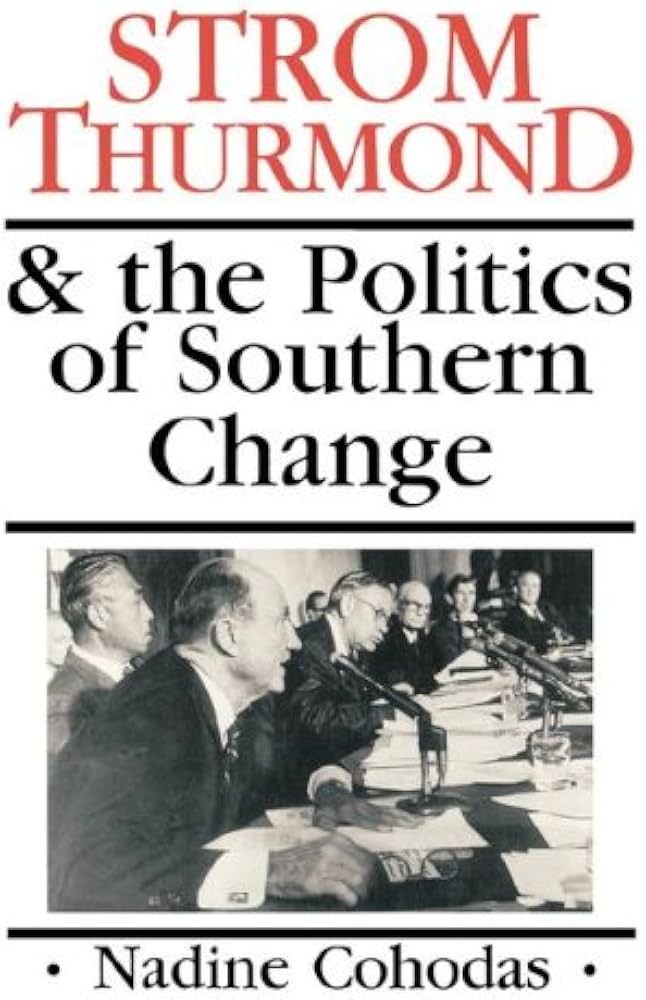
‘Anybody who had a chance to be elected,’ Thurmond would say later in his career, ‘had to stand with the thinking of his people, or couldn’t vary too far from it’.” (1994).
 javen.bear.