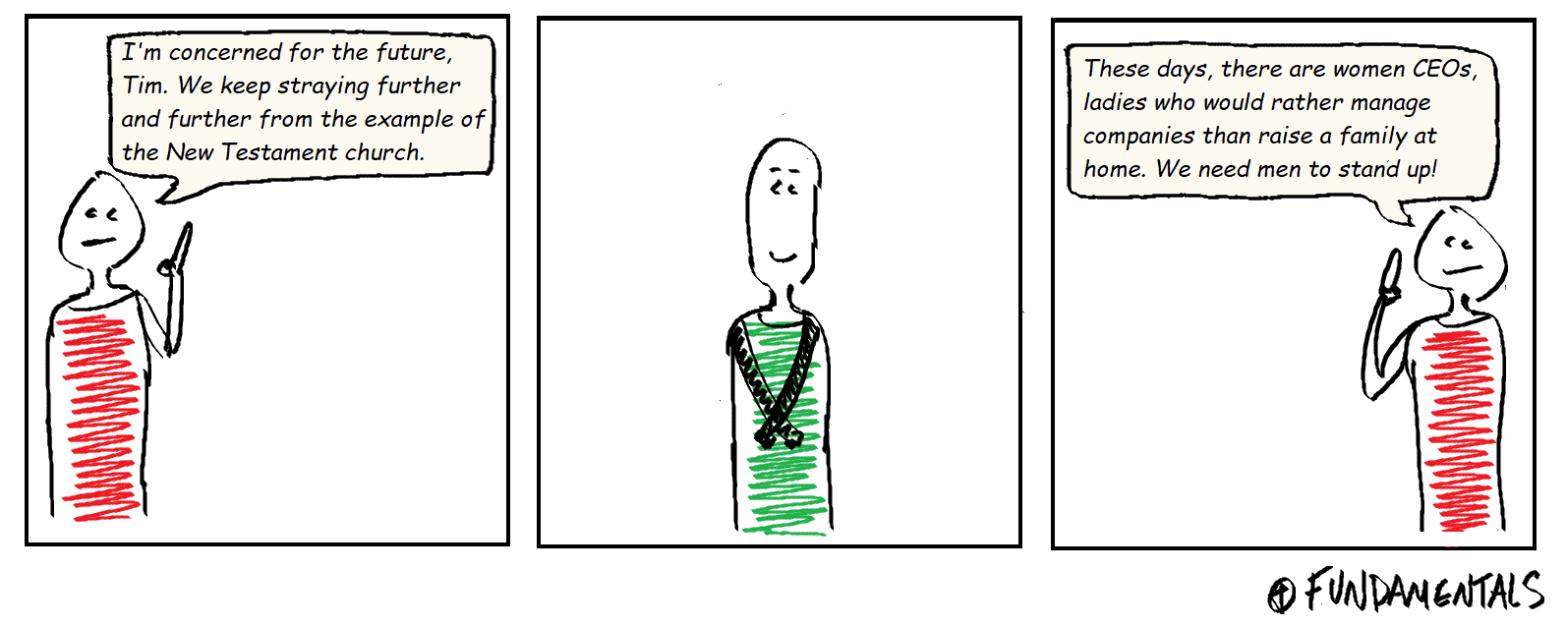
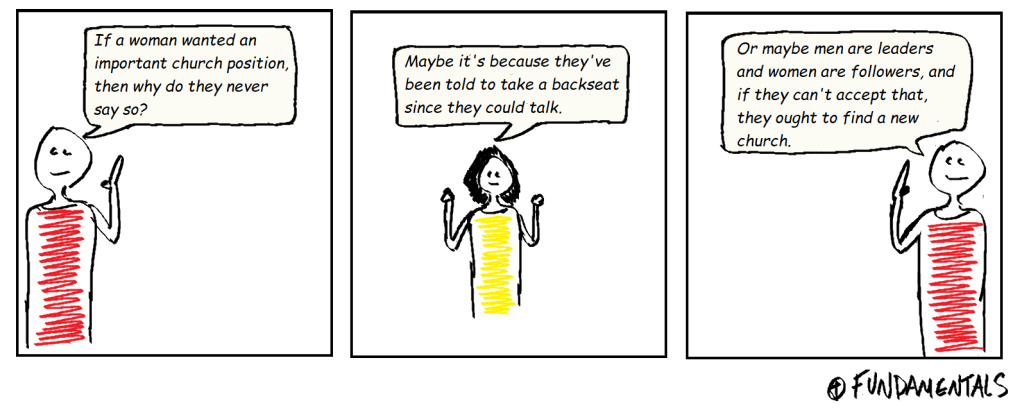
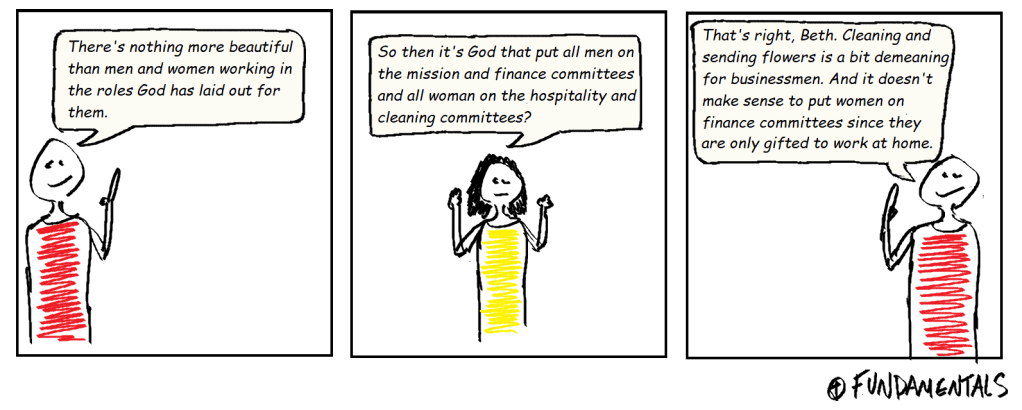
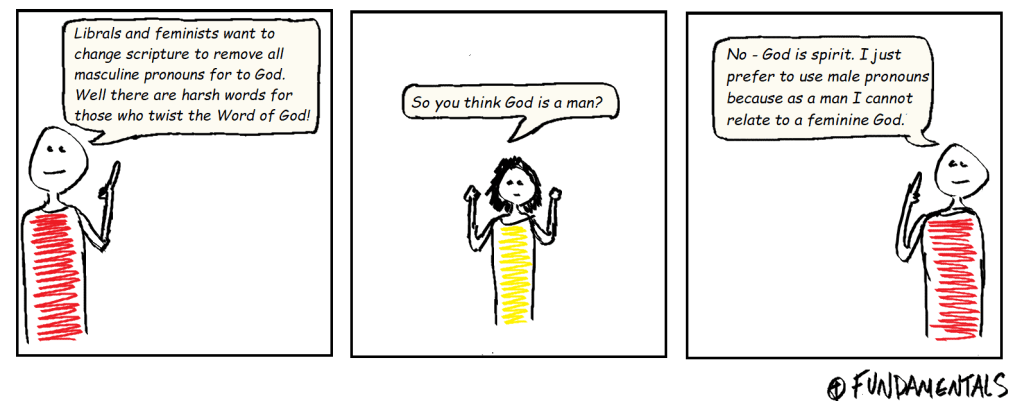
If we wonder how our church views what men and women are capable of, we can take a look at the way we delegate responsibilities. If the missions committee is made up of all men, and the hospitality committee is make up of all women, that says a lot about what we believe women are capable of helping with. What we may find in sexist environments is that women are invited into spaces where physical service is required and excluded from spaces where intellectual work is required (making decisions and coming up with ideas).
It can’t be well argued from scripture that women should welcome the role of secretary while men should scoff at it. Yet I’ve never sat beside a man in church who was a secretary (that I know of). It also can’t be well argued from scripture that men rather than women should decide how the church’s mission budget is distributed. The church exists inside of culture, and the cultural assumptions about who does what are alive and well inside the walls on Sunday morning.
I have certainly been guilty of exactly this. As a man, there is work I often tend to assume I don’t have to bother with, just because I’m a man. I’ve also made the stupid jokes that entrench gender stereotypes in the church family (Oh wow, nice job with the dishes, Bill! You’ll make someone a great wife someday.) And when I’ve been in charge of handing out responsibilities, I’ve often just assumed that based on sex someone will be willing or able to perform a task. Perhaps it would be better if I trusted the Holy Spirit to that task and delegated work according to the ability God has given, rather than sex.
What would happen if I empowered everyone around me to serve as their gifting allowed?
Have I suppressed gifts I was given for fear of breaking gender norms?
What would it look like to shed cultural stereotypes regarding who serves where in church?
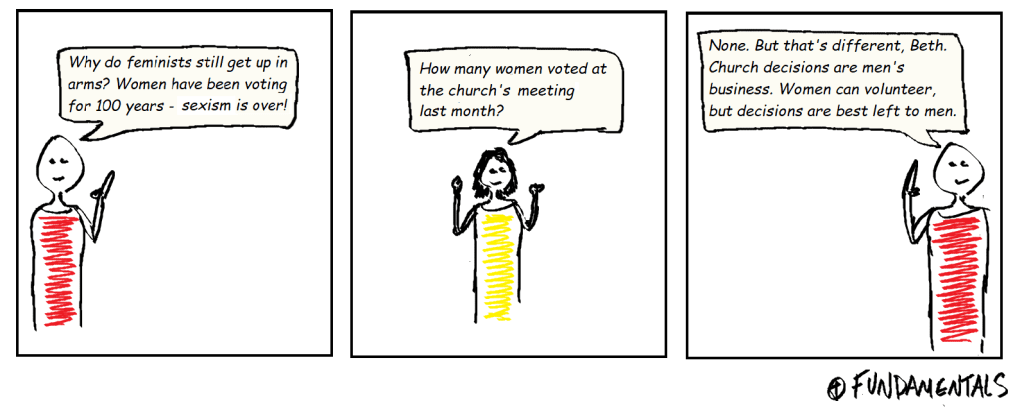
Denominations have different procedures for making church decisions. In some churches, members vote in a democratic process. If only men are empowered to voice their opinions, not only does it remove every woman from a participatory role in the decision making process, it also ensures that the agenda, debate, and decisions make in meetings are void of any female perspective. Some would say this is just an oversight, but then again, when every church position is filled by men only, it’s not hard to see why women would also be left out when it was decided how decisions would get made.
The decisions made at these meetings have to do with finances (do we buy new chairs?), church ascetics (what color do we paint the sanctuary?), church appointments (who will be in charge of what?), etc. Buy excluding women from the democratic process, they are not only kept from church offices, but are completely removed from any decision making input or capability. In this system, men as young as 17 are afforded full membership voting capacity, while wise, mature women are not.
I have been a part of and voted in democratic meetings. And rarely (if ever) did it strike me as odd that half of our congregation was being completely excluded from this fellowship in which we articulated and furthered the vision of the body. It’s so easy to just go along, and like me, to never notice (much less open the conversation) who is being excluded and who is being made important.
How have I participated in activities which excluded large portions of the church family?
When I realize what’s going on, do I have a responsibility to speak up?
If no one else is willing to acknowledge what’s going on, what does it mean to be faithful?
My mom and my aunt tell me how when I was a very young boy I used to give passionate sermons to them both about how women need to submit to men, how men are leaders and women need to obey them. I was an impassioned fundamentalist of a child. 20 years later, the questions are still in mind.
In some churches where women are not permitted to have any kind of “authority” over men. This brings many questions to bear, one of which is what is authority? Wayne Grudem went to the trouble of listing 83 activities in 3 categories and drawing a hard line – everything underneath a woman may do, everything over the top women may not do. In category 1, he draws the line between items 9 and 10. In category 2, between items 10 and 11. In category 3, between items 1 and 2.
So Grudem would permit a woman to be chairperson of a committee, but not to be a leader of a fellowship meeting in a home. He would allow a woman to teach the bible to a high school age Sunday school class, but not to a college age Sunday school class. Finally, he would allow for a woman to be licensed to perform ministerial functions, but not be an ordained pastor.
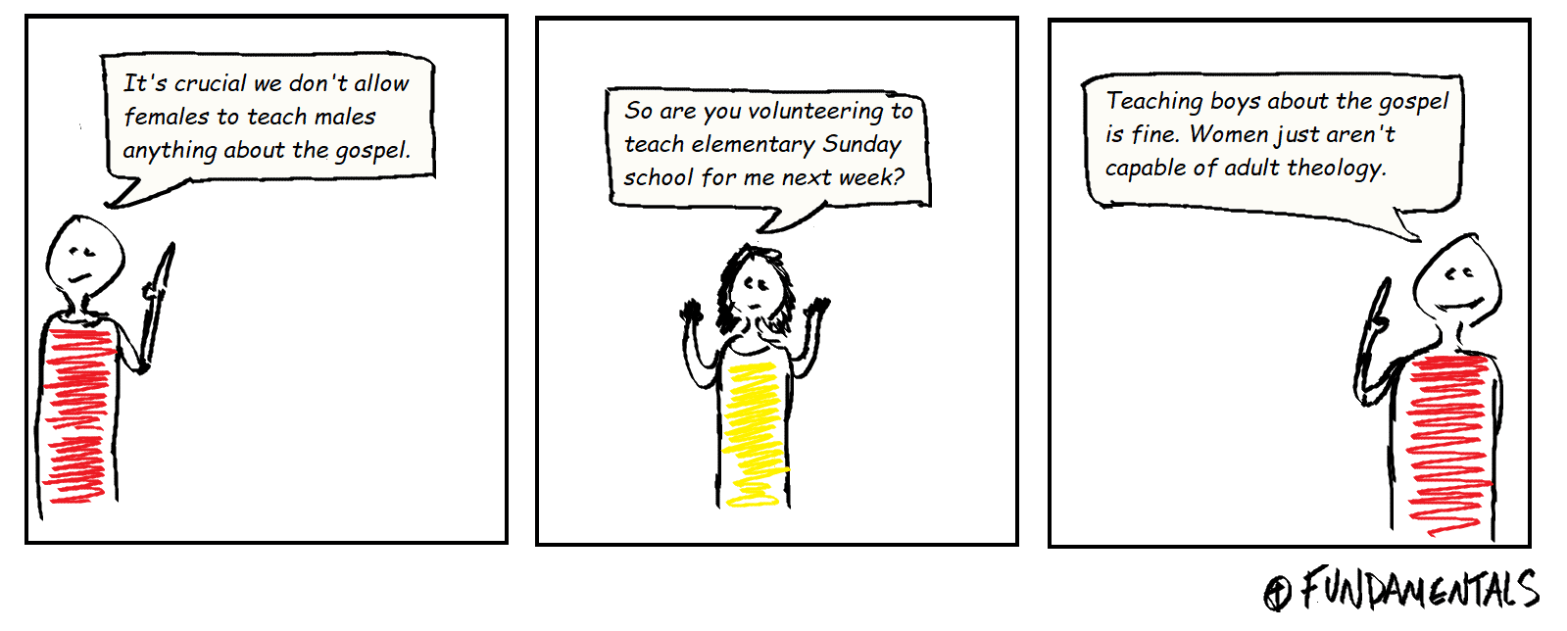
So what’s the difference between high school age and college age Sunday school class? Why are women allowed to teach 17 year old men but not 18 year old men? What are the implications of telling women they can be trusted to instruct boys, but never adults? What are the implications of telling women that a woman may teach them the Bible – but telling men that a woman may never teach them the Bible? These are all questions Grudem and those who don’t permit women to teach have to answer for. Often though, the answer is merely, well that’s just the way it is.
In contexts where this is the way it is, we prefer to have young, inexperienced male teachers than thoroughly trained, well-equipped female teachers because it is seen as a grave error for any woman to have any authority over any man. While the theology may not be spelled out, this is often how it gets worked out – women are afraid of overstepping an imaginary line and getting in trouble. A moment I’ll think about for a long time occurred when young singles class needed a substitute teacher for the next week. The male teacher asked if anyone was willing to teach next week – the men stayed silent because no one wanted to. The women stayed silent because they knew they were disqualified. Finally, someone broke the silence with a joke – perhaps the teacher’s wife could come in and teach us how to give massages. Amidst the laughter the message was clear: women, no matter how educated, are useful to a group for physical service; only men can be trusted with scripture and the thoughtful (not physical) work of teaching males.
Where (if at all) do I draw the lines in Grudem’s categories?
In our church rules, who gets to draw the lines? Are women involved in deciding what they’re allowed to do?
Are the women around me uncomfortable for fear of crossing my “lines”?
How does my assigning church roles affirm or challenge the status quo?
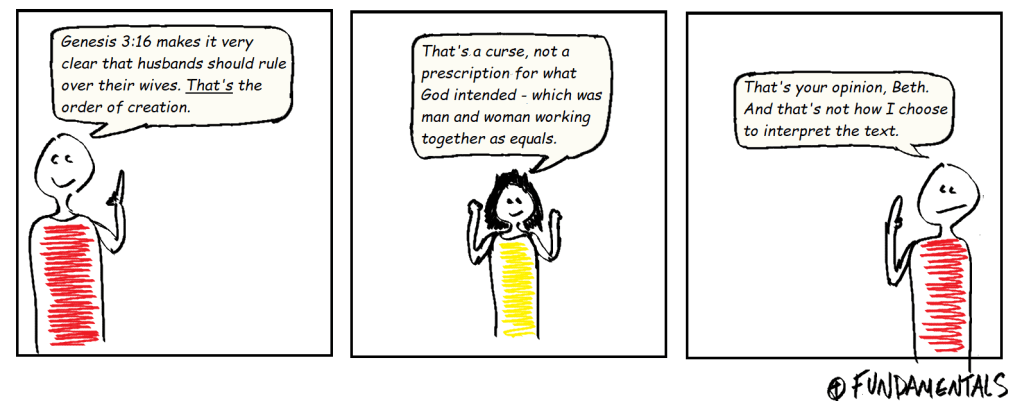
Interpreting and applying scripture is an active process. When we read, and especially when we tell each other what passages mean, we are making choices about what we think the author is doing. Many of us cite Genesis 3:16 as a “prescription” for how things ought to be. It is also read, more correctly I think, as a “description” of what happens when humankind forsakes God’s way of doing things and rebels against his order.
“I will make your pains in childbearing very severe; with painful labor you will give birth to children. Your desire will be for your husband, and he will rule over you.” (Genesis 3:16)
In this rebellion, we see men domineering over women like animals domineering over each other due to physical strength. While this is not God’s plan, it is the unfortunate reality of the curse .The opening chapters of Genesis are some of the most wonderful and mysterious texts in the Bible. Unfortunately, we sometimes use them as weapons against each other, or to make arguments they were not intended to make.
When have I been guilty of weaponizing the opening chapters of Genesis to advance my arguments?
Does my theology about men and women allow for other faithful readings of Genesis 3?
If Genesis 3:16 is a curse description and not a prescription for life, what would this mean?
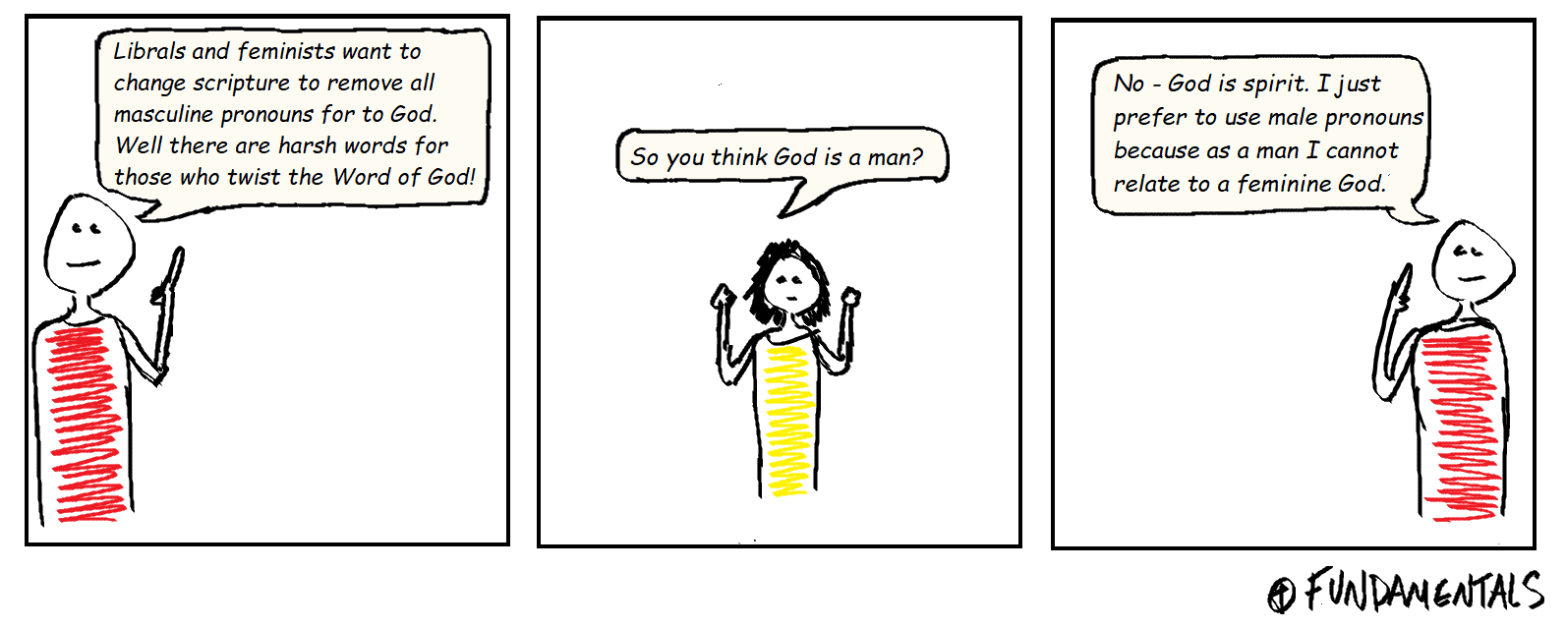
Around 2005 a new translation of the Bible was released which sought to accurately translate scripture with regard to pronouns. Whereas the translators of the KJV used almost exclusively male pronouns even in cases where the original Greek and Hebrew words were gender neutral (or included men and woman), this new translation sought more accurately represented the original intended meaning. A huge debate and controversy ensued (a brief overview of which you can read here). Folks like Wayne Grudem claimed the translators were tampering with God’s word.
It seems what was being tampered with was language which was not faithful to the authors’ intended meaning. As it turns out there were many many instances where the word choice of a passage was meant to include men and women, but translators used only male pronouns. If we want to read the text in an accurate, faithful format, perhaps the TNIV would be a helpful tool.
Does gender neutral language make me uncomfortable?
Is my discomfort related to an incorrect reading of scripture or just my own wrong assumptions being upended?
If God is not male, why do I feel better when he is referred to as a man?
We’ve probably all heard some form of Jimothy’s complaint in the first frame. Maybe we’ve even said the same thing ourselves. Yet we have to recognize some form of “this was written in context.” Often we fool ourselves into thinking we really want to apply every verse literally. However, when it comes to something like slavery, we’re often quick to ditch that logic and respond as Jimothy does when challenged. It’s been said “The Bible was written for us – it was not written to us.” So Beth’s question is a valid one: how do we decide when the text ought to be applied just as written and how do we decide when that isn’t the case? We can probably all agree that commands to not eat shrimp were written but are not applicable. When it comes to instructions given by Paul, it’s a more difficult conversation.
Do I hold a consistent view of interpreting and applying scripture – or do I just pick and choose when it’s convenient?
Do I encourage discussions about what should be applied literally and what shouldn’t, or do I shut them down?
Have I excluded people who want to be faithful to scripture but who apply it differently than I/we do?
When we take Jimothy’s position and boil it down real nice and simple, we deceive ourselves (and those we instruct) into thinking the Bible is always straightforward and easy to comprehend – and to say otherwise is to somehow insult God. Perhaps what is being insulted is a low view of scripture.
Have I been guilty of oversimplifying scripture in order to get my way?
Do I find other valid readings of scriptures threatening?
Do I, like Jimothy, feel I am so correct that to disagree with how I interpret scripture is to disagree with God?
I’ve never been much of an artist. I once decided to make a sketch everyday to improve my drawing skills – I think I made about three. However, I have made 28 drawings for this new project!
I reflect on my life just about every day. I think about my life, how I grew up, where I’m headed, all the things. This comic strip is a piece of reflection centered on the topic of gender roles, women in ministry, the way we read scripture, and set up our churches.
We all grew up somewhere. Even if you want to run from it, if you are immensely proud of it, or you don’t wish to remember it – we all come from somewhere. I am profoundly thankful for the people and the community I got to grow up in. My parents are about the kindest people I know. Kindness was a virtue my family required and instilled.
Where I was raised, it was really normal for people to spend their Saturday helping each other with significant projects like building a new house or replacing an old roof. In the place I live now, these aren’t really the kinds of things neighbors help each other with so much – they just hire companies.
In my church, everyone pretty much knew everyone. An older man in my church agreed to mentor me and maybe bought me enough breakfasts to equal my yearly salary at that point in my life. In the movie Ragamuffin movie, Rich Mullins says a line about how he learned the nuts and bolts of theology by beingwith those in his church, more than just sitting in church and listening. I really connect with that sentiment.
It is also true that any place where there are people, there is culture. The identity of that culture is defined by the agreements, the rules, the interpretations, the precedents, the arrangements, the status quo – the way we’ve decided we’re going to live together. My reflection, and my work in this comic strip is an attempt to examine more closely some of the arrangements in the evangelical church. To explore, to question, and where needed – to disrupt. It is a truth we must be willing to bear that we live in a place where there are arrangements which need to be acknowledged, examined, accounted for, and sometimes called to question. When what we find is less than good, true, and beautiful, there is work to be done. This work is for “us” and “we.”
I am a man of unclean lips, and I live among a people of unclean lips. God have mercy.
I am a man with blood on my hands, among a people with blood on their hands.God have mercy.
This comic strip, called FUNDAMENTALS, will be published every day of February 2022. It’s based around three characters and investigates ideas, tropes, and disagreements surrounding men’s and women’s roles within the conservative evangelical church space. By subscribing to my email updates (in the bar below), you can get the comic strip in your inbox everyday.
The Strip
Meet the FUNDAMENTALS Characters
Jimothy
The main character who appears in the first and third frame of every strip. Jimothy embodies the ideology of the fundamentalist. He is self righteous, utterly convinced of his self righteousness, and overbearing in his proclamations. Jimothy is an archetype, and in him I see some of the teachers and preachers I’ve sat under, people I’ve sat in church beside and heard across tables and in comment threads. But it isn’t that straightforward. Jimothy also represents me: misguided, somewhat arrogant, and almost totally clueless as to the the magnitude and complexity of the issues I was talking about so confidently.
Beth
Beth appears in the second frame of many strips. She is Jimothy’s antagonist. She asks the questions Jimothy either hasn’t considered or never bothered to care about. Her hands are always up in exasperation. As a woman, she sees Jimothy’s foolishness , but she isn’t in a position to do much about the ideas he spouts which set the cultural tone they both inhabit.
Tim
Tim listens. He is the wisest character in the strip, but he never opens his mouth. While Beth spars with Jimothy, Tim simply listens with his arms folded. He is a faithful presence and represents those in our lives who listen to us and hope someday we will truly hear ourselves talking and come around.
This comic strip is about a culture in which women aren’t valued the way men are, where they are second rate citizens. I’ve lived in or adjacent to this teaching for a long time. And while I’ve been convinced change is needed for some time, I’ve mostly just read books, prayed, and had one on one conversations. I hope this comic strip is a small agent. I hope to illuminate some of the latent ideas and embedded commandments which keep things the way they are and so resist the change I believe God wants to see us make. This change would be toward recognizing his image more fully in both men and women. I’m also linking the paper I wrote called “Gender Roles in the Church: Some Reflections” which you can read by clicking the image below. (it is now free to read where before it was $2).
We are drawing the curtain on the year, and I want to say thanks – thanks for stopping by this page to read my work and my thoughts from time to time. Maybe you found what I had to say helpful – maybe it make you stop and think – maybe shake your head. Maybe all of those. Either way, thank you.
36 of you get articles delivered right to your inbox. If you’d like to do that, you can enter your email address here:
I wrote (almost monthly) about my life, about politics, faith, some poetry, philosophy, ideas I found interesting, and other things. All told about 4,000 visitors came by this year.
January, I wrote about politics and the election (and about 1,500 of you came by to read that!)
That’s just about an article every month. And maybe you read some of them – or maybe you read all of them. Maybe you recognize one cover images below, maybe because that article moved you, or angered you, or made you think you appreciated what I had to say, or that you didn’t know me as well as you thought. Whatever the case, thanks for coming by. I appreciate you.
Today I’m excited. I just submitted the application and essay questions to be admitted to a masters in clinical mental health counseling program at Grand Canyon University. If I am accepted to the program, it will mean several years of coursework and many many internship hours – but I’ll be on a track to become a fully licensed counselor. You could actually pay me money to let me listen to you talk about your life – what a concept! It will also mean learning a whole lot more about how our minds and bodies work and what it means to be human. I’m excited to write about that.
Maybe more has happened to me this year than any other year before. I graduated from college! My lovely wife and I moved to Phoenix where we both took new jobs and where we had our 1 year anniversary.
We are really excited about what’s on the horizon next year, even though we don’t see it clearly at all yet. I hope to continue writing about once a month if time permits. And I do hope you, dear reader, might stop by again soon.
*if you can’t figure out the subscription, just email me and I’ll help: javen.bear@gcu.edu
enter email address > hit subscribe > view confirmation email (may be in your junk) > confirm you want to subscribe.
One of my goals is to become a counselor. That said, therapy, mental health, and counseling ideas are something I think and read about a good deal. This week, I came up with an idea for a way of helping myself understand my own life, and I wonder if it might be helpful for someone else as well. It’s a bit of an exercise which I’ve outlined below, and I think it’s kind of fun. It’s by no means an original idea – but it did just occur to me this week. It goes like this.
Here is an idea to help us out of despondency – to help jolt us back when we’ve gone away, to help us get a sense of ourselves when we feel gone. I will think of my life as a movie. Most movies (and stories in general) can be though of as having three parts: setup, confrontation, and resolution. Think about Pixar’s movie Cars. Lighting McQueen is a racing star (setup), he is swept away to the town of Radiator Springs where he confronts some hard truths and has to learn some hard lessons (confrontation), he goes back on the big track and wins a unique kind of victory (resolution). We even do this without thinking when we tell an everyday kind of story.
Me and Louis were gonna go to a baseball game. But on the way we got a flat tire. So we spent three hours finding a spare and a tire iron and finally ended up at Applebee’s just in time for half price apps. Bing, bang, boom.
You can think of pretty much any story this way. The Bible works rather nicely as well, on large and small scales. Creation, fall, redemption. Or – Jesus predicts Peter’s denial, Peter denies Jesus, Jesus reinstates Peter. It’s a great way to understand stories. And here’s how I think this could be helpful when getting a grip on our own stories as they unfold.
Part 1 – speak truthfully
Prompt: Tell your own story with the present day on which you are speaking as act 3 (resolution). This places the current self (and one’s circumstance) as the resolution. Today is the conclusion of what has come before. And that may not be so appealing, especially if the current state is despondent/bored/removed/unsatisfied. The goal here is to speak truthfully.
Example: [In keeping with my wanting to be a counselor.] (1.) I first decided I might like to be a professional counselor in my senior year of college. (2.) It was too late to change my major from communication studies to counseling psychology, but I was able to add a family counseling class as an elective. (3.) Currently, I am an admission counselor at Grand Canyon University. This isn’t really what I was aiming for, but I do at least get to perform some counseling role with students.
Part 2 – think logically
Prompt: Tell your story as act two. Something, or some thousand things, have set the stage, and now we find the self in a state of action, of conflict, of movement, of friction. This allows for explaining the present as in part a result of the past. However, this exercise should be completed by imagining and articulating the third act as a logical conclusion. How is today a springboard into the resolution? If part 1 has happened, and this present thing is happening, then what seems likely to happen? Again, this may not be appealing.
Example: (1.) I was able to take a class on counseling in college and got an idea of what the profession was like from my professor. I decided that this is the career I would like to pursue. (2.) I took a job as GCU as an admissions counselor so I could get experience advising people on a daily basis and start a master’s program in mental health counseling. (3.) In the future I will most likely finish my degree and become a licensed counselor able to practice in some state(s).
Part 3 – speak imaginatively
Prompt: Tell your story as act one. Finally, the narrator should tell their story imaginatively. The present moment is act 1 of a 3 part drama. You must tell the story of the present day as a precursor to what you hope will happen in the future. You should be realistic about the opposition that will be faced in act 2, the friction. And most importantly, you must articulate a vision of your desired resolution. What is the best possible way this could end?
Example: (1.) I am an admissions counselor who sits at a computer most of the day and talks with students, sometimes on the phone sometimes in person. (2.) I will become licensed as a counselor and open my own practice. It will be difficult at first as I will probably take a major pay cut when starting out. I will have to figure out where to practice and how to build a clientele. I will also have to figure out whether to own my own space or work for/with someone else. (3.) My career will be enormously fulfilling, even while challenging. The experience I gain will allow me to write a book as well as teach at a local university in a beautiful city near the coast where I live with my wife, our family and a small dog and surf at least twice a week.
These three exercises are an attempt to make sense. In doing so, it becomes clearer how the past, present, and future are giving way to one another, that we are in the same breath being and becoming. The first part helps me be realistic about where I am and how I’ve gotten there. The second part helps me think about where my current path is likely to take me if I continue on it. The third part helps me articulate what it is I hope will happen, what it is I am aiming at as I move forward. This is the most important part I think. The examples I gave are true, if somewhat broad and trivial. This exercise may also be helpful for getting a look at the things in life we don’t have the courage to talk about very often.
There’s a funny interaction in Alice in Wonderland that I learned about in a high school class. It goes like this:
[Alice said] ‘Would you tell me, please, which way I ought to go from here?’ ‘That depends a good deal on where you want to get to,’ said the Cat. ‘I don’t much care where–‘ said Alice. ‘Then it doesn’t matter which way you go,’