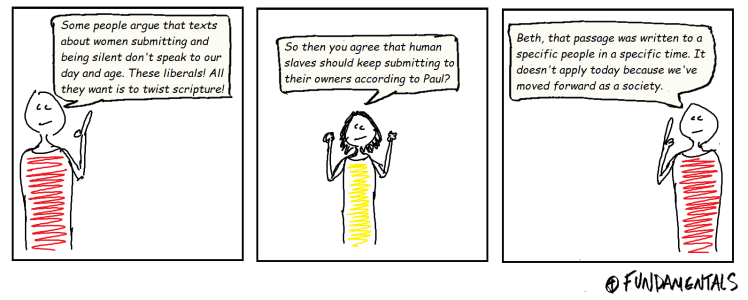
We’ve probably all heard some form of Jimothy’s complaint in the first frame. Maybe we’ve even said the same thing ourselves. Yet we have to recognize some form of “this was written in context.” Often we fool ourselves into thinking we really want to apply every verse literally. However, when it comes to something like slavery, we’re often quick to ditch that logic and respond as Jimothy does when challenged. It’s been said “The Bible was written for us – it was not written to us.” So Beth’s question is a valid one: how do we decide when the text ought to be applied just as written and how do we decide when that isn’t the case? We can probably all agree that commands to not eat shrimp were written but are not applicable. When it comes to instructions given by Paul, it’s a more difficult conversation.
Do I hold a consistent view of interpreting and applying scripture – or do I just pick and choose when it’s convenient?
Do I encourage discussions about what should be applied literally and what shouldn’t, or do I shut them down?
Have I excluded people who want to be faithful to scripture but who apply it differently than I/we do?
When we take Jimothy’s position and boil it down real nice and simple, we deceive ourselves (and those we instruct) into thinking the Bible is always straightforward and easy to comprehend – and to say otherwise is to somehow insult God. Perhaps what is being insulted is a low view of scripture.
Have I been guilty of oversimplifying scripture in order to get my way?
Do I find other valid readings of scriptures threatening?
Do I, like Jimothy, feel I am so correct that to disagree with how I interpret scripture is to disagree with God?
I’ve never been much of an artist. I once decided to make a sketch everyday to improve my drawing skills – I think I made about three. However, I have made 28 drawings for this new project!
I reflect on my life just about every day. I think about my life, how I grew up, where I’m headed, all the things. This comic strip is a piece of reflection centered on the topic of gender roles, women in ministry, the way we read scripture, and set up our churches.
We all grew up somewhere. Even if you want to run from it, if you are immensely proud of it, or you don’t wish to remember it – we all come from somewhere. I am profoundly thankful for the people and the community I got to grow up in. My parents are about the kindest people I know. Kindness was a virtue my family required and instilled.
Where I was raised, it was really normal for people to spend their Saturday helping each other with significant projects like building a new house or replacing an old roof. In the place I live now, these aren’t really the kinds of things neighbors help each other with so much – they just hire companies.
In my church, everyone pretty much knew everyone. An older man in my church agreed to mentor me and maybe bought me enough breakfasts to equal my yearly salary at that point in my life. In the movie Ragamuffin movie, Rich Mullins says a line about how he learned the nuts and bolts of theology by beingwith those in his church, more than just sitting in church and listening. I really connect with that sentiment.
It is also true that any place where there are people, there is culture. The identity of that culture is defined by the agreements, the rules, the interpretations, the precedents, the arrangements, the status quo – the way we’ve decided we’re going to live together. My reflection, and my work in this comic strip is an attempt to examine more closely some of the arrangements in the evangelical church. To explore, to question, and where needed – to disrupt. It is a truth we must be willing to bear that we live in a place where there are arrangements which need to be acknowledged, examined, accounted for, and sometimes called to question. When what we find is less than good, true, and beautiful, there is work to be done. This work is for “us” and “we.”
I am a man of unclean lips, and I live among a people of unclean lips. God have mercy.
I am a man with blood on my hands, among a people with blood on their hands.God have mercy.
This comic strip, called FUNDAMENTALS, will be published every day of February 2022. It’s based around three characters and investigates ideas, tropes, and disagreements surrounding men’s and women’s roles within the conservative evangelical church space. By subscribing to my email updates (in the bar below), you can get the comic strip in your inbox everyday.
The Strip
Meet the FUNDAMENTALS Characters
Jimothy
The main character who appears in the first and third frame of every strip. Jimothy embodies the ideology of the fundamentalist. He is self righteous, utterly convinced of his self righteousness, and overbearing in his proclamations. Jimothy is an archetype, and in him I see some of the teachers and preachers I’ve sat under, people I’ve sat in church beside and heard across tables and in comment threads. But it isn’t that straightforward. Jimothy also represents me: misguided, somewhat arrogant, and almost totally clueless as to the the magnitude and complexity of the issues I was talking about so confidently.
Beth
Beth appears in the second frame of many strips. She is Jimothy’s antagonist. She asks the questions Jimothy either hasn’t considered or never bothered to care about. Her hands are always up in exasperation. As a woman, she sees Jimothy’s foolishness , but she isn’t in a position to do much about the ideas he spouts which set the cultural tone they both inhabit.
Tim
Tim listens. He is the wisest character in the strip, but he never opens his mouth. While Beth spars with Jimothy, Tim simply listens with his arms folded. He is a faithful presence and represents those in our lives who listen to us and hope someday we will truly hear ourselves talking and come around.
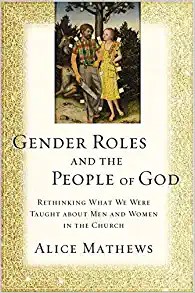
This comic strip is about a culture in which women aren’t valued the way men are, where they are second rate citizens. I’ve lived in or adjacent to this teaching for a long time. And while I’ve been convinced change is needed for some time, I’ve mostly just read books, prayed, and had one on one conversations. I hope this comic strip is a small agent. I hope to illuminate some of the latent ideas and embedded commandments which keep things the way they are and so resist the change I believe God wants to see us make. This change would be toward recognizing his image more fully in both men and women. I’m also linking the paper I wrote called “Gender Roles in the Church: Some Reflections” which you can read by clicking the image below. (it is now free to read where before it was $2).
We are drawing the curtain on the year, and I want to say thanks – thanks for stopping by this page to read my work and my thoughts from time to time. Maybe you found what I had to say helpful – maybe it make you stop and think – maybe shake your head. Maybe all of those. Either way, thank you.
36 of you get articles delivered right to your inbox. If you’d like to do that, you can enter your email address here:
I wrote (almost monthly) about my life, about politics, faith, some poetry, philosophy, ideas I found interesting, and other things. All told about 4,000 visitors came by this year.
January, I wrote about politics and the election (and about 1,500 of you came by to read that!)
That’s just about an article every month. And maybe you read some of them – or maybe you read all of them. Maybe you recognize one cover images below, maybe because that article moved you, or angered you, or made you think you appreciated what I had to say, or that you didn’t know me as well as you thought. Whatever the case, thanks for coming by. I appreciate you.
Today I’m excited. I just submitted the application and essay questions to be admitted to a masters in clinical mental health counseling program at Grand Canyon University. If I am accepted to the program, it will mean several years of coursework and many many internship hours – but I’ll be on a track to become a fully licensed counselor. You could actually pay me money to let me listen to you talk about your life – what a concept! It will also mean learning a whole lot more about how our minds and bodies work and what it means to be human. I’m excited to write about that.
Maybe more has happened to me this year than any other year before. I graduated from college! My lovely wife and I moved to Phoenix where we both took new jobs and where we had our 1 year anniversary.
We are really excited about what’s on the horizon next year, even though we don’t see it clearly at all yet. I hope to continue writing about once a month if time permits. And I do hope you, dear reader, might stop by again soon.
*if you can’t figure out the subscription, just email me and I’ll help: javen.bear@gcu.edu
enter email address > hit subscribe > view confirmation email (may be in your junk) > confirm you want to subscribe.
One of my goals is to become a counselor. That said, therapy, mental health, and counseling ideas are something I think and read about a good deal. This week, I came up with an idea for a way of helping myself understand my own life, and I wonder if it might be helpful for someone else as well. It’s a bit of an exercise which I’ve outlined below, and I think it’s kind of fun. It’s by no means an original idea – but it did just occur to me this week. It goes like this.
Here is an idea to help us out of despondency – to help jolt us back when we’ve gone away, to help us get a sense of ourselves when we feel gone. I will think of my life as a movie. Most movies (and stories in general) can be though of as having three parts: setup, confrontation, and resolution. Think about Pixar’s movie Cars. Lighting McQueen is a racing star (setup), he is swept away to the town of Radiator Springs where he confronts some hard truths and has to learn some hard lessons (confrontation), he goes back on the big track and wins a unique kind of victory (resolution). We even do this without thinking when we tell an everyday kind of story.
Me and Louis were gonna go to a baseball game. But on the way we got a flat tire. So we spent three hours finding a spare and a tire iron and finally ended up at Applebee’s just in time for half price apps. Bing, bang, boom.
You can think of pretty much any story this way. The Bible works rather nicely as well, on large and small scales. Creation, fall, redemption. Or – Jesus predicts Peter’s denial, Peter denies Jesus, Jesus reinstates Peter. It’s a great way to understand stories. And here’s how I think this could be helpful when getting a grip on our own stories as they unfold.
Part 1 – speak truthfully
Prompt: Tell your own story with the present day on which you are speaking as act 3 (resolution). This places the current self (and one’s circumstance) as the resolution. Today is the conclusion of what has come before. And that may not be so appealing, especially if the current state is despondent/bored/removed/unsatisfied. The goal here is to speak truthfully.
Example: [In keeping with my wanting to be a counselor.] (1.) I first decided I might like to be a professional counselor in my senior year of college. (2.) It was too late to change my major from communication studies to counseling psychology, but I was able to add a family counseling class as an elective. (3.) Currently, I am an admission counselor at Grand Canyon University. This isn’t really what I was aiming for, but I do at least get to perform some counseling role with students.
Part 2 – think logically
Prompt: Tell your story as act two. Something, or some thousand things, have set the stage, and now we find the self in a state of action, of conflict, of movement, of friction. This allows for explaining the present as in part a result of the past. However, this exercise should be completed by imagining and articulating the third act as a logical conclusion. How is today a springboard into the resolution? If part 1 has happened, and this present thing is happening, then what seems likely to happen? Again, this may not be appealing.
Example: (1.) I was able to take a class on counseling in college and got an idea of what the profession was like from my professor. I decided that this is the career I would like to pursue. (2.) I took a job as GCU as an admissions counselor so I could get experience advising people on a daily basis and start a master’s program in mental health counseling. (3.) In the future I will most likely finish my degree and become a licensed counselor able to practice in some state(s).
Part 3 – speak imaginatively
Prompt: Tell your story as act one. Finally, the narrator should tell their story imaginatively. The present moment is act 1 of a 3 part drama. You must tell the story of the present day as a precursor to what you hope will happen in the future. You should be realistic about the opposition that will be faced in act 2, the friction. And most importantly, you must articulate a vision of your desired resolution. What is the best possible way this could end?
Example: (1.) I am an admissions counselor who sits at a computer most of the day and talks with students, sometimes on the phone sometimes in person. (2.) I will become licensed as a counselor and open my own practice. It will be difficult at first as I will probably take a major pay cut when starting out. I will have to figure out where to practice and how to build a clientele. I will also have to figure out whether to own my own space or work for/with someone else. (3.) My career will be enormously fulfilling, even while challenging. The experience I gain will allow me to write a book as well as teach at a local university in a beautiful city near the coast where I live with my wife, our family and a small dog and surf at least twice a week.
These three exercises are an attempt to make sense. In doing so, it becomes clearer how the past, present, and future are giving way to one another, that we are in the same breath being and becoming. The first part helps me be realistic about where I am and how I’ve gotten there. The second part helps me think about where my current path is likely to take me if I continue on it. The third part helps me articulate what it is I hope will happen, what it is I am aiming at as I move forward. This is the most important part I think. The examples I gave are true, if somewhat broad and trivial. This exercise may also be helpful for getting a look at the things in life we don’t have the courage to talk about very often.
There’s a funny interaction in Alice in Wonderland that I learned about in a high school class. It goes like this:
[Alice said] ‘Would you tell me, please, which way I ought to go from here?’ ‘That depends a good deal on where you want to get to,’ said the Cat. ‘I don’t much care where–‘ said Alice. ‘Then it doesn’t matter which way you go,’
My wife, Aleisha, and I live in Phoenix, AZ and have just started attending a church a few blocks from our house. We’re beginning the work of making friends, getting connected, finding a place. Lately, I’ve been doing a lot of reflecting on the tradition and church I was raised in. Many of my dearest friends I met there – much of who I am was developed there. Still, it’s really complicated. If church is the family of God, and if that community is where we figure out who we are and who we should be, then it really matters what we’re telling each other.
In Christ,
Javen.
Introduction
The Mennonite story is one filled with oppression and relocation. The tradition takes its name from Menno Simons, born in the Netherlands in 1496. Simons became a priest at age 28, and then split away from the Holy Roman Empire’s Catholic church after reading scripture, something he was afraid to do for his first two years as a priest. Reading led him to first deny transubstantiation and later the infant baptism taught by the Catholic church. After being a preacher for several years “without spirituality or love as all hypocrites do,” he had something of a spiritual awakening after witnessing the death of three hundred radical Anabaptists killed by authorities, his own brother, Peter, among them (Galli, 2000). “For nine months thereafter [Simons] essentially preached Anabaptist doctrine from his Catholic pulpit, until he finally left the church and…fully cast his lot with the radical Reformers” (Galli, 2000). These radical reformers would later take his name and call themselves Mennonites.
German Mennonites
Relocation of Mennonites to America came in various waves and for varying reasons, a common theme being the desire to practice a non-resistant faith in freedom. Steve Nolt notes three prominent groups of Mennonites who came to the New World: Mennonites from Germany (Swiss and German), Russian Mennonites, and a third group which will be of special interest in this paper. The Mennonites from Germany settled largely in Pennsylvania from round 1680-1710 (Nolt, 1999). According to Steve Nolt, these Mennonites identified largely with the German speaking subculture already present in north-eastern America, though they only comprised a very small part of it. While they understood themselves as distinct from mainstream American society, “political life was less a cooperation with worldly state coercion and more an expression of commitment to and identification with a friendly ethnic community. In many ways Mennonites within Greater Pennsylvania found an acceptable and comfortable ethnic identity in Pennsylvania German culture. (Nolt, pg. 490).
Russian Mennonites
Russian Mennonites whose privileged status was revoked by an order of St. Petersburg in 1870 made up another migrant wave (Saul, 1974). About a third of the Mennonite population in Russia migrated to the great plains of North America. Russian Mennonites found somewhat less of a subcultural identity among other immigrants with which to identify. “America’s Russian Mennonites forged an ethnicity that tended to create cultural islands in the midst of larger American society” (Nolt, pg. 494). This German speaking group of Mennonites started their own print publications as well as primary and secondary schools. Yet, similar to the Pennsylvania German Mennonite ethnicity, the Russian Mennonites envisioned their faith as “one piece of a broader identity that in turn connected them to neighbors or an ideal across the ocean. In both cases ‘secular’ culture – as each group defined it – did not threaten faith” (Nolt, pg. 496). Neither of these groups, the Dutch or the Russian Mennonites, became homogenous with mainstream American culture. Yet both saw their identity as a people as something which allowed them to live at peace with and integrate to a certain extent with the society around them.
A Third Kind of Mennonite
Juxtaposed alongside these two Mennonite visions of identity in the New World is a third group of Anabaptists. The Dutch and Russian Mennonites forged a cultural identity which in some way harmonized with surrounding society. This was not characteristic of this third group of Mennonites.
“What was different for these Mennonites was not their need to separate themselves from what they considered worldly American society but their lack of an alternative community with which to integrate…the church itself became an alternative and primary community and means of identity. H. Richard Niebuhr’s characterization of Mennonites as representing “Christ against culture” probably fit these Mennonites best…[they] tended to define themselves more in terms of their specific beliefs and religious practices…[living] as strangers in an American frontier shaped society. ” (Nolt, pgs. 496-497).
This third group of Anabaptists built the institution of Mennonitism, seen as a third way and not distinctly Protestant or Catholic. “Activists constructed a world of alternative Mennonite structures— eventually able to handle everything from denominational business to personal financial services” (Nolt, pg. 498). These alternative structures included published written content, private schools, missional efforts, financial loans for conscientious objectors, insurance agencies, credit unions, retirement centres, boys’ and girls’ camps, psychiatric hospitals, and travel agencies.
“The new ethnic Mennonite could send her children to school, save money, buy insurance, invest savings and plan vacations all through Mennonite institutions.”
(Nolt, 499)
When this third group of Mennonites found no sub-culture into which to integrate their distinct identity, they built their own from the ground up. The result was an Anabaptist belief system operating within its own institutional infrastructure. Mennonites already viewed the world from a largely dualistic perspective. Now the in the world but not of the world mantra could be applied in almost every facet of life. This paper will focus on this third group.
Part One
Key Scriptural Texts and Interpretations
In a paper published by the Mennonite Quarterly Review, Steve Nolt observes, “Even a brief review of Mennonite history leaves one unsure whether this topic is best framed as a discussion of religion and ethnicity, or religion as ethnicity.” (Nolt, pg. 485) Mennonites find a great amount of personal meaning through their religion, so that lifestyle seems a more appropriate word. Kevin Gushiken notes, “Ethnic groups cultivate identity by constructing “group boundaries and social solidarity” (i.e., by defining and preserving ethnic thickness)…Ethnic thickness or thinness is the degree to which a person’s identification with a particular group is important or not important” (Gushiken, pg. 34). The third group of Mennonites possesses a profound sense of ethnic thickness. This ethnic identity is based largely on a specific interpretation of certain New Testament writings.
Historically, Mennonites have favoured a rather literalistic reading of scripture and certain Pauline texts in particular. Below, I will outline some of the key texts and attempt to demonstrate how these readings serve to construct gender roles and establish the normative, everyday in the Mennonite church.
In I Corinthians 11, Paul writes to the church at Corinth regarding guidelines for the church in worship. The Mennonite church has historically interpreted this passage as a call for women in the church to cover their head with a veiling when praying or prophesying. And since Paul also calls believers to pray without ceasing, many Mennonite churches require women to wear the prayer veiling continually. The veiling then also serves as a symbolic tool – women who cover their heads are easily identified as part of the Mennonite church.
I Timothy 2 is another key passage. Here, Paul gives instructions for how women ought to dress. “I also want the women to dress modestly, with decency and propriety, adorning themselves, not with elaborate hairstyles or gold or pearls or expensive clothes, but with good deeds, appropriate for women who profess to worship God” (I Timothy 2:9-10). Deuteronomy 22:5 states, “A woman must not wear men’s clothing, nor a man wear women’s clothing, for the Lord your God detests anyone who does this.” Combining these passages, many Mennonite churches do not permit women to wear pants, which are seen as men’s clothing, and require either dresses (or “cape dresses” which are specially sewn so that less of the bodily form can be detected) or skirts. Wearing jeans (or other legged pants), shorts, or dresses which accentuate the female form is seen as sexually provocative and as a violation of Paul’s command for women to dress modestly as well as the Deuteronomistic restriction on cross dressing.
In I Timothy, Paul goes on to write, “A woman should learn in quietness and full submission. I do not permit a woman to teach or to assume authority over a man; she must be quiet. For Adam was formed first, then Eve. And Adam was not the one deceived; it was the woman who was deceived and became a sinner. But women will be saved through childbearing” (I Timothy 2:11-15a). From passages such as this, the Mennonite church has established that only men must be permitted to teach or have authority in worship settings. Women are permitted to participate in some ways, so long as their role in not one of authority over an adult male in the church, for instance: playing an instrument to accompany a male worship leader, teaching a women’s Sunday school class, caring for children, giving a personal testimony to the congregation, etc.
Representation
The third group of Mennonites has consistently found themselves existing outside the bounds of secular society. Originally, this was due to a lack of subculture with which to integrate the Anabaptist value structure in the New World. However, isolation from broader society is also largely intentional. In the Mennonite church there is often the notion that other Evangelical Christians have failed to differentiate themselves from the secular in really meaningful ways. The Mennonite church has found effective ways to accomplish this self-othering through the use of symbols. The members of most church denominations are not easily distinguished by their clothing. However, Mennonites have long set themselves apart in this way. Today, Amish men are easily distinguished by their long beards and black (or straw) hats while women are seen wearing long, plain dresses with bonnets to cover their head. Since most of the Amish travel by horse and buggy, their ethnic identity is easily observed even when passed on the road. In the following sections, this paper will observe Mennonite churches which (like the one I was raised in) which have thrown off many of the limitations embraced by the Amish (horse and buggy transportation, no electricity, homemade clothing, etc.) but which still insist on symbolic otherness by way of physical identity markers.
Many of the third-group Mennonites are descended from the Amish and employ some of the same strategies in symbolic distinguishment. Along the continuum of more and less conservative Mennonites, there are different ways of symbolically differentiating from the secular world. In more conservative Mennonite churches, men are required to wear suspenders rather than belts, and members can drive only black cars. It is of particular interest to note however, the methods employed as some Mennonite churches become less and less distinct from other Protestant denominations. There is a tendency to project the othering symbols onto women in order to conserve a distinct identity while permitting men to look and act like members of contemporary secular society.
The Head Covering
The Mennonite church interprets much of Paul’s instructions to the early church as normative teaching for the church throughout history. According to their reading, which is a distinct minority in contemporary theology, women must pray and prophecy with their head covered by a symbolic veiling. This veiling serves to fulfill Paul’s command about covering the head as well as symbolize women’s submission to men in the Christ-man-woman headship order. Women must also wear the veiling (and their hair up in a bun) in public spaces in order to signify this headship, and because they may desire to pray outside of a worship service. The result is that Mennonite women bear a symbol to the world on their heads at all times – they belong to a certain church, and they submit to the men of that church. Before any word is spoken or any act is committed, they bear a visible image which ties them to a conservative Christian belief system. They are symbolically other than the secular society into which they enter when they leave the home or the Mennonite church. Since Paul makes no comments regarding men’s outward appearance in worship (other than perhaps not having wearing long hair), the head of a Mennonite man looks the same as that of any other man one might see in the marketplace. He is not identified as Mennonite through a symbolic image on his head.
Dresses, Skirts, and Nikes
Traditionally, women in the Mennonite church were required to wear dresses when they were in worship settings or outside the home. More conservative denominations also prohibited any kind of graphics or logos on clothing. In some activities such as swimming or hiking, long pants or “modest” shorts may have been permitted. Today, some Mennonite churches still employ this as a normative requirement for Mennonite women. However, many of the children of these more conservative Anabaptists have reimagined what it looks like for women to dress “modestly.” In most of the Mennonite churches I’ve attended, women are required to wear skirts. In this way, women are permitted a bit more freedom in their clothing choices while still remaining easily identified in the public and private sphere as Mennonite.
Mennonite women today are often seen wearing name brank apparel, such as Nike shoes or other name brand clothing. They are able to participate in society’s status-signifying markers by purchasing trending brands and styles, so long as they still maintain a dress code of a long skirt to cover their legs and head veiling to cover their hair. This is evidence of the Mennonite church’s willingness to integrate into mainstream meaning-making narratives in some manner while still attempting to retain a distinct ethnic identity. Mennonite men in this environment are no longer participating in the cultivation of a symbolically otheridentity. They are permitted to dress in the same manner as other males in contemporary society. If you pass a Mennonite woman at Walmart, she is immediately identifiable as part of the Mennonite church. If you pass a Mennonite man, it is not in any way clear from mere appearance what religion or ethnic identity he is associated with. Mennonite women alone bear the burden of wearing the symbolic otherness which the Mennonite church hopes to keep as a core part of its identity.
Part Two
Consumption & Regulation
I once heard a Mennonite man speak about his experience of finding a home in a new Mennonite church after being raised in one which tended toward hard legalism. He spoke, with a smile, about his surprise in finding this new church which had very few rules at all. However, he stated that whether or not we make them, there are always rules. This gentleman’s insight is a profound one. Whether or not there is a codified collection of rules or not, a group will establish a status quo – what is normative and what is out of bounds becomes familiar to those within the culture. In many ways a narrative embodied by the collective can be much more effective at enforcing the status quo and quelling resistance to it than can a document of rules. When acceptance into the culture or ethnic identity is predicated on keeping unwritten, but very present, rules, each one who keeps the code stamps their signature on an embodied narrative.
Who Makes the Meaning?
Power to shape the structure of community lies in the ability to assign meaning. Likewise, authority to govern rests on leaders’ ability to assign meaning. The United States Government possesses great power in that they are vested with the responsibility of telling the people what the constitution means and how that meaning will be instituted. The government assigns meaning by imposing codes and regulations – what it means to be law abiding in this town is to drive at 55 mph, and it means such because they have decided and said so. Meaning assignment is present is every aspect of culture, and those with power are those whose declarations about what things mean are accepted. When the declarations of the government are meaningless to a people, there is disorder and anarchy. This is described in the book of Judges as “Everyone did what was right in his own eyes” (Judges 17:6). Great implications for gender roles and leadership structure lies in the Pauline texts described above. Much, perhaps most, of the nuts and bolts of Mennonite ethnic identity is built from their interpretation. Therefore, the ones who interpret those texts, whoever assigns them their functional meaning, holds a great deal of power. In the Mennonite church this has been almost exclusively men.
Since the Mennonite church does not permit women to have authority over men, and teaching of any kind is viewed as authority, women are excluded from any hermeneutical work. The interpretation, handling, and teaching of scripture is an exclusively male task. Other leadership roles which require decision making on behalf of the church (such as finance committees, mission boards, building fund managers, etc.) must be filled by men. Women are deemed unfit for this kind of work, either because their femaleness renders them inadequate for the task or because of an interpretation of scripture which restricts women from authoritative positions. In a letter to the editor of a Mennonite newspaper, a reader submits a nice summation of the Mennonite church’s historical attitude towards women.
“It doesn’t matter what [women] feel any more than it matters what I feel. It only matters what God says in His Word. Scripture does not say that women cannot lead but it does say that they are not to have authority over men. This is if they lead, they are to lead women and children, but not men. I say to these women and others that if you desire true fulfillment, then obey Christ and forget what you “feel”.
(Davis, 1993)
The narrative is clear and powerful; God has restricted women to domestic, submissive, quiet roles. If that seems inequitable, undesirable, or out of step with their gifting, it is because women are resisting the true fulfillment God intends for them.
Creating Identities
I was born and raised in the Mennonite church. For as long as I can remember the vision of life I consumed through worship services on Sunday morning and evening and through weekday life among community members was highly complementarian and male run. That preachers, worship leaders, deacons, and those in charge of anything other than food, flowers, or hospitality were male was normative. As I grew older, I was trained to develop into a leader in these kinds of roles while the girls I grew up with prepared to take on the submissive, quiet role afforded to them. One morning in the young adult Sunday school class, the teacher announced he would be gone the next Sunday, and someone would need to fill in to teach. An awkward silence pervaded the room as none of the male members of the class spoke up – it was taken for granted this was a task no female was capable of. Finally, someone broke the silence, and jokingly suggested the teacher’s wife could fill in; we could just spend the time giving each other back massages. Everyone laughed. Obviously teaching a group of people from scripture is beyond a woman’s capability, though perhaps physical service to a group would be appropriate for her skill set.
After I graduated high school, I began regularly attending the congregational meetings which took place from time to time to make collective decisions and dialogue about the future of the church. These gatherings were called “men’s meetings.” Decision making and open debate was an activity appropriate for men; if women were interested, they should ask their own husbands at home; for it is disgraceful for a woman to speak in the church. The church operated from a very democratic style of leadership. Almost every issue was put to a vote: should the church buy new speakers? Who should lead VBS? Who would be the new Sunday-school superintendent? How much money would go towards missions? These were all decisions in which male members had equal voting power. In her paper Me Tarzan, Son of Menno-You Jane, Mennonite Mama, Katie Funk-Wiebe writes about gender roles in the Mennonite church.
“For men, legitimate authority to do theology is achieved by education, position, knowledge, personal charisma, and the wisdom of experience in church life. But often gender has been the first prerequisite. Young men are elected to positions in church councils or boards of elders ahead of highly experienced and educated women. Men have the authority of tradition backing them as polemicists; men have always been leaders in thought in the Mennonite church. Our Tarzans have been our male theologians. Our Janes have been our Mennonite mamas.”
(Funk-Wiebe, pg. 12)
The decisions about how the church would be structured and who would fill which positions was decided democratically, but women were excluded from this decision-making process. In the Mennonite church, femaleness is an image which defines a woman’s identity much more than her gifting, experience, or skill set. By producing a vision of male competence and female domesticity, college educated women of the church are excluded from meaning making structures, like voting in meetings, which include seventeen-year-old “men”.
Paths to the Good Life
The Mennonite church has long championed a dualistic ontology in which “us” and “them” are easily distinguished. This commitment to doctrinal purity through intentional othering was also prevalent in the fundamentalist churches before the Evangelical movement (Smith, 1998). By intentionally separating from “worldly” structures through conscientious objection, prohibition, commitment to tightly-knit community etc., the Mennonite vision remains potent and distinct. Historically, conservative Mennonite and Amish communities deemed education to the 8th grade as sufficient for children who would then join a workforce trade or find a husband. The possibility of a college education has in recent decades become a more plausible option for young people in the Mennonite church.
After graduating high school, I enrolled in a four-year program to study communication. At college, I was able to integrate into the student body identity. Aside from my decidedly theologically conservative background, I was largely undifferentiated from other college students. I was able to flow freely between the world of the Mennonite church and the world of liberal arts college. My female friends from the church did not have the same experience. They were required to bear the identity of symbolic otherness at all times. In the marketplace, in college, in restaurants, in every social environment, they were easily identified as different and other. They are often asked why they wear a veiling or why they always wear dresses and skirts, the marks of symbolic otherness. They are not able to navigate seamlessly between the sacred and the secular as men are. The church’s vision for them is one of marriage and then childbearing. In the past both Mennonite men and women expressed their commitment to being separate from the world through worn symbols. More recently, that task has been relegated solely to women.
Marriage is the expected ideal of young folks in the Mennonite church. Because of the passive, receptor identity perpetuated in all the ways discussed, women are expected to wait for a male partner to approach them romantically. They may reciprocate affection shown (or not), but to approach a male with romantic interest would be decidedly non-normative. Because of the difficulty women experience in moving between the church community and the marketplace, most unmarried Mennonite women take jobs at local Mennonite-run businesses. In this space they can safely maintain the church’s dress code requirements and be sure to not rise to a position of authority over a man. They are expected to work while they wait for a Mennonite male to approach them romantically.
If they should resist the prescribed image of veiled and skirted submissive woman in order to make themselves romantically appealing to non-Mennonite men, they would find themselves in stark violation of cultural expectations expressed through an established female identity. The projected ideal is produced and maintained in this way. The line between “in” and “out” is as clear as adherence to outward identity markers, symbolic othering tools which make the lines between “us” and “them”/ “church” and “society” vividly clear. Mennonite males on the other hand are free to move between secular and sacred spaces and are unbound by symbolic othering identity markers. They might romantically pursue women who are inside or outside of the church while working at a job inside or outside the Mennonite community. This feminine ideal serves as a uniting image, the fabric of the ethnic identity.
Part Three
Accepting and Resisting
In his book The Moral Vision of the New Testament, Richard B. Hays examines the work of feministic theologian Elisabeth Schüssler Fiorenza, writing, “The patriarchal household became the model for the church, and women were explicitly relegated to subordinate roles. Schüssler Fiorenza suggests…emergent early Catholicism suppressed Christianity’s original egalitarian impulses…Even though their alternative vision lost out historically to the power of patriarchy, it stands as a faithful witness to ‘Jesus’ alternative praxis of agape and service” (Hays, 271).
Each new generation of Mennonites enters the space of establishing the ethnic identity. They must reckon with both living in the world and integrating an Anabaptist theology which recognizes Christians as set apart, a remnant operating from a different value system. What symbolic inventory will be employed in the quest to shape this set apart identity? This identity has been largely preserved through easily identifiable outward symbols worn by women. It seems a distinct theology, a way of being is much more difficult to teach and to recognize than simply instituting dress codes. Anabaptist theology is rich with distinctions such as non-resistance, believer’s baptism, and practiced generosity. Yet these “images” are much less potent, much less effective at creating cultural boundaries than physical markers.
The Amish have long practiced shunning, the disowning of those who fail to keep the community’s rules. While the Mennonite church has mostly abandoned this practice, the same effect is achieved by establishing a rigid status quo in which there is little grey area. Those who do not bear the appropriate symbols are in clear violation of the ethnic norm. This creates an ultimatum in which members either conform to the idealized image or leave the community, and it serves to implement a strong, homogenous identity. The status quo is developed through a very conservative biblical hermeneutic handled exclusively by men and carried out exclusively by women. Sexist gender role expectations are normative, and very little room for resistance or negotiation is present. These identities and ideals are produced by the men with the power to assign meaning and consumed through teaching and observance of (and participation in) the status quo of the everyday.
A Way Forward
Some of the Mennonites who came across the Atlantic to the New World found themselves estranged from all that was familiar. Like the children of Israel, they were forced to build their own ethnic identity and the systems needed to support it. Yet like Israel, the Mennonite church has often forgotten its charge to bless the nations – too often, Mennonites have built barricades between their communities and outside world. As new generations renegotiate the narrative of being in the world but not of the world, they must renounce the sexism which has pervaded the Mennonite church in the past. There is real power in the core tenets of Anabaptist theology, power enough to sustain an ethnic identity which has previously handed women the task of maintaining identity through symbolic othering.
The Mennonite church must reject the patriarchal church structure described by Schüssler Fiorenza and work toward “an enGendered story” (Funk-Wiebe, pg. 21). This story ought to recognize women as capable of exercising their gifts in hermeneutical and leadership work. It must listen incorporate their voices and empower them to demonstrate the otherness of the Mennonite way of being in the world through more than easily identifiable outward markers. Traditional Mennonite narratives have discouraged diversity and championed stereotypical gender identities through the rigid enforcement of a male-determined status quo. Inviting women into the spaces of meaning assignment (like voting, teaching, and leading) is the only way the Mennonite church will rid itself of its pervasive sexism. This would allow for a truly unique Anabaptist identity which would not rely on merely external tools for symbolic othering.
A few weeks ago I sat down with my friend to eat some Vietnamese food, and over my lemongrass dish I explained about a piece I’d starting writing – this piece about getting vaccinated. And my friend wasn’t convinced it was a good idea – you should at least put it behind a paywall so less people read it. I do that sometimes with pieces I write that I wouldn’t want just anyone reading (in fact I have one written I’d like to share soon). And so I agreed. Then, about a week later, my friend brought it up again and said no I think you should just write it. So that’s what I did.
And I didn’t write this for the trolls. Whenever I choose to write on a complex issue with a lot of energy around it, there are always a few familiar folks who show up with their minds made up, totally sure, seeing it black and white. They’re easy to spot, and that’s alright – but I didn’t write this with them in mind. I wrote this in that grey middle space, for folks like me, not totally sure and not up for brawling about it. If that’s you, I hope it’s at least a little helpful. These are my words, my experience, what I’ve learned, my thoughts – may I entrust them to you?
The Two Questions at Hand
I believe the question is not so much are these vaccines effective and safe? The question is what do these vaccines mean? I want to address that first question a bit farther down, but to start, I want to think about the second question: what do these vaccines mean?
My Own Experience Getting Vaccinated
On Thursday two weeks ago I decided to get vaccinated. Vaccines have been available for quite some time, so I’m not exactly sure why I waited so long.
There were a few tangible reasons that made up my mind. First, Covid-19 is hitting us very hard again, here on the west coast and back on the east coast. As NPR reported in August, hospitals across the U.S. are, again, filling up. And again we’re in danger of being in a situation where people who need treatment will not be able to get a hospital bed because folks with severe cases of Covid-19 are filling them (we’re already there is some places). 1 out of every 500 Americans have now died from Covid-19. And no, we’re not talking about just those infected. The US population (331,449,281) divided by the number of Covid-19 deaths reported (663,970) = 499.19. 1 out of every 500 people in the US has now died from a virus that popped up less than 2 years. This has been verified by CNN, FOX, The Hill, and others.
Second, one of my trusted friends in medical field, Karlin Bacher, shared a video in which the Republican house representative of S.C.’s 5th district, Neil Collins, spoke with four local doctors and professors: Dr. Helmut Albrecht (prof. at USC), Delphine Dean (prof. at Clemson), Dr. Ted Swann (family doctor in Clemson), and Dr. Phillip Buckhaults (prof. at USC). They discussed the vaccines and gave their advice. They spoke with clarity and unity about the safety and efficacy of the Covid-19 vaccines, and testified they’ve not only been vaccinated but also arranged to have their family, children, and close friends take it as well.
And thirdly, I recently got to take a trip home to South Carolina where quite a few members of my home community have been recently hospitalized with the virus. I got to see my grandparents. I really love my grandparents, and while I would probably be find if I got Covid (I survived it once), I don’t know that they would be. Since I live 3,000 miles away, there’s a very small chance I would pass it to them. But the vaccine would ensure there would also be only a very very tiny chance I could inadvertently pass the virus to anyone else’s grandparents either.
We’ve all read a thousand articles and posts about Covid-19. But on that particular Thursday those three reasons, that hospitals are getting really full as the virus surges, that medical friends and professionals from my home area gave me a convinced, informed opinion, and that there was a real chance someone with a not-so-great immune system could actually die if I gave them a virus I could’ve not given them – these were enough for me to make my choice.
I searched “vaccine near me” and then took about five minutes to schedule a Walgreens appointment for the first dose of the Moderna vaccine. On Saturday, I drove to Walgreens and parked my car. On the way in, I was asked by a rough looking older man for assistance. I was reaching for a $1 bill when I realized he was asking me to roll him a cigarette. He had little papers and a can of tobacco. I told him I didn’t know how, and he said he didn’t either, but he was trying to learn. Inside the store, I filled out a page of paperwork, sat in a chair, then followed a pharmacist to another chair where he gave me a shot in the left arm with a silver needle. I stuck around to be observed for fifteen minutes, and then I was given a card, and I walked out vaccinated.
It’s so puzzling to me that so many of us are scared to be vaccinated. I was even puzzled why I waited so long. I think – even though I’m embarrassed to say so – I kind of believed all the hype. It wasn’t doctors’ opinions or professional advice that came across my newsfeed everyday making me suspicious. No – It was pundits or friends who think they have the latest scoop, and folks who are out doing their own research and sharing Tik-Toks. These are people I would never want medical advice from. Still, being surrounded by all this talk, all the rumors and accusations kind of got to me. What if they’re right? But on Thursday, I decided 96% of doctors means more to me than folks tapping on their iPhones.
So what does the vaccine mean? This is the central question for many of us. It was developed as a medical remedy, but for many of us it’s a symbol. Vaccines, like masks, have come to represent political expressions – they’ve morphed into more than things. Wearing a piece of cloth on your wrist does not have particular meaning associated with it. But we’ve all felt the awkwardness of wearing a piece of cloth over our face and not being sure what it means – how is this interpreted by the others in the room? While we could hardly care less if someone has the flu shot, asking someone if they’ve been vaccinated is a question with mountains more attached. We tend to assume so much – if I know this one thing, then I can pretty much put the rest in place. Did you hear so and so got vaccinated? – yeah, that seems about right, they seemed like the type! So what do these vaccines mean? You could write a mountain of articles and research papers asking that question. We all have to decide what they mean. And in our deciding we contribute to the collective conception.
Back to the First Question
Are these vaccines safe and effective?
I reached out Karlin for help compiling some data. Whether or not data means much to us is up to us. If we are totally engrossed by the other question, the one about what they mean and what kind of person would or would not get vaccinated, this second question and its answers won’t matter so much for us. But I think it ought to.
Are our doctors actually taking the vaccine?
96% of doctors are vaccinated (this is verified by Fox, Forbes, USA Today, The American Medical Association, and a whole lot of other organizations). Of the doctors who have not yet been vaccinated, 45% intend to take the shot. I think this is important. If we had physicians recommending treatment they would not administer to themselves or their families, that would seem to be cause for concern. Yet our doctors are in unison on the question of whether or not to be vaccinated. There are a very very small subset of outliers – the collective opinion among doctors is pretty unified.
Do the vaccines actually work?
Prisma Health is a care provider in South Carolina (they service the hospital I was born in), and they’ve been tracking and publishing data from Covid-19 hospitalizations. Their latest data at the time this is published shows:
Karlin has been tracking this data over time and reports, “The overall average of unvaccinated COVID-19 patients at Prisma Health this past month calculates out to 91%, but it has ranged from 86%-96% depending on the day.” The vast majority of those in the hospital suffering from Covid-19 are those who have not been vaccinated, and this is not an isolated trend. Forbes reports,
“For every 100,000 unvaccinated individuals, you could expect 2.03 of them, every day, to need to go to the hospital for a Covid-19 infection. Comparatively, for every 100,000 vaccinated individual, that same hospitalization rate is just 0.17: a risk reduction of 92%. Not only are you less likely to be infected at all if you’re vaccinated, but even if you get an infection, you’re far less likely to require hospitalization for your condition…if you’re unvaccinated as opposed to fully vaccinated. Across every relevant metric, the outcomes are undeniably worse.”
What about breakthrough infections?
There is concern that even those who have been vaccinated against Covid-19 could still contract the virus as breakthrough cases have been reported. As of the writing of this article, about 208 million Americans have received at least one dose – more than 50% of the population has been fully vaccinated. A graphic from the NYT shows:
A study from Los Angeles County reported by Reuters shows, “3.2% of fully vaccinated individuals who were infected with the virus were hospitalized, just 0.5% were admitted to an intensive care unit and 0.2% were placed on a ventilator. Among the unvaccinated who fell ill, 7.5% were hospitalized, 1.5% were admitted to an intensive care unit and 0.5% required breathing support with a mechanical ventilator.” As summarized by my friend, even in cases where vaccinated folks do contract the virus, “Vaccinated people who experienced a breakthrough infections seem to be less contagious & contagious for a shorter period of time than if they had not been vaccinated.”
The Heart of the Matter
Getting a needle in the upper arm at Walgreens wasn’t sexy at all. And when I went back outside the cigarette guy wasn’t even there for me to tell him about it.
At the end of the day, our hospitals are not out of beds because people are shooting up churches. Our neighbors and our grandparents are not in much danger of being hit by a terrorist attack. But 1 in 500 of our neighbors are dying from Covid-19. There is really transmissible virus putting a lot of people in some real trouble. We are collectively pondering what to do about that – maybe you’ve already decided – maybe you aren’t sure – maybe heaven and hell together couldn’t get you to do anything. I believe with all my heart that to live means to put your faith in something. You can’t believe in nothing – you can’t have no faith – everybody puts their faith somewhere. And faith without works is dead, even if your faith isn’t afraid of anything. The decision I made to get vaccinated is what I believe was the right thing to do. Of course, some folks have real medical reasons why they shouldn’t be vaccinated, but most of us don’t.
I’m reminded of what Martin Luther (the Reformation guy) had to say when the Black Death (bubonic plague) fell upon a deeply divided civilization in 1517:
“[Some] are much too rash and reckless, tempting God and disregarding everything which might counteract death and the plague. They disdain the use of medicines; they do not avoid places and persons infected by the plague, but lightheartedly make sport of it and wish to prove how independent they are. They say that it is God’s punishment; if he wants to protect them he can do so without medicines or our carefulness. That is not trusting God but tempting him. . . .
No, my dear friends, that is no good. Use medicine; take potions which can help you; fumigate house, yard, and street; shun persons and places where your neighbor does not need your presence or has recovered, and act like a man who wants to help put out the burning city . . . Therefore I shall ask God mercifully to protect us. Then I shall fumigate, help purify the air, administer medicine, and take it. I shall avoid persons and places where my presence is not needed in order not to become contaminated and thus perchance infect and pollute others, and so cause their death as a result of my negligence. If God should wish to take me, he will surely find me, and I have done what he has expected of me and so I am not responsible for either my own death or the death of others. If my neighbor needs me, however, I shall not avoid place or person but will go freely, as stated above. See, this is such a God-fearing faith because it is neither brash nor foolhardy and does not tempt God.”
Conclusion
We live in trying times my brothers and sisters – each time has its own perils and challenges. Here we find our own. I do hope that my experience and perspective shared above might be of some help to you in some small way. I don’t mean to condemn you if you are of another mind. I do hope you will take into account not only one but both of the questions I raised in this article. And I hope we follow the example of Christ and the words of Paul to look not only to your own interests, but also to the interests of others.
My good friend Jeff recently shared a podcast with me about bias (Learning How to See with Brian McLaren). In the first episode of the second season, they outline 13 kinds of bias which keep us from seeing well – I’ve listed a few I think are really relevant here. I think we do well to keep these in mind when we’re looking at tough issues.
Confirmation Bias: it’s easy to see things that fit in with what I already think.
Community Bias: It’s easy to see what my community sees, and very hard to see something my community does not see.
Contact Bias: I see only what I have contact with.
Incompetency Bias: I am unaware of how much I do not know and have not seen.
Conspiracy Bias: I tend to believe stories that cast us as the hero or the victim, never stories where I am the villain or accomplice.
Catastrophe Bias: I accept information about clear and present danger – I struggle to see danger that is coming slowly.
I hope we will all be faithful in loving our neighbors and loving God, whatever that looks like.
I’ve never been big on using the language of “spiritual attacks,” but I think I was spiritually attacked.
The week before we moved to Arizona, we bought a bike for me. It was a beautiful red and silver bike with narrow road tires and a heck of a lot of gears. I was pretty proud of it, and on it I gracefully cruised the streets of Phoenix. It was such a great bike I didn’t even mind that I didn’t know where I was going – riding was so enjoyable taking the long way was no bother, getting lost was a pleasure.
Fast forward a few weeks. I’m reading in Luke 6, and I came across Jesus’ words.
“Give to everyone who asks you, and if anyone takes what belongs to you, do not demand it back.”
Luke 6:30
I was a bit struck by that. Jesus doesn’t throw in any caveats or backdoors. If you want to obey Jesus, it looks like you actually have to give to every single person who asks of you. People constantly ask me for things in town. Most folks just want a little change – last week a guy outside Walgreens asked me to help him roll a cigarette. The more I thought about this the more perplexed I became. If you want to follow Jesus, you actually don’t get to say no when people ask you for somethingmaterial. And then I remembered reading that my friend Rich in NYC said he keeps gospel tracks and quarters with him so whenever someone asks he has something to give.
So that night after work I pitched my idea to Aleisha. I’ll make a real effort to keep $1 bills in my wallet. And whenever someone asks, I will have something (admittedly very small) to give them. This way, I already know before I’m asked that the answer is yes. I don’t have to evaluate or ask them what they want to spend it on – Jesus didn’t say any of those things matter. I figured, hey – I probably get hit up for cash five times a week max, and we can spare $5 a week.
Little did I know the very night I was telling Aleisha my dollar bills plan in the kitchen someone was stealing my bike! My beautiful bike! Someone walked down the steps into our complex courtyard, cut the cable bike lock holding our two bikes together, and took off with mine. Her bike remains unlocked and no one touches it, which offends her just a little.
I was pretty shocked. Of the two of us, I’m definitely the least cautious one about locking things up. I once even wrote a post about how we shouldn’t lock our cars (which I now definitely do). It jarred me that someone would bring a cable cutter and drag off my bike. I still contemplate what I would do if I saw it peddled around the neighborhood. Jesus seems to say I should just keep driving. And this brings up the question, why help peopleif you know they’re not going to “better themselves” with your gift? We ask this all the time. When we were back in South Carolina last weekend, it came up around the Sunday lunch table. What is our response when someone continually takes what we give them and makes bad choices? When they are handed resources and their situation does not improve?
I’m convinced the answer lies in our reason for giving. If we give away our money, our time, our resources, etc. solely because we are aiming to instigate change, we will become bitter and only begrudgingly give our gifts. If our giving (and lending) is done in a way that the wisdom of giving (or not giving) is judged by the result, we will have a very very very hard time keeping Jesus’ command in Luke 6. If we see our gifts, our helping hand, as an investment into someone else intended to pay dividends or produce results or get that person to change, we’re going to get jaded. And fast.
Our reason, I’m convinced, must be much more simple: because Jesus said to do it. With this as our why, we are no longer tied to what becomes of our gifts. We can give knowing we have done the work of God, kept the commands of Christ, pleased our Lord. And there are those who say, well what iftons and tons of people ask me for money? And I suppose that’s why it’s hard for the rich to enter the kingdom – there is much more to leave behind. In this model, we don’t have to walk through life sighing and groaning about other people’s bad decisions or lack of judgement or poor investments. If we give because Christ is Lord and it’s what he has asked, our joy is not tied to the results of the gift. I think it could be argued that we are more blessed when we don’t see those results.
“So when you give to the needy, do not announce it with trumpets, as the hypocrites do in the synagogues and on the streets, to be honored by others. Truly I tell you, they have received their reward in full. But when you give to the needy, do not let your left hand know what your right hand is doing, so that your giving may be in secret. Then your Father, who sees what is done in secret, will reward you.”
Matthew 6:2-4
I believe this idea of giving and being free from worrying about the result actually applies much more broadly. In one of my classes, we studied a work by communication scholar John Durham Peters. He compared Jesus’ teaching style with that of Socrates and used the parable of the sower as an illustration. Socrates, he argued, taught with dialogue – if you’ve ever read The Republic, you remember how it’s a few guys sitting in a circle arguing about things, and Socrates is always winning them over to his point of view. It’s back and forth and Socrates doesn’t move on to the next point until the hearer is tracking with him. He doesn’t waste his words – he speaks to persuade.
Jesus did not do that. He went up on a mountain side and told confusing stories to crowds of people. He was a masterful teacher, but he didn’t always make things very clear or make sure everyone was on board with the message. Sometimes he was so cryptic that even the disciples came up to him afterwards and asked what the heck he was talking about. He sowed the seed of his word on all kinds of ground – some of it came up, and some of it did not. But Jesus was obedient to his father in proclaiming the truth to them who had ears to hear. Peters’ point is that Jesus sows indiscriminately – his love is given out – his words are often “wasted” in the sense that they don’t produce followers. Sometimes his words actually turned people away. But Jesus is about his father’s work, not about producing results and making cunning investments.
And what a freeing paradigm that is. Our work, our gifts, our time, and our lives do not have to be measured by the return they yield. Our effort does not have to be validated by the results produced. I think this is what Paul means when he says,
“Whatever you do, work at it with all your heart, as working for the Lord, not for human masters, since you know that you will receive an inheritance from the Lord as a reward. It is the Lord Christ you are serving.”
Colossians 3:23-24
If I work for the Lord, if I give because Jesus told me to, then the observable results are not how I measure my success or failure. Instead, I take joy in knowing I have been obedient. Obedience is how the kingdom of God comes to earth, not crafty investments, not high interest rates, not giving to the “right” beggars. When I get up on stage and give a speech, the crowd’s reaction has nothing to do with whether or not I was obedient. When I post this piece, whether or not any of you “like” it has nothing to do with whether or not I wrote as to the Lord. When I am honest about my taxes or when I pick up trash or return a shopping cart or lend money to that person again or share the gospel with a stranger; if my reason for doing so is because Jesus told me to, it doesn’t matter so much what happens next. Jesus, and his people, scatter freely. They refuse none who ask.
So I’m going to try to keep dollar bills in my wallet. And I’m going to try not to be resentful if I see my bike in the neighborhood. And I’m going to try to work as to the Lord.
And there lies, I think, the real freedom that Christ and his kingdom have to offer. It’s a new way of seeing the world and seeing the other.
Even in darkness light dawns for the upright, for those who are gracious and compassionate and righteous. Good will come to those who are generous and lend freely, who conduct their affairs with justice.Surely the righteous will never be shaken; they will be remembered forever. They will have no fear of bad news; their hearts are steadfast, trusting in the Lord. Their hearts are secure, they will have no fear; in the end they will look in triumph on their foes. They have freely scattered their gifts to the poor, their righteousness endures forever; their horn will be lifted high in honor.
In the last two weeks I put put together three videos telling stories. The first is about the first week of vacation bible school at Aim Right. The second is a highlight video shot at Circle K Camp in Colorado where Aim Right takes a group of teens each summer. And the third is a narrative briefly telling the history of Aim Right from 1991 to 2021. These videos were made to be shown at Aim Right’s 30 year anniversary reunion in Ohio. This post is about shooting and producing these videos and our trip to Ohio this past weekend.
I’m new enough to videography that it seems like I learn a new skill or tool each time I make a video. In this video I learned how to do a flicker scene change. It makes for a more interesting transition and helps to move from one portion of the narrative to another.
This was an interesting project because it’s built around a piece of music. Before the week of VBS started, I’d been trying to figure out a way to capture the feel and look of the empty church sanctuary and juxtapose that with scenes of excited kids. I was thrilled when I came across this music track that matched that idea perfectly. And I’m really pleased with how it turned out. As I was going through the footage I noticed I had almost perfectly captured the same shot twice on two different days. This meant I had the panning shot of the light bulbs in the sanctuary both with and without kids in the room. And this is what the transition from the first to second part is built around.
Aleisha and Mike Dienner shot all the footage for this project. I had just started my new job at Grand Canyon University a few weeks before they left for camp, and taking off for a whole week to go to Colorado wasn’t really an option.
During editing this project I learned a bit about how to make elements from different scenes interact with one another. You see this in the intro when the Aim Right logo appears and the rest of the shot turns to black and white. I needed the background washed out in order for the logo to be clear, so making it seem like the logo’s appearance moved the scene to black and white was a natural choice. The intro is definitely my favorite part of the project. Mike flew my drone up the river and also high above the kids playing soccer. By reversing the direction of the river clip and speeding it (and the soccer clip) up to about 1250%, I got the effect of pushing in and then rushing out that I wanted.
The ending scene is similar. They got a cool shot of Nicole blowing out candles, but I couldn’t figure out where to put that in the video. I decided to try to make the candles flickering out and the logo flickering in coincide, and it worked! By slowing down the footage of the candles, I was able to make the logo part of that interaction as well.
This project was created to highlight some of Aim Right’s history as well as the partnerships the ministry is currently involved in. I filmed Caleb and Stephanie talking about the partnerships at different locations and then had Stephanie read an overview I wrote.
In this video I learned how to make dots on a timeline appear. This was surprisingly hard, and it undoubtedly could’ve been done more efficiently. I literally found a shape and made it appear 30 separate times by using 30 separate video tracks, each entering slightly after the one before. In video editing there are tons of ways to make what you want to see happen. I’m still learning how to be efficient. See photo below showing 7 of the 30 tracks.
The most challenging part of this project was in pacing and narrative structure. How do you let the audience know they’ll be hearing a narration read by a voice off screen and still keep them interested in what’s happening on screen? How do you weave a story spanning 30 years together with information about current events? By slowing the videos down during the narration parts and then playing the interview-on-site scenes in real time with no b-roll, I was able to signal what was happening in a (hopefully) coherent way.
Ohio
Aleisha and I got on a plane to Cleveland on Friday at 8:30 a.m. Unfortunately, that plane’s main engine overheated during takeoff and we had to make a landing in Denver. [Side note: the Denver airstrip looks like the middle of a cow pasture] A few hours later, we boarded a new flight and then got to reunion in Holmes County, Ohio at about 10:30 p.m., just as everyone was walking out. We took the pizza they saved for us back to the house where we were staying and devoured it. I for one was famished and dehydrated – Frontier Airlines kept apologizing for our inconvenience, but still wanted three bucks for a bottle of water and didn’t serve any refreshments. Lesson learned on buying the cheapest flights.
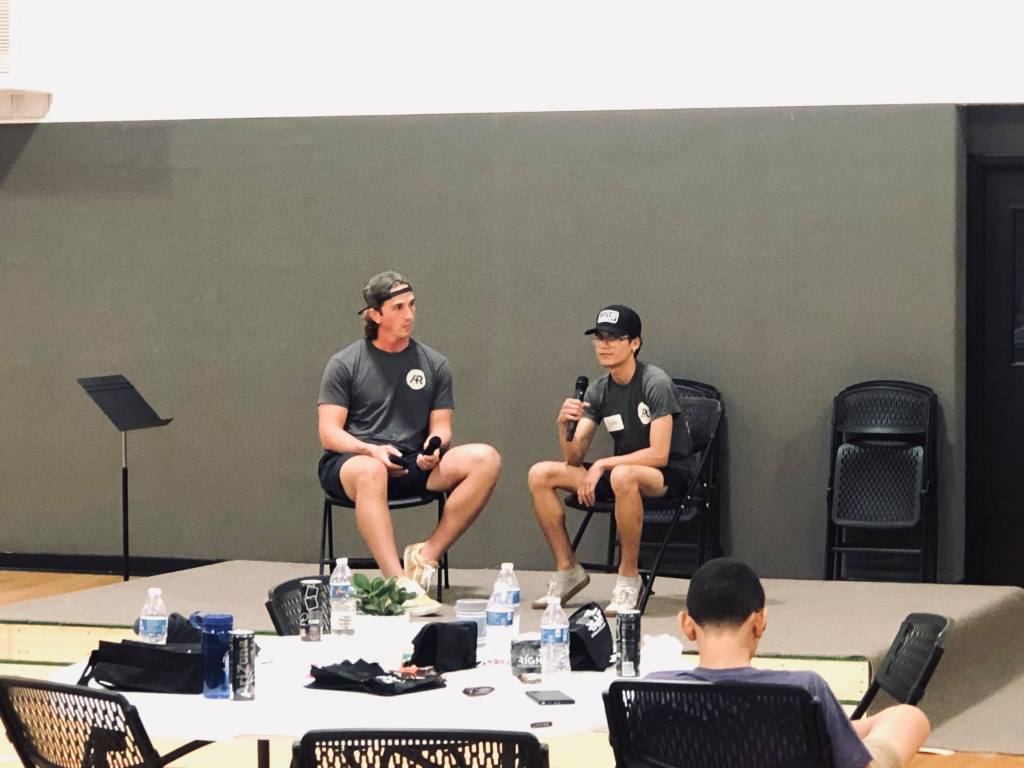
The main event was Saturday. We got to see and hear from interns and staff members of Aim Right spanning all the way back to the early 70s. Aleisha was part of a panel of interns who talked about their experience serving at Aim Right. Everyone got these cool mugs and t-shirts. There was even one of those banners to take a picture beside. Below, Mike is interviewing Jose about his experience as a teen who has been a key part of Aim Right for several years.
One of the first things I noticed as we flew into Cleveland was the grass. It was so green, everywhere. That’s something I took for granted before moving to the desert. There are also hills and all the roads are curvy – it was fun driving winding roads again. As we walked into the house we were staying at, I just kind of stopped and looked around – the place seemed huge. Rooms and rooms and two levels and closets everywhere. In the context of the country living, it wasn’t a very large house. But after moving into an apartment, houses with four or five bedrooms, a kitchen, dining room, living room, ect. just seem massive, and kind of excessive. There’s so much empty space.
Our flight back to Phoenix left at 8:30 p.m. on Sunday, so we had time to eat lunch with Ruby’s family and the other Aim Right interns. About 45 minutes into our trip to the airport, we realized we were indeed headed to the wrong airport. Thankfully we only felt foolish and didn’t miss our flight. It’s long been a dream of mine to fly at night on July 4th. And it was magical. As we descended into Nashville for our layover, the ground below us was alight with red, blue, green, white, and gold. You could see fireworks going up out of subdivisions and big commercial displays and kids holding Roman candles in driveways.
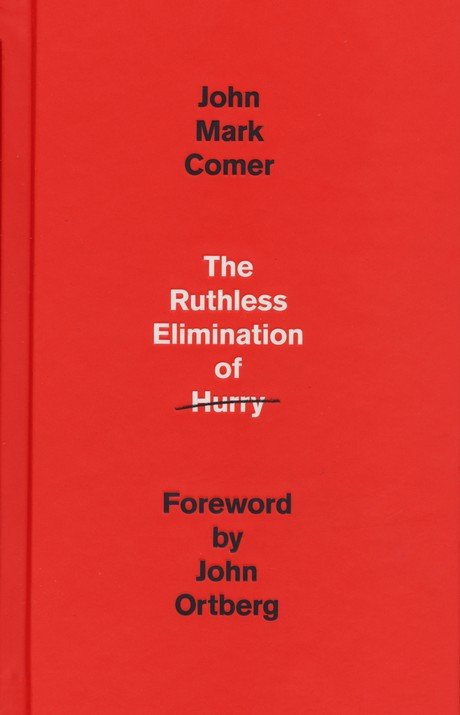
On the flight back to Phoenix, we read our books and crooked our necks trying to sleep while the plane bumped along through storms and winds and whatever is up thirty thousand feet between Nashville and Phoenix. Aleisha is reading The Ruthless Elimination of Hurry: How to Stay Emotionally Healthy and Spiritually Alive in the Chaos of the Modern World – John Mark Comer, and I’m readingThe Body Keeps the Score: Brain, Mind, and Body in the Healing of Trauma – Bessel Van Der Kolk. She’s learning practices to help up live more restful and less frantic lives – something that Protestant Americans are just simply programmed against from birth. And I’m learning about the way a traumatic experience can alter our bodies, rewire our brains, and keep us unable to distinguish past from present. It’s also a fascinating look into the different ways we know and remember. As modern people, we tend to assume all knowledge is housed in the brain, and we neglect the ways our bodies learn, know, and remember at a much deeper level. I’m planning to do a master’s degree in clinical mental health, and this book is making me consider focusing on trauma. I’d highly recommend it – it’s easy to read and loaded with stories.





















 ‘That depends a good deal on where you want to get to,’ said the Cat.