
“Dying Daylight” is a twelve minute short film made by Alex Dienner. I watched it for the first time yesterday, and then watched it again, and then watched closer. It’s evocative, profound in its subtlety, and tightly composed with tasteful editing and beautiful cinematography. Here, I’ll explore some themes and my interpretations of the film.
The Composition
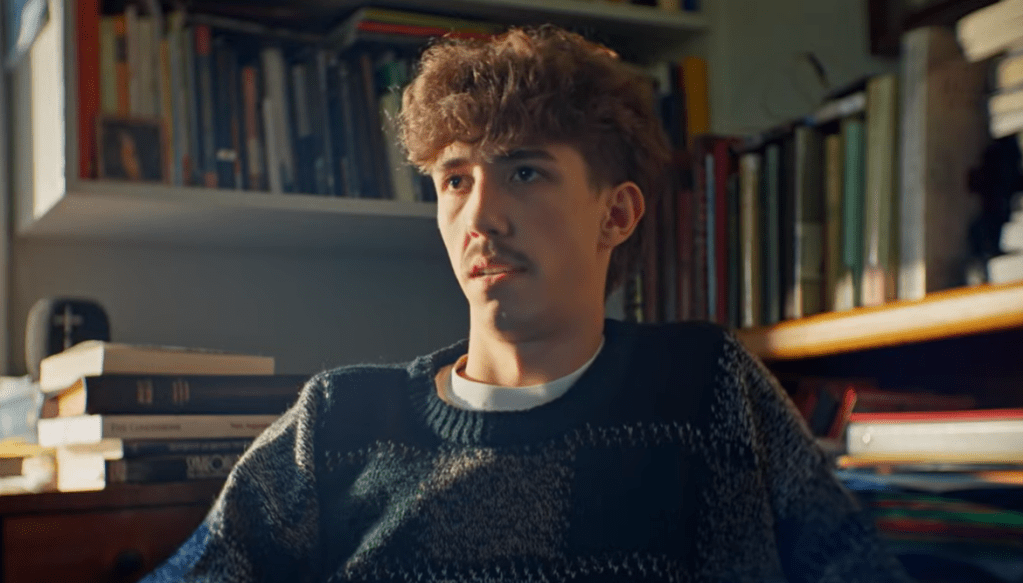
The story works semi-chronologically, but the scenes do not all happen in sequential order. The story follows a young male character named Dylan who is grappling with a relationship he isn’t sure he is ready to commit to. The story begins and ends with a stanza of poetry; there are four stanzas total. The film is bookended with both a line of poetry and a sunrise setting. The first and last lines of poetry we’re given both read,
In your warmth I am delivered.
The first and last scenes are composed of Dylan at the top of a mountain, the main character waiting for the warmth of the coming sunrise. Between these two sunrise settings the rest of the film takes place. In this way, the “dark” of the film makes up the bulk of its content with only one other daylight scene. In many of these dark scenes, our character wears a jacket, further indicating the coldness being conveyed.
We are soon introduced to Dylan’s girlfriend, Sarah, via a phone call from his car. Between these scenes of Dylan at the top of a mountain taking in the sunrise, one with and without Sarah, he encounters four male characters, all of whom are in some sort of romantic relationship. Through these encounters, we see his efforts to be connected and how he is thwarted.
Four Encounters
Dylan, the main character, encounters four men. From the viewer’s non-chronological perspective it is a middle aged counselor in his office, a young man at Waffle House, and an older man who stops to help him beside the road, and a young father at a gas station. The first three men function as a trope, representations across lifespan of who Dylan is afraid of becoming, terrified he might turn into. It’s the fourth man, the young father, who points him in the direction of the daylight.
The Counselor
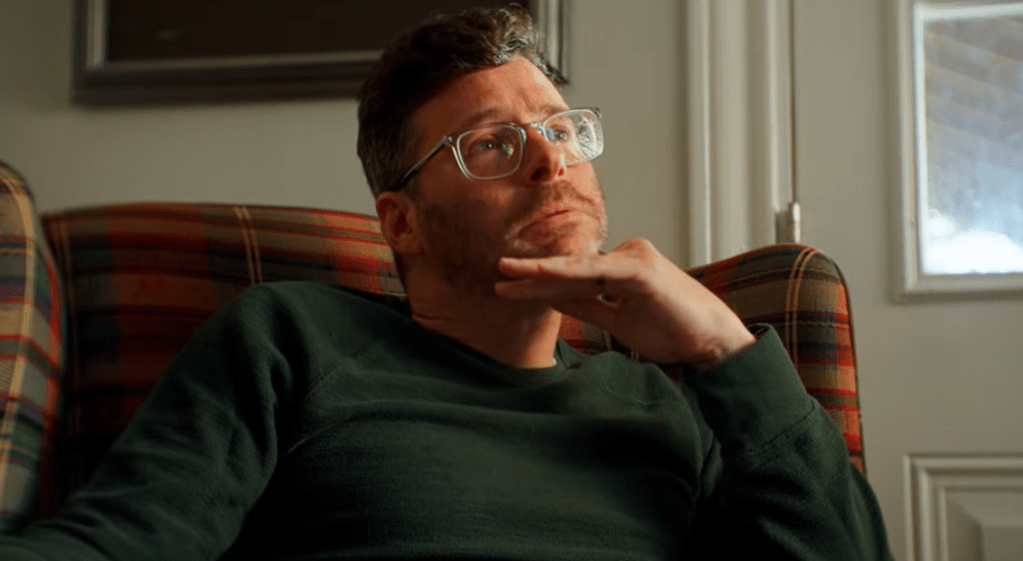
The counselor is the first of Dylan’s encounters with male figures. This setting, the only one shot in true daylight, and this figure represent perhaps the most painful missed connection of the whole film. In several exchanges, we see Dylan reaching out, wanting to be known – surely a professional will be able to grasp the pain he’s in and meet him there. Or not. Dylan takes a risk, makes himself vulnerable in the session, and talks about his uncertainty around his relationship, his hesitation about commitment for fear of falling out of love later. He asks, “What if in ten years I lose those feelings? What do I have?” The counselor makes an attempt to empathize, but misses. He says, “I remember that feeling,” and works to link his own nostalgia, listening to old Aerosmith cassette tapes when his wife is away, to the feeling Dylan is experiencing. But it doesn’t seem like the same feeling. So Dylan tries again, asking, “Can I show you a [poem] I’ve been working on?” He reads the poetry, hoping this courageous bit of sharing will connect him to the counselor. It misses again – the counselor responds with hesitation and says, “Is it finished?” Here again, Dylan has worked to make a connection and is left alone with his poetry and missed attempts at connection through expression.
Later in the session, Dylan shares about a hike a man (the young father at the gas station) told him about, a 15 mile trail leading to a sunrise view. The counselor listens but doesn’t give any indication he recognizes it. The door opens, and the counselor’s wife comes in to remind him it’s time to leave. We are shown that they are in fact going on the very same hike Dylan has just described as the wife details the beautiful hike and their plans to go, spend the night, and enjoy the sunrise – still the counselor says nothing, only sits uncomfortably. Here it is the female character who, in a matter of seconds and with no intention, provides exactly the sort of understanding and connection which Dylan has been unsuccessfully trying, presumably for hours, to forge with the male counselor.
Man at Waffle House
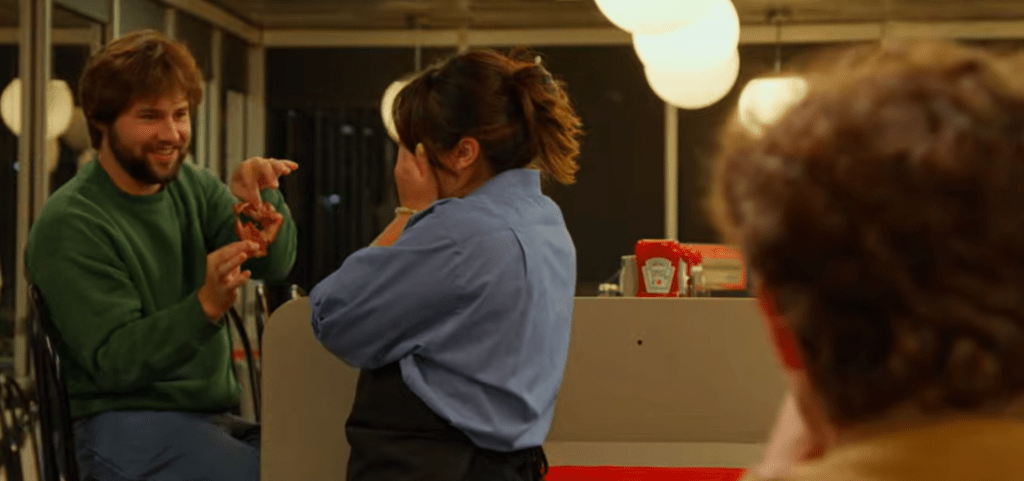
At night, sitting by himself in a Waffle House, Dylan watches a man flirt with a waitress. They make small talk, discuss her tattoos. It’s playful, exactly the sort of lighthearted conversation our main character seems incapable of enjoying. The man tells the waitress he has made something for her, and it turns out to be a piece of bacon sloppily folded into a heart shape. He tells her “It’s a little abstract.” It’s about the furthest thing from abstract. Here is a man of very little sophistication expressing his feelings for a woman using only bacon. The viewer watches Dylan who watches the interaction unfold. This is exactly the sort of thing he could never do. His inner world and its contradictions escape expression even through his poetry, psychotherapy, late night phone calls. Yet here is a man who can use bacon, and the waitress seems to be enjoying it, connecting to him. Our character is left chewing his hashbrowns alone.
Man Beside the Road

In another scene, shot in low light, Dylan’s car breaks down beside the road. A couple stops to help him. Like the scene with the counselor, he initially interacts with the male character. They look under the hood. The man makes his diagnosis, “Well that belt is tight. It should be good.” This seems also to be an assessment of our protagonist. Things appear to be in order with you, you ought to be alright. Still, the car has broken down for some reason, something deeper is amiss. Again, it is the female character who is able to make the connection. The man’s wife stands off to the back while the initial look is taken. Then, she offers him a plate of cookies and a hug, something to take up the mountain with him on his hike. Dylan has made an attempt to connect, asking where the couple is from. The man’s response is short, to the point, no question in return. Dylan mentions his girlfriend – the man doesn’t ask.
Young Father at Gas Station
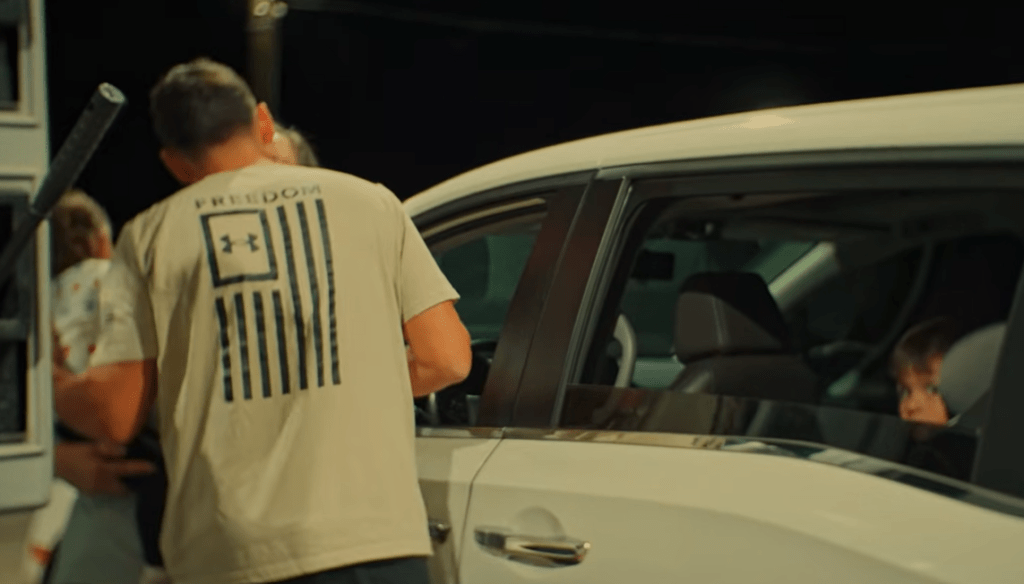
The fourth encounter is one in which we are only told about. We see Dylan watching a young couple with two children from his car. He’s writing something in a notebook. This is the man who tells him about the 15 mile hike. This man does not speak in the film. Still, he stands as the one character who opposes the male trope of the other three men. Here is a man who seems genuinely connected to his wife and children. We don’t know how old their marriage is, but judging by the children, they are moving toward the “ten years” which Dylan told the counselor he is afraid of getting to and not having the feelings anymore. Yet here is a man who kisses his wife at a gas station, embraces the little baby with his left hand, looks at his other child through the open window of the mini-van. And it’s this man who holds the knowledge of a trail that leads up to a magnificent sunset, one which takes 15 miles of walking to find.
Here though, the film doesn’t give us the sense that Dylan is able to picture this for himself, or maybe just barely. The soundtrack features mournful lyrics while the scene plays.
Today I met who I’m gonna be,
From now on, this is who I’m gonna be,

The audience, and perhaps Dylan, are both left wondering if “who I’m gonna be” is referring to the scene featuring the man and woman at the gas station, together and connected. Or perhaps it is referring to our main character, stuck on the outside, writing poetry in his car while watching that family, constantly missing connections and left misunderstood. The final scene, a striking sunrise vista, provides a glint that perhaps a connection is being deepened. The camera position begins by showing Dylan’s head in the foreground, the sunrise appearing far off in the distance. Then, the scene widens slightly to show us Sarah is leaning in, resting her head on his shoulder. She too is “in the picture,” looking off into a distance, watching the new light beginning to bathe the whole dark valley in its rays. The film closes with these lines.
In your warmth I am delivered, only now I can see,
Only now I can wake from slumber, to live as I once wanted,
The film’s most poignant revelation is that Sarah too is up on the mountain sitting with Dylan. This turn is revealed simply by reshowing the opening scene and widening the camera angle slightly. This remarkable subtlety leaves the viewer both with questions and with pieces to try to put together. It is a film which respects its audience and delivers a succinct meditation on what it means to be young, to look for connection, and to find it occasionally in between missed chances.
You can watch the short film, Dying Daylight, here:
Alex Dienner does videography in the Seneca, SC area and has experience with creative projects, commercial work, weddings, and more. He can be reached here.

