Feb 24


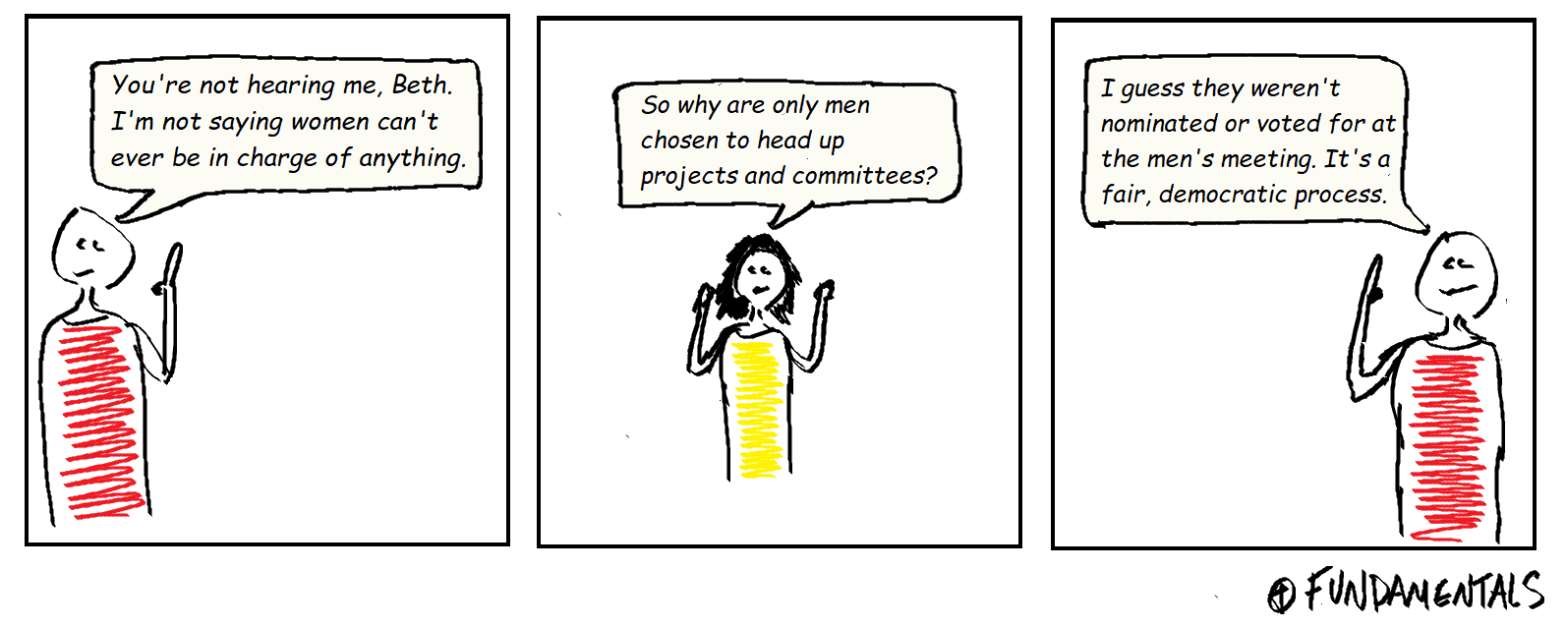
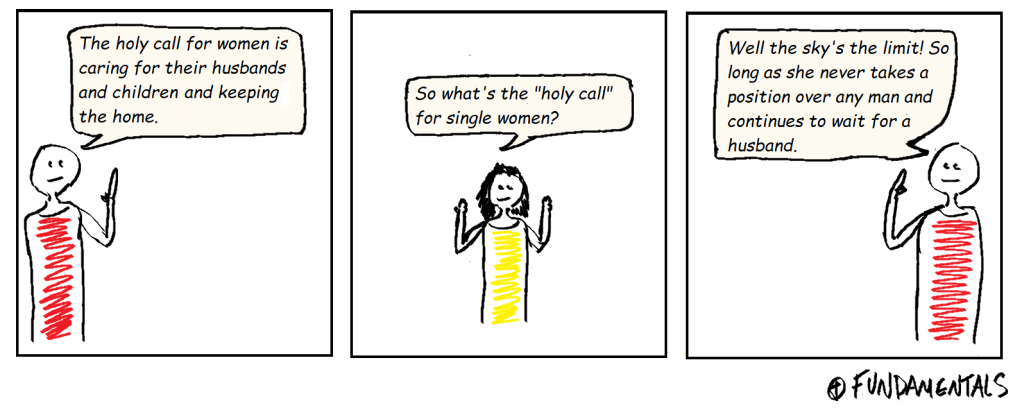
While single men are empowered and encouraged to build a career or get an education or start a business or get a job and move up the chain, single women are stuck in limbo. The ultimate (even if unspoken) goal is marriage, but while they wait for a man to approach them, they have to do something. If they take a job, they have to make sure not to move up the chain and gain authority over a man. If they expect marriage in their future, they know that as soon as they are married, they’ll need to give up their career.

What an impossible situation this puts so many young ladies in. Here is an entry point into the discussion about ideals. Some may argue that marriage isn’t necessarily required or even expected. Yet when we consider the norms, the unspoken expectation, the way social power is gained, it seems clear marriage is of high priority. So Beth’s question in a pertinent one – what’s the holy call for single women?


What does my community expect of single ladies?

Is it realistic to be a full member of the community while remaining single?

How can single women thrive if Jimothy’s goals for them are in place?

Feb 23


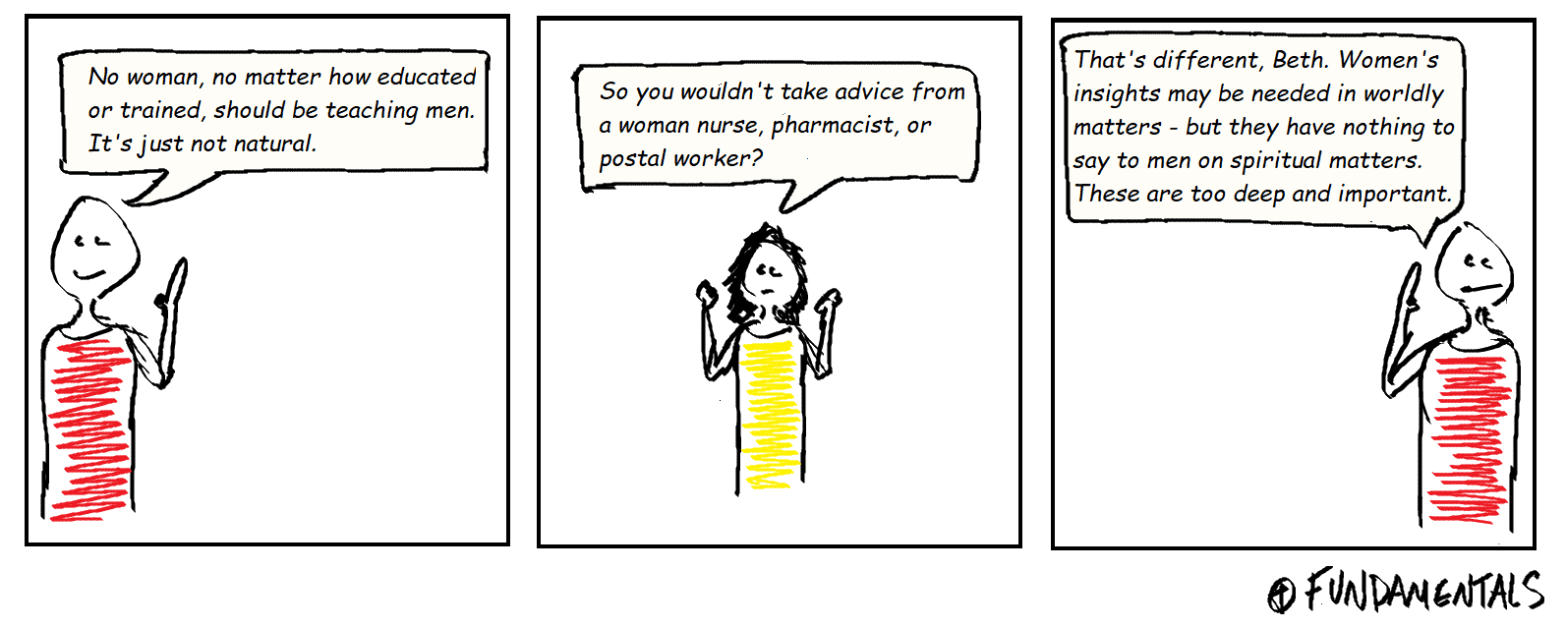
Jimothy’s answer suggests a sharp divide between the culture and way of living inside the church and out there in the world. I think we do well to seriously consider the implications of such an understanding of the kingdom of God. If the kingdom and its ways are only applicable inside the walls of the church, how exactly can we continue to build it on earth? Build more churches?

The second thing Jimothy’s answer suggests is that women may have useful insight (and the ability to wield it) in the world, just not in sacred (church) spaces. But isn’t it also interesting that women are also often discouraged from building careers in this outside world, the space where they may be allowed to become experts.

If we take Jimothy’s position, I think we miss out on two incredible things. (1.) We lose the ability to experience the presence of God in culture*1. When “spiritual matters” like singing in church are separated from “worldly matters” like working in a pharmacy, what does this say about where we believe God is operating? (2.) We lose the gift of beautiful service the women in our communities can offer. We miss out on their insight and full expression of God’s grace when they aren’t permitted to lean into their gifts inside the church.

*1. For more on this I highly recommend Tish Harrison Warren’s book (and maybe my paper which uses her book heavily)


Do I believe the ordinary places in life are sacred?

Do I believe God is using women to express his word in the world and in church?

Do I draw sharp lines between church and culture which may be hindering what God wants to do?


Feb 22


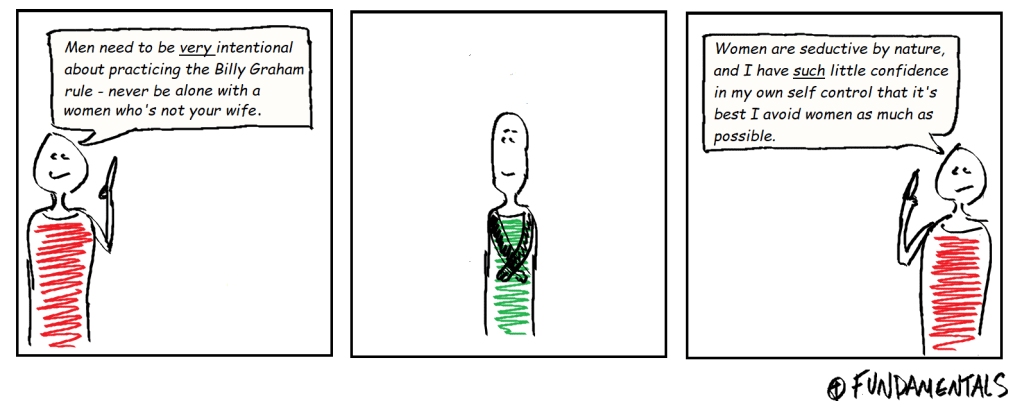
We can chuckle, but we must admire Jimothy for his honesty in the third frame. If he is so much as alone for a few minutes with a woman, he has no confidence his purity will survive the encounter. This is familiar talk given to young men in many churches.

Consider the view of women displayed here. When a man cannot be alone with a woman for fear of becoming tarnished, defiled, made impure – women are seen as agents of impurity, they are dirty and dangerous.

I remember hearing a man teach this rule. He said he had to call or message his wife anytime a woman entered the room where he was working as an act of accountability. This kind of behavior communicated two things: (1) Men are completely out of control when it comes to temptation and desire. Their sexual impulses are so strong and raging that the mere one-on-one encounter is to be avoided. (2) Women are tempters. They are out to seduce men. They cannot be trusted. In reality, the danger of a man raping a women is much more real when alone in a room (more likely than a woman seducing a man). Yet what is often taught to young men is to never be alone with a woman…or else. The message to women is to dress as modestly as possible lest they awaken these insatiable, uncontrollable desires and cause their brothers to stumble. That women are dirty and dangerous and that men need to remain pure and safe.

We may not be saying it out loud like Jimothy, but we’re saying it.


Do I communicate harmful views in the name of purity?

Have I unintentionally accepted or taught views of sexuality which cast woman as temptresses?


Feb 21

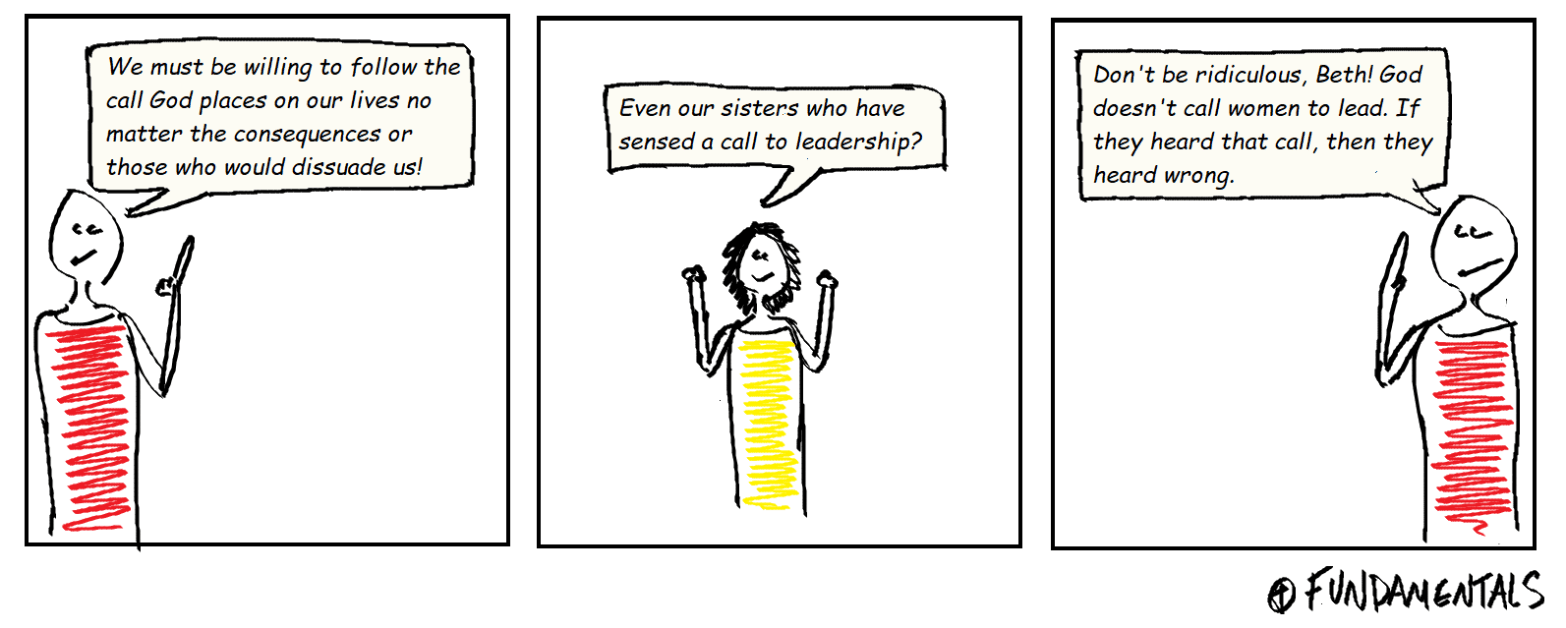
In order to keep women from any positions of authority of leadership it’s necessary to say that anytime a woman senses a call to these positions, she has heard wrong or that she didn’t hear from God. Conversely, when men demonstrate an ability to lead or if they sense they are gifted in leadership, they are often told this is a calling from God. In the end, men are told to trust their instincts: women are told to trust men.

Jimothy’s answer may sound ludicrous, but what other answer can there be? If we are totally sure woman aren’t supposed to be leading, what options are there when a woman starts to sense that calling? We have to say that either: we are wrong about what women are allowed to do or the woman is hearing wrong: God didn’t say that. Since the first option would kind of undermine the entire operation in many churches, we rely heavily on that second option.

Even more preferable is the silence and submission of women. If they seem to be gifted leaders, they can just keep that quiet and keep the community from having to make a visible choice (and saying out loud what Jimothy says).


Is every woman who senses a call to lead hearing wrong?

Do I encourage open dialogue about men and women stepping into their giftings?

How is Jimothy’s answer worded to women in other, less direct ways?


Feb 20

The logic of being completely different and kept apart (while still being “equal”) was employed during the Jim Crow era to keep black children out of all white schools. Eventually, even white people realized how ridiculous this logic was and were forced to integrate. This same kind of logic is employed in churches where men’s and women’s roles are seen as totally separate/different but “equal.”


Have I shut down conversations about gender roles with answers of men and women being “separate”?

Can we truly see ourselves as working together if we are divided up tasks according to gender?

If separate but equal doesn’t hold for race, why does it for gender?


Feb 19


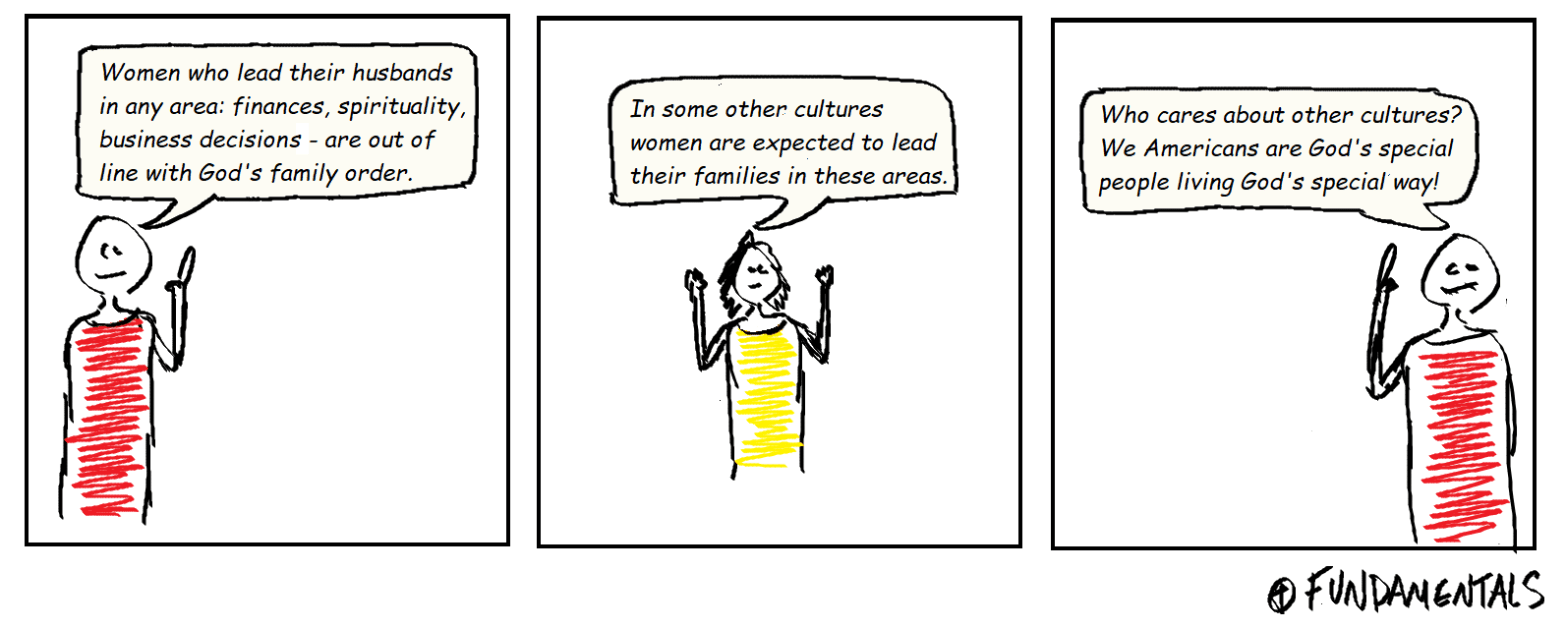
It is an absurd notion that women should be kept from leading men in any area. Yet this is commonplace in many church communities and done under the guise of being God’s will. When faced with the reality that many other cultures see the family order playing out much differently, we are either forced to say that there are other ways of living faithfully, or that everyone else is wrong and we’ve understood it and got it right. Jimothy takes the latter option.


Do Americans possess a special ability to understand scripture? Do we act like we do?

What might we learn from other cultures where men and women’s roles look different?

Does God love and approve of people who don’t live in American and don’t fit American gender stereotypes?


Feb 18


In many churches, women are discouraged from getting career jobs or investing in opportunities which would distract from what is seen as their true calling (motherhood in the home). And there is often an anti-education attitude which develops, perhaps unconsciously. When men are encouraged to follow the call God has placed on their lives by following the passions and giftings, a college education is sometimes encouraged. But if in the case of women that gifting, passion, and calling are predetermined for them, then higher education is deemed completely unnecessary.


What is ratio of men to women who choose higher education in my community?

Does my community encourage women to pursue higher education or frown on the idea?

Would a woman who went to college be perceived as forward, aggressive, or intimidating and therefore less desirable for a spouse?


Feb 17


When we examine a church or a business or other institution where people are involved, we can take a look at it’s ideal (what is the aim, the vision for the people there?) and the structure implemented (how are things arranged, who is in charge, etc.?) We can examine forwards and backwards with these things in mind. These two things aren’t isolated or separable. How we’ve set things up and what we think we’re going for are tightly connected.

If we aren’t sure what the ideal of our community is, we can look at what the system is set up to produce. What is in place to ensure this outcome? Structure >>> Ideal.

If we aren’t sure how things are structured, we can work backward from the ideal/vision. What is it we all have in mind to accomplish that we’re arranging things to produce. Ideal<<<Structure

If the ideal is to have only men’s perspectives in church decision making, the structure will reflect that and exclude women from the processes. If women are excluded from processes, we can see the ideal is one where men have the lion share of responsibility and freedom.


What are the ideals in my church community?

Who determines the structure/arrangement in my community?

Is my contribution to the ideals and structure of my community intentional?


Feb 16


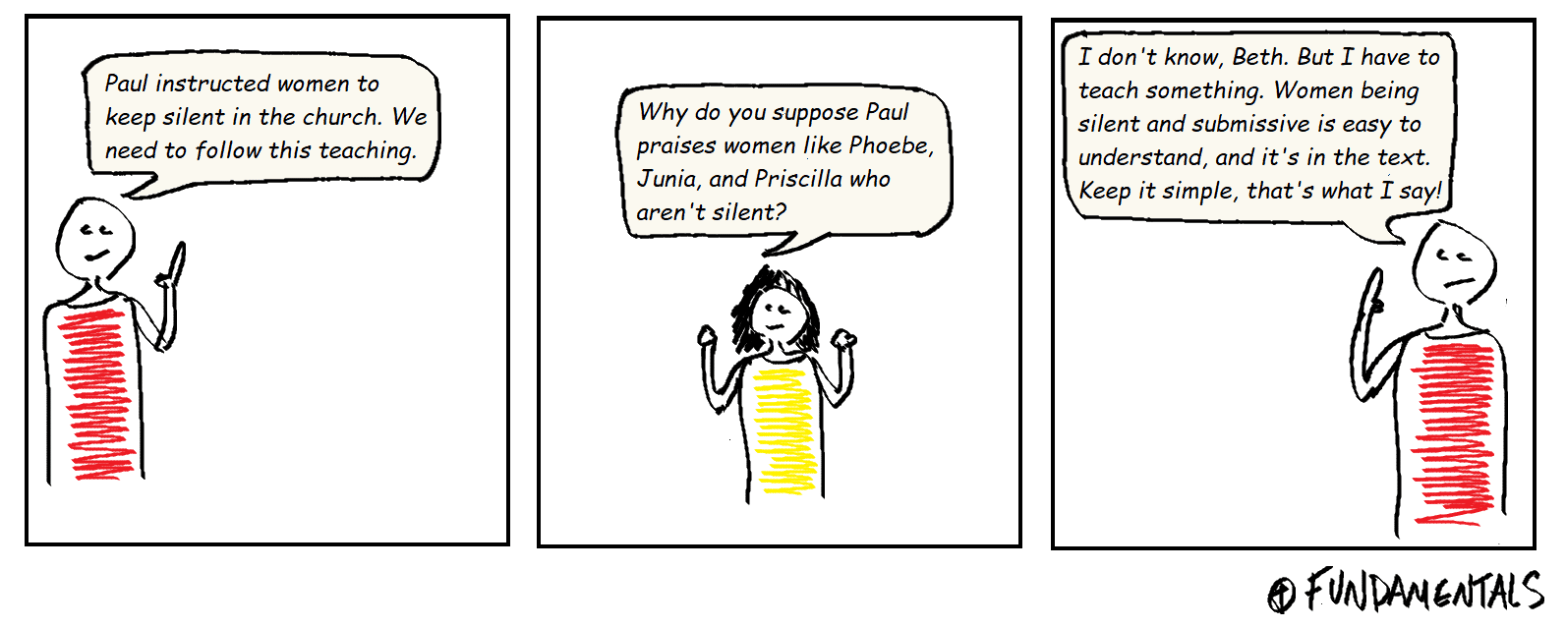
Jimothy here is at least honest. Some ultra-complementarians (like John Piper) admit there are pieces of scripture where women are praised for doing things that don’t reckon with their theological picture of gender roles/design. At the end the day, or the beginning rather, preachers have to preach something. And something that’s black and white is easier, even if it’s not faithful to the teaching in scripture and even if it subjects half their congregation to a limited existence.


Would I rather just keep it black and white even when it harms people?

Would the apostle Paul be labeled a liberal in my church for praising women who lead and teach?


Feb 15

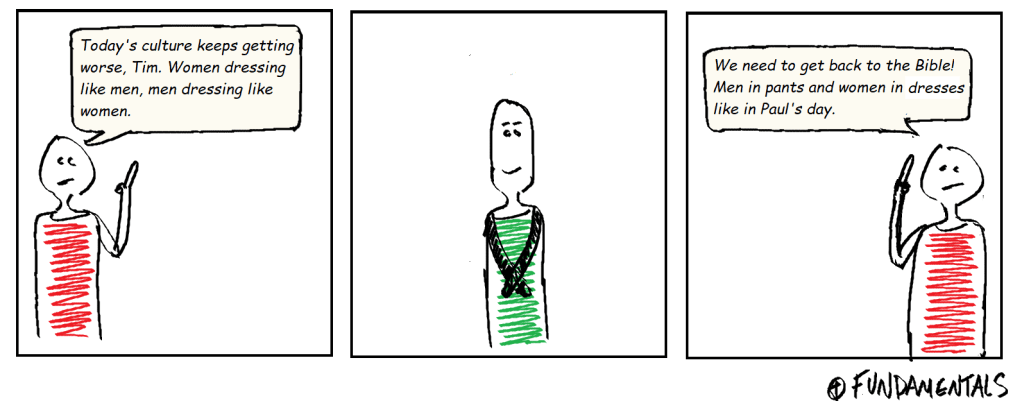
This strip brings to mind one of my favorite quips, If the King James Version was good enough for Paul, then it’s good enough for me!

Those who fret about the perpetual worsening of culture often have a very short memory and very little conception of the things which have happened in the distant and not so distant past. It wasn’t terribly long ago we were burning people at the steak for translating the Bible – closer than that was owning other people so we could get richer – closer than that was only letting certain colors of people in our businesses. Yet we’re often ingrained with this idea that things are generally getting worse and worse. Often our remedies have little to no grounding in scripture, like Jimothy’s solution for men and women’s dress.

Living separate from the world and establishing an identity through dress that binds a community together is one thing. Holding women to antiquated standards while allowing men to blend in with contemporary culture is quite another. If we really want to get back to the New Testament church, then we need to break out tunics and robes for everyone.


What would it look like to dress exactly like the 1st century church?

Since we aren’t interested in dressing like Bible characters, how do we determine what it means to dress well?

If culture is getting worse and worse, why are things so much better now than 200 years ago for so many people?