Feb 14

There is a difference between “husbands” and “men” just as there is a difference between “wives” and “women.” In conversations of gender roles, this is often garbled. Often times, sermons are given about husbands and wives, and the teaching focuses on what the dynamics of the relationship ought to look like. However, the meaning often gets extended from husbands/wives to men/women.

It is not the same thing at all to say that women (all women) need to submit to men (all men) as it is to say that a man should be the head of a household or lead his family. In church communities, many people end up getting married and therefore find themselves in a husband/wife relationship. However, not everyone does. It is a logical leap to say that since we may think a man should be in charge of his families, we also think men should be in charge women (or the church) in general. Those are different things.

One text which often gets brought up is 1 Timothy 2, in which Paul instructs the church at Ephasus, “I do not permit a woman to teach or to assume authority over a man; she must be quiet.” The strict complementarian position is that this scripture applies to all men and women of all times. Another (perhaps much better) way to read this scripture is that Paul was giving specific instructions for a specific church at a specific time. The church at Ephasus where Timothy was serving was in a time of crisis and disorganization. Paul’s letter gets down to business with specific instructions on how they need to operate to fix the problems. (Read more on this here). Given the way Paul praises Phoebe, Apphia, Junia, Priscilla, Lydia, all women who certainly were not silent in their churches and ministries, it seems impossible that Paul could intend this rule of women being silent as a universal command.

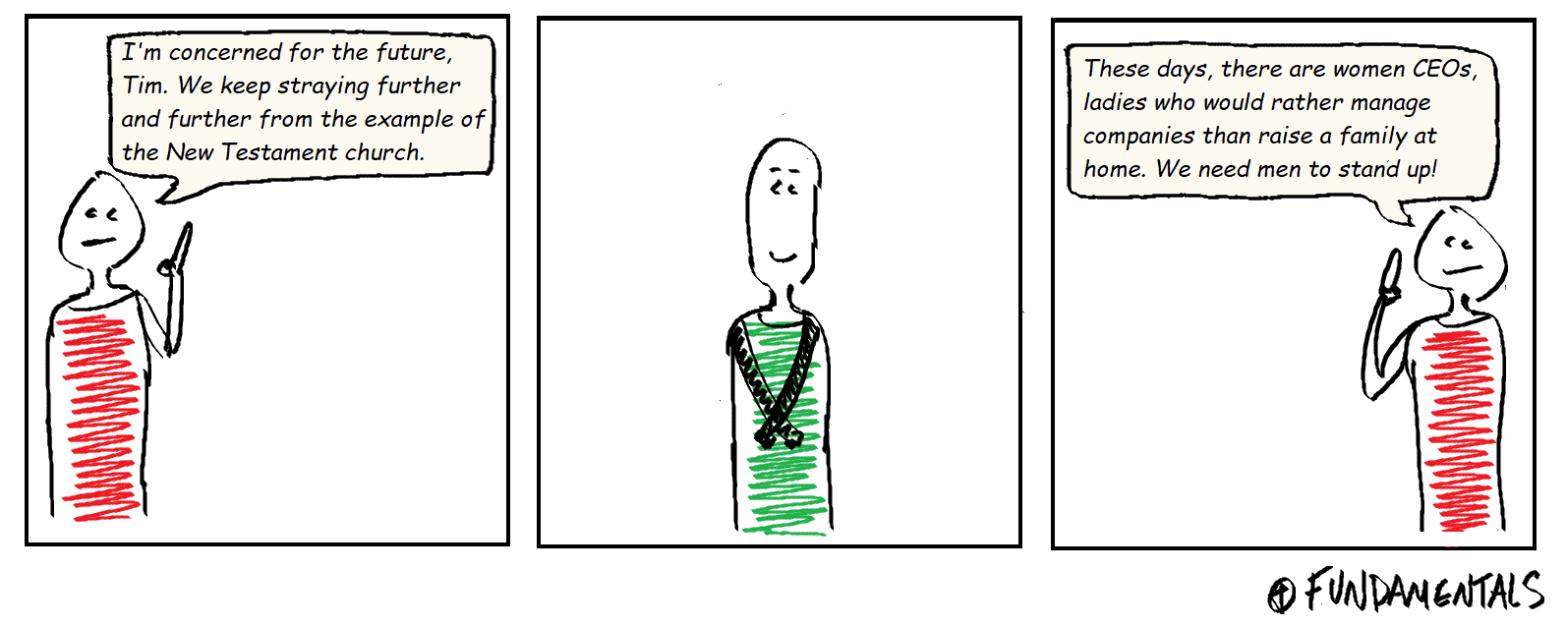
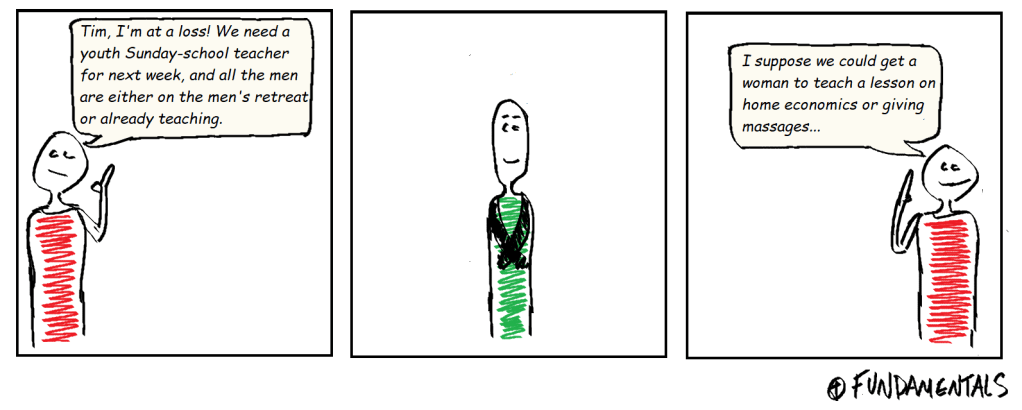
In order to realize this truth and intent of this passage, we have search out a bit more context than simply plopping open a Bible and quoting verses at women. When we read at face value, we can quickly end up like Jimothy here and suppose women are only fit for teaching home economics or giving massages. Certainly Paul didn’t think so.


Does God’s gifting or stereotypical gender roles dictate who does what work in my community?

Are young people in my congregation encouraged to exercise their gifts or simply please those in charge?

Have I (actively or passively) kept people around me from exercising their gifts freely?


*subscribe to get posts emailed to you as soon as they’re published.

Feb 13

Our memory is often quite short sighted. We tend to accept as gospel truth the idea that women have never lead or taught in church, in the Bible, or in history. An examination of scripture and history provides quite a challenge to this notion. From the Old Testament and the New Testament through the early church through the medieval church through the reformation through the present day, we do find women serving faithfully in teaching/preaching capacities. When we confront these past realities, we often balk (like Jimothy here) and just say that regardless of what may have been the case, men are the only ones allowed to teach/preach/lead now.


What does it mean when churches today are more strict about women’s roles than the early church?

If Jimothy is right, and it’s just men now, on what basis was this change made?


Feb 12

It’s often true, especially in very conservative church environments, that men can move much more easily between the church and the world than women can. The church’s teachings and standards keep women tightly bound to the church community which makes the thought of leaving that much harder.

While women are often discouraged from getting jobs in the world (outside of working for people in the church), while men are free to work wherever they please. Women may be required to dress so that they are recognizably of the church even when they do enter the outside world. On the other hand, men are free to dress as they please and find it easy to come and go between home, church, marketplace, etc.

This lends to a dynamic where if a man wants to leave the church, he has options and mobility. However if a woman wanted to leave the church, she would be taking a huge step – leaving behind all the familiar spaces where she was allowed to move. To continue dressing the way she had would make her stand out in another church – but men never have to feel this because they aren’t held to the same standards. This is why our theology and community standards really matter. It’s also why they should be fleshed out by everyone in the community, not just those (men) in authority positions. This isn’t a subject where we can just say, do what the Bible says. Men in Paul’s day weren’t wearing Levi’s, and women weren’t shopping online. Our standards in this case are what we make them.

I explored this topic at length in this article several months ago. I would also direct the reader to Katie Funk Wiebe’s excellent article, in which she points out

Historically, women were never the ones to introduce theological positions
but were expected to be the standardbearers of the positions held by the larger
church body, especially cultural traditions and social roles. Long after men had
moved in other directions, women were expected to be the social conservators of
… culture, presumably based on Scripture, particularly clothing and
hairstyles. Clothing restrictions were never as severe for men as for women
” (Wiebe, 16).


In my community, is it harder for women to leave than single men?

Who gets to set the standards for what’s considered kosher in my church?


Feb 11

In the New Testament, we see women like Lydia, a wealthy merchant woman who helps fund Jesus’ ministry. Paul calls a woman, Junia, an apostle. He entrusts Phoebe to deliver and read one of his letters in which he describes her as a deacon and a benefactor. The easy thing to do is cry “feminism!” when we see a woman exercising her God-given gifts in a way that looks unfamiliar to us or our community.

Something I often hear is that men are natural leaders/providers/protectors. Men are strong/stable/rational. In contrast women are followers/receivers/the protected. Women are weaker/more emotional/less rational. It may be that these generalizations are more true than untrue, meaning it could be that these descriptions are true more than 50% of the time. More men may have leadership qualities than women.

Yet it’s entirely another thing to say all men are this, and all women are that. There are many women who do possess strength, leadership ability, etc. And there are some men who are not gifted to lead, who are not emotionally stable, who are not very strong in general, or able to protect very well. When we operate with these generalizations as gospel truth, some people who fit the bill may be able to thrive; but some who don’t (the men who are built to follow and women who are built to lead) and will have an impossible time fitting the narrative we’ve constructed for them.

The statement “people in the city walk to work” is true for many many people around my apartment in Phoenix – but not all. To say “people in the country like hunting” is true for many many people in my hometown – but not all. Generalizations, like theories, are helpful to explain things. Yet they can be very harmful and frustrating for those whom they don’t fit.

For men and women in the church, these generalizations are often crippling and leave us trying to be people God didn’t make us to be. So what if instead of saying “men need to lead” we said “we need those people to lead whom God has gifted”? What if we approached roles with a faith in the Spirit of God to gift and call those whom he chooses, rather than those our generalizations fit?


Do I trust the Spirit to gift people in the way they will be able to serve well?

Is my community a place where men and women are expected to fulfill a generalized role, regardless of their personality or gifting?

Do I give lazy answers (make broad generalizations) about who a man or woman is supposed to be?


Feb 10


Here we see how women are invited into spaces where their physical gifts (like their singing voice, ability to play an instrument, or willingness to cook/clean/etc.) are desired as they serve the church. Some folks, like Jimothy, start to get uncomfortable when a woman starts talking between songs or is tapped to head up a worship team or project. It’s often the physical service only that’s wanted, not a woman’s ability to curate, discern, or lead in any way.

In I Corinthians 11, Paul writes, Every woman who prays or prophesies with her head uncovered dishonors her head.” The expectation seems to be that women will be prophesying in the congregational setting. My friend Emily recently reflected wisely on this passage in her thoughtful article (you must be one of her Patreon subscribers – so it costs $1 to read. It’s worth it!).


In my community, are women invited to serve with their bodies and their minds?

Am I uncomfortable with a woman sharing a word in a service?

Why is thought-work reserved for men in many churches?


Feb 9


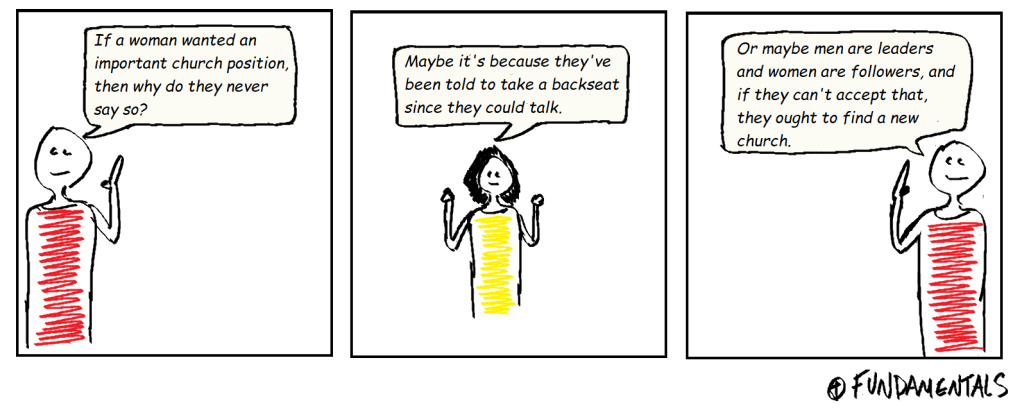
I remember sitting in a small group and hearing Jimothy’s explanation voiced regarding people who didn’t live or believe quite like the person speaking (this had nothing to do with women). I believe the person’s exact words were, maybe they ought to just go on down the road.

We must also consider that if a sexist church culture has gone on unchallenged for decades, the people there may have either tired of wanting a better situation or just moved on (like Jimothy suggests here). In my experience those who speak out either wear down and move on, or speak in a way so as to only be heard by those who will want to hear them.


Am I able to live alongside those with whom I disagree?

Is my community one where differing philosophies about men and women in church can coexist?

Do we have a responsibility to confront what is wrong, or is it better to move on down the road?


Feb 8


Sometimes we believe that God isn’t pleased with us if we admit we don’t know what’s going on, that he’ll be disappointed if we don’t have answers. When we view scripture as a textbook full of answers to life problems, we often are left having to choose and then defend our choice whatever the cost. In this case, the cost is often borne by those without agency in the process of decision making.


Am I willing to acknowledge grey areas where I don’t know the right answer?

Is my church a place where we’re allowed to say we don’t know?

Do I invite people into nuanced conversations or shut down anything resembling a threat to black and white thinking?


^ become an email subscriber to have articles delivered to your inbox as soon as they are published ^

Feb 7


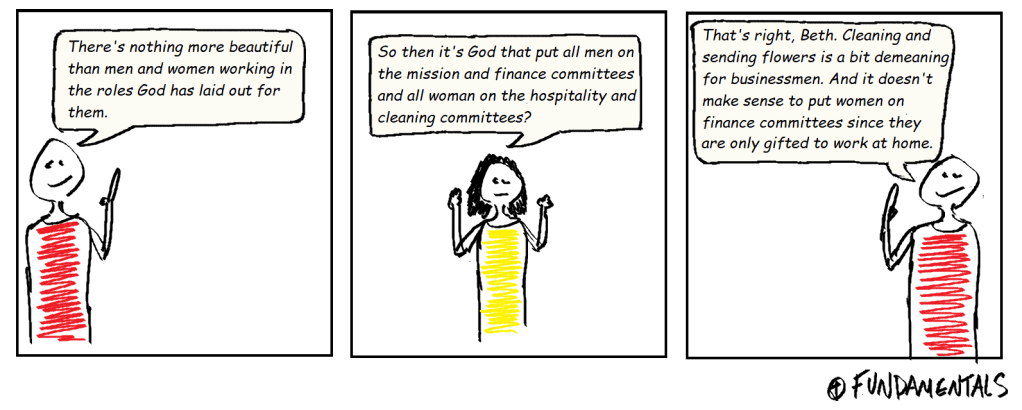
If we wonder how our church views what men and women are capable of, we can take a look at the way we delegate responsibilities. If the missions committee is made up of all men, and the hospitality committee is make up of all women, that says a lot about what we believe women are capable of helping with. What we may find in sexist environments is that women are invited into spaces where physical service is required and excluded from spaces where intellectual work is required (making decisions and coming up with ideas).

It can’t be well argued from scripture that women should welcome the role of secretary while men should scoff at it. Yet I’ve never sat beside a man in church who was a secretary (that I know of). It also can’t be well argued from scripture that men rather than women should decide how the church’s mission budget is distributed. The church exists inside of culture, and the cultural assumptions about who does what are alive and well inside the walls on Sunday morning.

I have certainly been guilty of exactly this. As a man, there is work I often tend to assume I don’t have to bother with, just because I’m a man. I’ve also made the stupid jokes that entrench gender stereotypes in the church family (Oh wow, nice job with the dishes, Bill! You’ll make someone a great wife someday.) And when I’ve been in charge of handing out responsibilities, I’ve often just assumed that based on sex someone will be willing or able to perform a task. Perhaps it would be better if I trusted the Holy Spirit to that task and delegated work according to the ability God has given, rather than sex.


What would happen if I empowered everyone around me to serve as their gifting allowed?

Have I suppressed gifts I was given for fear of breaking gender norms?

What would it look like to shed cultural stereotypes regarding who serves where in church?

Feb 6


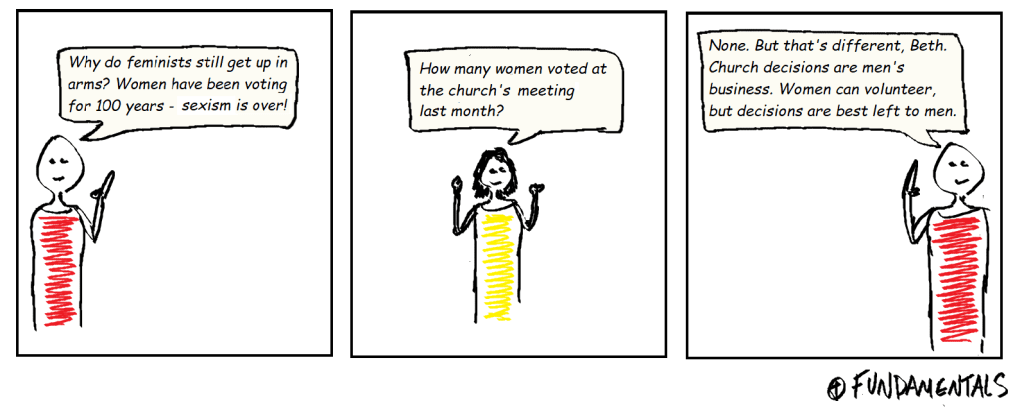
Denominations have different procedures for making church decisions. In some churches, members vote in a democratic process. If only men are empowered to voice their opinions, not only does it remove every woman from a participatory role in the decision making process, it also ensures that the agenda, debate, and decisions make in meetings are void of any female perspective. Some would say this is just an oversight, but then again, when every church position is filled by men only, it’s not hard to see why women would also be left out when it was decided how decisions would get made.

The decisions made at these meetings have to do with finances (do we buy new chairs?), church ascetics (what color do we paint the sanctuary?), church appointments (who will be in charge of what?), etc. Buy excluding women from the democratic process, they are not only kept from church offices, but are completely removed from any decision making input or capability. In this system, men as young as 17 are afforded full membership voting capacity, while wise, mature women are not.

I have been a part of and voted in democratic meetings. And rarely (if ever) did it strike me as odd that half of our congregation was being completely excluded from this fellowship in which we articulated and furthered the vision of the body. It’s so easy to just go along, and like me, to never notice (much less open the conversation) who is being excluded and who is being made important.


How have I participated in activities which excluded large portions of the church family?

When I realize what’s going on, do I have a responsibility to speak up?

If no one else is willing to acknowledge what’s going on, what does it mean to be faithful?


Feb 5


My mom and my aunt tell me how when I was a very young boy I used to give passionate sermons to them both about how women need to submit to men, how men are leaders and women need to obey them. I was an impassioned fundamentalist of a child. 20 years later, the questions are still in mind.

In some churches where women are not permitted to have any kind of “authority” over men. This brings many questions to bear, one of which is what is authority? Wayne Grudem went to the trouble of listing 83 activities in 3 categories and drawing a hard line – everything underneath a woman may do, everything over the top women may not do. In category 1, he draws the line between items 9 and 10. In category 2, between items 10 and 11. In category 3, between items 1 and 2.

So Grudem would permit a woman to be chairperson of a committee, but not to be a leader of a fellowship meeting in a home. He would allow a woman to teach the bible to a high school age Sunday school class, but not to a college age Sunday school class. Finally, he would allow for a woman to be licensed to perform ministerial functions, but not be an ordained pastor.

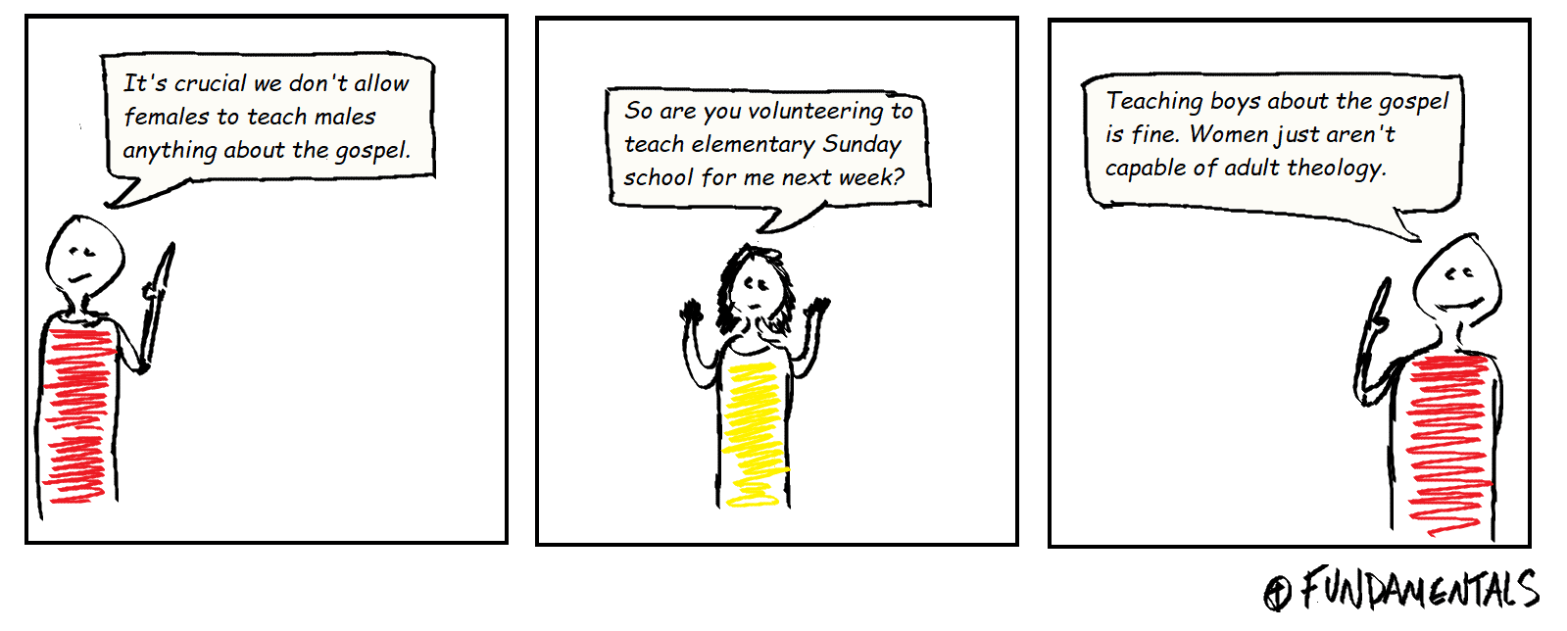
So what’s the difference between high school age and college age Sunday school class? Why are women allowed to teach 17 year old men but not 18 year old men? What are the implications of telling women they can be trusted to instruct boys, but never adults? What are the implications of telling women that a woman may teach them the Bible – but telling men that a woman may never teach them the Bible? These are all questions Grudem and those who don’t permit women to teach have to answer for. Often though, the answer is merely, well that’s just the way it is.

In contexts where this is the way it is, we prefer to have young, inexperienced male teachers than thoroughly trained, well-equipped female teachers because it is seen as a grave error for any woman to have any authority over any man. While the theology may not be spelled out, this is often how it gets worked out – women are afraid of overstepping an imaginary line and getting in trouble. A moment I’ll think about for a long time occurred when young singles class needed a substitute teacher for the next week. The male teacher asked if anyone was willing to teach next week – the men stayed silent because no one wanted to. The women stayed silent because they knew they were disqualified. Finally, someone broke the silence with a joke – perhaps the teacher’s wife could come in and teach us how to give massages. Amidst the laughter the message was clear: women, no matter how educated, are useful to a group for physical service; only men can be trusted with scripture and the thoughtful (not physical) work of teaching males.


Where (if at all) do I draw the lines in Grudem’s categories?

In our church rules, who gets to draw the lines? Are women involved in deciding what they’re allowed to do?

Are the women around me uncomfortable for fear of crossing my “lines”?

How does my assigning church roles affirm or challenge the status quo?