Last summer, Aleisha and I were in Arizona sitting around a dinner table when someone threw out a job offer and said we should move out. At the time, I was doing an internship for my degree while Aleisha was leading a group of interns at Aim Right Ministries. After those six weeks in Phoenix , we flew back home to South Carolina; Aleisha went back to her new job, and I started my senior year of college. Still the dinner table conversation and the offer stayed in the back of our minds.
During my senior year, I got to take the best classes of my degree programs. Communication and theology courses at the 300 and 400 level – to me that’s exciting, some folks not so much, I get that. I really loved those courses and the papers I got to write, and I started thinking about a master’s degree – but I wasn’t sure I wanted to do it in communication. Over the summer I’d listened to a lot of podcasts and lectures from (and about) psychologists, and I was toying with the idea of a master’s degree in counseling psychology. By the time graduation came, I decided therapy was the career path I wanted to start pursuing. And unlike many positions, that ain’t one you can just learn on the job – you have to do a masters degree. As Aleisha and I talked about our options, Phoenix started making more and more sense.
The job offer from our dinner conversation was at Grand Canyon University as an admissions counselor – included was the benefit of free tuition to the university as an employee. Aleisha was also offered a job as the youth pastor of Aim Right Ministries where she’d served as an intern for several summers. After a few phone calls to make sure the job offers were serious and not just off-the-cuff remarks to make conversation, we decided to move from the green hills of east to the desert of the west. Our timeline for moving changed more times than I can remember. The end of June, the end of May…and we ended up moving the end of April, right after my graduation party.
Phoenix.
And here we are!
It was not easy in many respects. Finding an apartment in your own town in crazy hard right now, much less the other side of the country. Getting all your belongings across Texas and every other state standing between is hard as well. Somehow we did both in a very short amount of time. But several times I’ve remarked to Aleisha how nearly impossible it would’ve been if we didn’t have a support system around us. We had friends in Phoenix who scoped out a place for us to rent – our families to help us figure out transferring legal documents, selling vehicles, and loading all our earthly possessions in a one way U-Haul – and we had grandparents who so graciously drove our things all the way across the country so we didn’t have to worry about taking a car we didn’t trust or renting a truck that would be way too big. And there were so many friends who slid us a gift card or some cash or a blessing for leaving.
Grandma and Grandpa!The building where I work at GCU
Currently, we’re living on the upper level of the beautiful old church building where Aim Right is located. Our lease didn’t start for more than a month after I had to start my job training, so we wake up every morning in an old Sunday school classroom and walk through the sanctuary to go the bathroom. Aleisha is transitioning into directing the youth programming at Aim Right. I’m working for Grand Canyon University on the third floor of building 18. I plan to take about a year to enjoy being graduated and get settled before starting the masters in mental health counseling program.
We’re loving life in the city. The other night we walked with Mike into downtown to get some drinks. And on Saturday morning, we went for a hike up a local mountain. If you search for a restaurant, the question isn’t whether there’s one around but which one is closest. If you can live without seeing much grass, Phoenix pretty much has everything. Except of course for emptiness and wide open spaces. Having everything does come at the cost of not having empty places – sounds obvious when you say it, but part of the charm of the rural southeast is the fact that there isn’t everything. The campus where I work has two Chic-fil-a locations within a square mile. I remember seeing Los Angeles for the first time, then sitting down on a couch and writing these words about that city – they seem true of this one too.
It’s something like Cinderella / Something like a machine,
Something like my hometown / Just got more of everything,
At the time of moving we didn’t trust either of our cars to make it across the country. So we flew out and bought this 2009 Toyota Venza. It’s been great so far, and you could probably sleep in the trunk space. I take it to work four days a week. The apartment we’re getting is within biking distance of Aim Right, so that’s how Aleisha will be getting to work for the time being.
Sunday starts the first week of Aim Right’s summer VBS. We’ve been coming out to help with it for the past three summers, and I love it so much. We also get to help with “mobile pantry,” one Thursday morning a month a local food bank brings a semi-truck with pallets of food which we set up on tables in the parking lot and distribute for free to anyone who comes by (usually between 30 and 60 families). We also got to be a part of the last serve event Unite PHX put on. (see the video I made below).
My favorite T.V. show of all time is The Newsroom. And there’s a scene where Charlie asks this kid musician, Bo, “What’s a kid from New Rochelle doing singing about Memphis?” And he says, “Memphis is a stand-in for wherever you are right now. That it really means that’s how I got here.”
I always think it’s fun to think back through the thread of events that lead up to the present, to see if you can pull the strand all the way to its end. Of course, it’s never really possible since no thing exists outside of relation to the things around it. I’m sitting on a couch in a church in Phoenix right now because we got a job offer last summer – but we were only there because when she was 20 Aleisha decided to move to Aim Right to volunteer for a year – and I really decided to take my new job because of the tuition benefit for the masters program – I only knew I wanted to be a therapist after getting a communication degree – it was in Oregon as an intern that I decided to go to college at all. Each moment is in some way brought into existence as the one before it passes away. One thing dies so another can live – we have been becoming who we are all along. Or as a philosopher said, “The self is only that which it is in the process of becoming.”
We’re always in process, and it has been such a gift for Aleisha and I to figure out what will come next for us in the presence of such good folks. Our families have helped us – our friends have supported us – other friends have taken us in – and the Lord has led us. And I suppose you might say, that is how we got to Memphis.
This is a revised version my capstone paper for the communication studies program at TFC. The full paper can be found here.
Workin’ Nine to Five
The workweek is often viewed as a prerequisite to the weekend. This is to say the workweek is a necessary, but somewhat contemptible, element of surviving 21st century American life. For many, the hours between 9 a.m. and 5 p.m. represent a sort of paid servitude in which they submit themselves to the whims of corporations so they can live the good life on weekends and holidays. The work done from Monday through Friday is often a kind of ritual we participate in as a tradeoff: daily labor in exchange for daily sustenance and the freedom and means to enjoy the weekend. Implicit in this paradigm is the conclusion that if we could bypass the ritual of the workweek and live in a constant state of “weekend,” we would experience a much more fulfilling existence. However, in order to understand the nine to five workweek and subsequent weekend from a biblical perspective, we must understand humanity’s purpose in culture and the true meaning of our work.
What Is Culture?
The essentialist notion suggests culture is merely the sum total of individuals melded together – that our identity is formed and then imposed upon culture in an impactful way. I don’t think this is a good way to understand the situation. Rather, culture is the space where our identity is worked out, where choices are made, and where meaning is constructed. Apart from culture we cannot know our identity. We cannot make sense of our existence apart from culture, for it is in the space of society that we negotiate, construct, and share meaning.
We cannot know or experience God apart from culture. In culture, we realize our purpose, become holy, and fulfill the task of being God’s image bearers. Culture is where humanity glorifies God by creating and ruling, and no attempt should be made to escape from the context of culture. Not only is this impossible, but to do so is to flee from the invitation to meet God.
[Christology] How Does Christ Demonstrate True Humanity?
Christ comes to earth as the “seed” spoken of prophetically all the way back in Genesis 3. He fulfills the tasks given to humanity, and he does so as a man. Christ is the first human to truly and completely bear God’s image, thus he is the first true human since Adam. Throughout his life, Christ demonstrates the love of God, always yielding to the Father’s will and never committing a single act of sin. If it is true that Christ’s triumph was located in the space of culture and cultural activities (brushing his teeth, going to market, learning a trade etc.), then it must be true that these are activities inside the realm of the sacred work God intends for humanity to do.
[Ecclesiology] How Does the Church Function as True Humanity?
When Christ came to earth, he did not integrate with the flesh nor did he integrate into culture; he became flesh – he was born into culture. As the complete and perfect vision of what humanity ought to be, the divine Word took on flesh and lived the life of a human being familiar with he struggles and experience of humankind (Heb 4:15). Christ is not human in some abstract way, nor is his humanness limited to the pain he felt on the cross. For thirty-three years, Christ experienced an embodied life on earth and participated in the activities of culture. He learned to speak, learned to walk, learned what kinds of foods his particular set of tastebuds liked, developed a unique personality, made friends, went through puberty, etc. It was not in spite of these elements that Christ was able to demonstrate what true humanity looks like; rather, it was through them. And though he lived as true humanity, his own brother failed to recognize him as such, a testament to the regularity and normalcy which served as the context for his perfect life.
Tish Harrison Warren writes,
“The crucible of our formation is in the anonymous monotony of our daily routines.”
Like Christ, we inhabit cultural space, and this is the position in which we meet God. Like Jesus, the saints find themselves in the crucible of the everyday, situated inside familiar worlds with familiar routines and tasked with working out what it means to represent God faithfully. It is in the minute-by-minute actions and choices of the everyday that we construct our identity, that we lay claim to a status quo, that what will be normal is brought into existence. Whether this reality will be one of kindness or exploitation is decided in the space of the everyday, because it is in the everyday that the self works out what and who it will be.
Warren continues,
A sign hangs on the wall in a New Monastic Christian community house: “Everyone wants a revolution. No one wants to do the dishes.”… I often want to skip the boring, daily stuff to get to the thrill of an edgy faith. But it’s in the dailiness of the Christian faith – the making the bed, doing the dishes, the praying for our enemies, the reading the Bible, the quiet, the small – that God’s transformation takes root and grows.
(Warren, 36).
Warren’s point is that we can glorify God in the space of culture not in spite of, rather because of, our embodiment. However, it is only when we understand our bodies as instruments of worship that we are able to give the whole of our lives in service to God. Too often, we fear the worship we are called to can only take place in what we’ve deemed to be special or spiritualized contexts. There is a messiness and uncertainty about parts of our lives which often leads us to understand only certain pieces of our existence as potential contexts for worship.
[Streams of Meaning] How Do We Make Sense of Our Lives?
Within Evangelical Christianity, there is a prevalent, and often implicit, principle by which all of life is organized. This principle organized life into two streams: one sacred and the other secular. From this perspective, every action, artifact, event, and person can be understood as existing in either the one stream or the other. A clear line of delineation separates the holy from the profane, the Christian from the worldly, the sacred from the secular. This creates a dichotomy and envisions effective believers as those who build bridges between the sacred and the secular in hopes of impacting culture. Implicit in the framing of the Christian’s place in the world is the understanding that to be sacred is to be apart from culture – that to be kingdom minded is to move actions, artifacts, events, and persons from one stream to the other, secular into sacred.
“Secular” spaces are viewed as places to be won over into (or influenced by) the “sacred” sphere. This framework often leads us to be suspicious of creative, artistic endeavors which aren’t done for the express purpose of evangelism and perhaps why films like God’s Not Dead, though a bit cheesy, are so appealing. It’s easy to see understand owning Atheist professors as God-honoring, perhaps it takes a bit more faith to see weeding a garden, painting a portrait, or going to a concert as such. So Christians have often sought to create outside the context of “the world.” The word Christian is a moniker for supposedly non-cultural creative endeavors. Movies, music, conferences, consumer items, businesses, etc. are created in hopes of being a bridge between us and them, church and world, sacred and secular. Perhaps a better, and more biblical, model is to understand all of creation, that is every inch of culture, as a potential dwelling place for God. This would mean the Christian’s task is to institute the order of God wherever she finds herself. The two-stream model gives way to the understanding that God did not give humankind only a small piece of the world to inhabit and rule.
The command to exercise creativity and authority is not limited to “Christian” spaces if all of creation is a potential dwelling place, a temple, for God. Our obedience to God makes present the kingdom of heaven and moves towards the restoration of relationships between God, humanity, and creation. Yet the potential for this work is severely stunted when we try to impact culture from an understanding in which the church exists outside of and then moves into culture.
[The Workweek] How Can Vocation Be Understood as Temple and Work as Worship?
The 40-hour work week must be understood as a space in which we worship God and in which we become holy. All the tasks which await the worker are opportunities to glorify the God who made humankind with the ability to create, to arrange the chaotic cosmos into an ordered world, to take an acre and make it a garden, to take raw data and draw a conclusion. Warren writes, “We grow in holiness in the honing of our specific vocation. We can’t be holy in the abstract. Instead, we become a holy blacksmith or a holy mother or a holy physician or a holy systems analyst. We seek God in and through our particular vocation and place in life” (Warren, 94). Whether we find ourselves as mothers, architects, teachers, ditch diggers, or mathematicians, the workweek must be understood, in faith, as a cultural ritual in which we joyfully participate for the purpose of meeting God and offering him our work as worship.
Martin Luther said, “God himself will milk cows through him whose vocation it is.”
I remember listening to Mike Donehey say with an air of profundity between songs at a Tenth Avenue North concert that he was not a musician who happened to be a Christian, but rather a Christian who happened to be a musician. Warren is suggesting that we cannot become properly “Christian”, which is to say like Christ, outside of embodied experience. We cannot become rightly Christian before we become musicians – it is only in working out what it means to be a Christ-like musician, or a carpenter like Christ, or a metalworker in the image of God that we can become Christian, that God will make us holy. We are intended to live lives of worship grounded in cultural space. Quips like Donehey’s, while perhaps helpful in some way, suggest implicitly that one can develop an essential identity in Christ and then impose it upon the outside world. However, Warren’s approach is preferred as it is able to give a much fuller, more holistic account of the everyday. Whereas Donehey’s Christianity comes before his cultural vocation, Warren’s doesn’t exist without it.
In Exodus 31, there is a connection between being filled with God’s Spirit and being able to do vocational work well.
See, I have chosen Bezalel son of Uri, the son of Hur, of the tribe of Judah, and I have filled him with the Spirit of God, with wisdom, with understanding, with knowledge and with all kinds of skills – to make artistic designs for work in gold, silver and bronze, to cut and set stones, to work in wood, and to engage in all kinds of crafts. (Exod 31:2-5)
In this passage it seems being spiritual and being vocational are intertwined. It was precisely in these acts of crafting that Bezalel demonstrated wisdom, understanding, and communion with the Spirit of God. Yet many Christians are only able to draw a connection between vocation and communion with God, or worship, if the work is explicitly church related. In this way, we default to the two-stream paradigm of some work being sacred and some being secular, and we miss out on understanding all the labor of our vocation as an offering of worship.
When we lack the faith to believe God might receive the worship we offer him through our ordinary work, we resort to other conceptions of the workweek. Tim Keller notes some popular options we tend to choose:
“a place to get rich so we can be generous, a place to wear a cheerful face, a place to evangelize coworkers, or a place to find satisfaction in enjoyable tasks.”
These conceptions of vocational worship may have their place, but in them the potential for understanding work as worship and culture as temple is diminished. The faithful Christian teaching holds that all work which is not immoral or unethical is part of God’s kingdom mission, his plan to redeem all things. If the Lord is serious about redeeming all things, then there is no task which cannot be understood as kingdom work. Warren writes,
When we use our bodies for their intended purpose – in gathered worship, raising our hands or singing or kneeling, or, in our average day, sleeping or savoring a meal or jumping or hiking or running or having sex with our spouse or kneeling in prayer or nursing a baby or digging a garden – it is glorious, as glorious as a great cathedral being used just as its architect had dreamt it would be.
Warren, 45
We must not be content with any eschatological conception of work which relegates activities into realms of sacred and secular based simply on spiritualization. If Christ really became a man born of woman, and if he really did rise from the dead, then believers can take to the world and joyfully bring their God-given creativity and authority to bear in the cultural context of the everyday. We can be confident the ordinary tasks of everyday existence are acts of worship if we will only offer them.
[Sabbath] How Can the Weekend Be Understood as True Rest?
Life in the 21st century west is governed by cyclical rhythms. Most of these rhythms are drawn from the natural order: the four changing seasons signaled by the weather, 365-day years signaled by the earth’s revolution around the sun, 30 day months signaled by the moon’s orbit of the earth, etc. However, there is no clear indication from the natural world which would signal a seven-day week (or a two day weekend). This rhythm is an arbitrary social construction which, in Judeo-Christian thought, originates from the creation account in which God works six days and rests on the seventh. In 1926, Henry Ford decided to give employees Saturday and Sunday off, and he instituted the forty-hour work week. “An altruistic move in part, it also gave his workers the opportunity to spend their down time buying consumer products, keeping cash circulating through the economy” (BBC, 2019). It wasn’t long before the weekend caught on nationally and became a defining element of American life.
A prevailing conception of the contemporary workweek/weekend paradigm understands the forty hours of work from Monday to Friday as a barrier to the good life. The weekend is the ideal – it is where we revel in enjoyment, freedom, and leisure while the stress of the next workweek looms. From this perspective the workweek is a barrier, and the weekend is a destination. This desire to escape the workweek ritual is evidenced by the willingness of the working class to play the lottery. Millions of dollars are spent each year in hopes of hitting the jackpot – this incredible sum of money is sought as a guarantee that the workweek will no longer be a necessary part of the American experience.
In their study, Bankrate found “Americans earning less than $30,000 admit to spending about 13% of their income on lottery tickets”
(Leonhardt, 2019).
For the believer who understands the workweek as a site of worship, exhausting though it may be, the weekend can be understood as a time of rest, reflection, and anticipation. Rather than an escape from the meaningless and mundane, the weekend can be viewed as Sabbath rest. Here, there is space for reflecting on the work of the previous week, regaining strength for tasks to come, and looking forward to the sacred tasks which are in view. In this way the weekend and the workweek are not disjointed, opposed realities but elements of a sacred rhythm. The weekend from this perspective is no longer the ideal, rather it is a celebration of what God has allowed us to do as well as preparation for the work he has planned for us. Congregants can gather together on Sunday as brothers and sisters in the process of being made holy through their vocations and celebrate the presence of the kingdom manifested in their workweek. They can also understand their Sunday (or Monday or Tuesday…) afternoon at the lake or in the woods as worship.
Conclusion
If any action cannot be understood as a sacred, kingdom oriented, God-glorifying task, then either it is sinful or the framework for understanding that action is insufficient.
Our theology of culture must be able to account for every act performed by the Christian in freedom as a fulfillment of the task given to humanity, provided that act is not unethical or immoral. As such, every interaction with a coworker, every email, every purchase, every step, every breath is an opportunity to be the image of God – not by spiritualizing every interaction – but by choosing the way of Jesus moment by moment. The vast majority of Christ’s life is not recorded in Scripture. Yet we know he was faithful in every regard; in every cultural activity he embodied faithfulness. With this in view, we can say with confidence: if God has tasked humanity with bearing his image through creativity and authority, and if the Spirit of God has set free from bondage those who are in Christ, and if Jesus himself exemplified true humanity by living within the context of embodied experience on earth, then every moment may be sacred. Every floor tile may be holy ground. Every action may be one which expands the order of the kingdom. Every inch of creation may be a temple for the Lord God.
In episode 7 on The Abstract Podcast, we wrestled with the idea and implications of the death penalty and looked at what Paul has to say in Romans 13. Below are some of my own thoughts (compiled for a class assignment) and posted here to accompany our discussion on the podcast. There are certainly varying opinions on this matter, but I think it’s an one important to think about.
You can listen to Ep. 7 “Dr. Suess, Firing Squads, and Big Checks for Everyone” using this link – or by finding us on Spotify, Apple Podcasts, ect.
The death penalty is a hard issue for me to grapple with. My position comes is that the government does indeed have the right to exercise capital punishment. The pros for this argument seem pretty straightforward. The state is responsible for the protection and well-being of its people. It is tasked with opposing forces which endanger the well being of its people. Often, these enemies are outside the territory, or country as the case may be. The state may deem violence necessary as an act of protecting its people, and it may kill those whom it deems an imminent threat. Similarly, the state may declare a person/force inside the territory to be an immanent threat and decide violence against them is the best move forward.
Paul writes in Romans 13:4, “For the one in authority is God’s servant for your good. But if you do wrong, be afraid, for rulers do not bear the sword for no reason. They are God’s servants, agents of wrath to bring punishment on the wrongdoer.” From this scripture, as well as rather simple logic, it seems the state must possess the authority to do violence against threats to the common good for the purpose of protecting its people. Paul assumes in this chapter that the state is set up and operating for the purpose of punishing evil, not good. “For rulers hold no terror for those who do right, but for those who do wrong” (Romans 13:3).
However, the situation is muddied for a few reasons. Paul writes, “Let everyone be subject to the governing authorities, for there is no authority except that which God has established…For the one in authority is God’s servant for your good.” (Romans 13:1, 4). Paul assumes the “one in authority” has the good of the public in mind. This is obviously not always the case. In most instances of abuse, the abuser is able to perpetrate violence against the victim because of the power situation – the authority was theirs, but they wielded it for harm. Surely, victims in every scenario cannot be expected to submit themselves to violence and abuse simply because they are not in charge. Paul here assumes the general interest of the state/one in authority is the good of the people. Throughout the New Testament, we also witness Paul himself getting thrown into prison time and time again for defying governing authority.
I am not in favor of the death penalty being sentenced in the United States for a few reasons. Firstly, we have the resources to mitigate the threat of persons who are too violent to live freely. They can be put in prison. Their death is not necessary to keep the public safe. Some have argued the death penalty functions as a deterrent to crimes, but this doesn’t seem to be the case when the statistic are examined. Executing terrorists who are an active threat to order and peace is not the same thing as strapping incarcerated people to a chair and electrocuting them (or shooting them at the hands of a firing squad as Utah, and perhaps South Carolina, propose). Executing prisoners with electric, poison, or assault rifles is not only practically unnecessary and barbaric, it negates any possibility of redemption and restoration. This is the Christian’s first and last hope.
In Romans 13:10 Paul writes, “Love does no harm to a neighbor.” The death penalty is the declaration stating a person is not and can never again be a neighbor in any capacity. Perhaps the most striking element of Romans 13, for the contemporary American, is Paul’s tacit assumption that the state will not act in a Christian manner. The state is not capable of the enemy love commanded by Jesus in Matthew 5. The state, which is God’s ordained institution, is not capable of the mercy characteristic of the kingdom of heaven.
Christ tells his followers to expect to be taken advantage of. However, he commands them not to retaliate and to pray for their enemies. This is a higher calling than that of the state – thus the notion of a “Christian state” is untenable. Fundamentally, the state cannot serve its purpose if it institutes the kingdom ethics required of believers. The purposes of the state and followers of Jesus are not one. As a follower of Jesus, I recognize the state’s right to exercise capital punishment, but I am not in favor of it. I recognize the protection afforded citizens comes at the expense of the blood of those who threaten, but I do not want that blood on my hands. I belong to a kingdom of loving enemies and walking the extra mile, of turning the other cheek, and doing good to those who curse. My allegiance is to that kingdom even while I walk the soil of another.
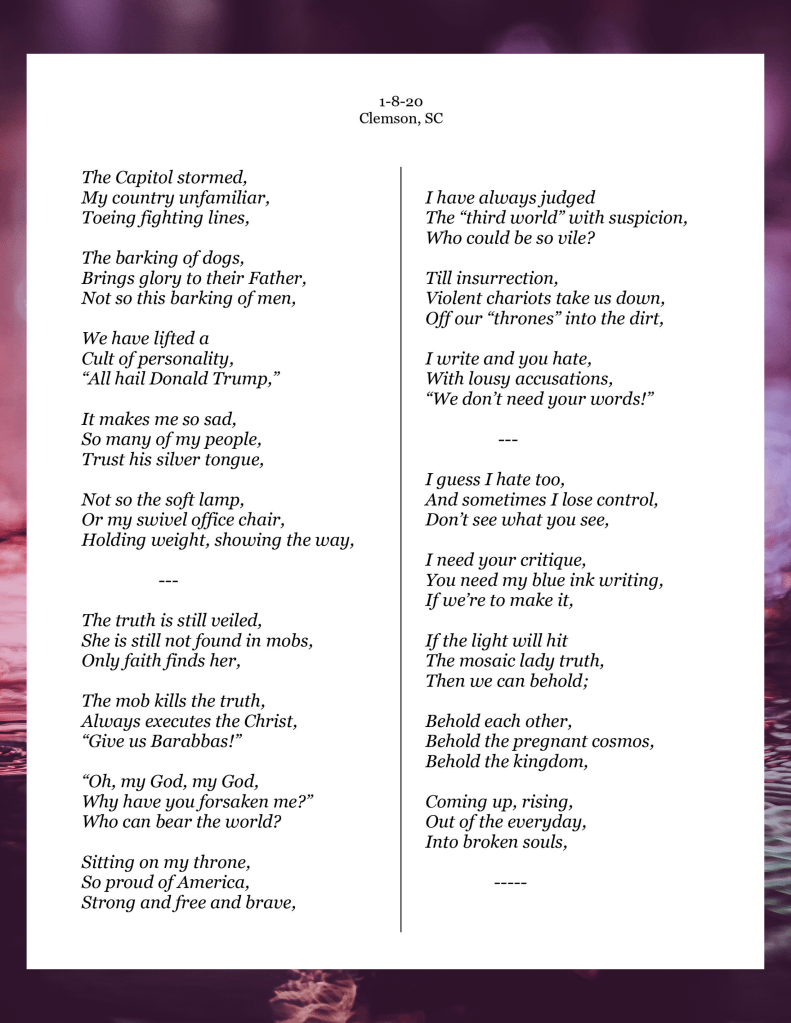
I’m kind of a hoarder, but really only when it comes to things I write (so it’s ok, right?). I’ve got journals from the last 10 years, all the notebooks, songs, poetry, and class notes I’ve ever penned. Or at least I thought I did. Tonight, I was preparing for a comprehensive Bible & Theology exam covering all the Bible classes I’ve ever taken, and I couldn’t find any notes on THE-393 (Old Testament Theology)! As a meticulous keeper of everything, this is pretty upsetting. In the midst of searching, I did come across an angsty poem I penned at the start of 2020. It made me laugh tonight – looking back on it and the year that was to come.
In the final stanza I declared the new year laughed first, but I would laugh last. I’m still not sure how all that panned out. Overall, it was a good year for me. But not without its ups and downs and a particularly rocky start on January 2.
My words to our current new year are much softer and more concise. What a strange trip around the sun we’ve had.
There are two phrases that keep coming back to me.
“It is what it is.” & “It’s not what it could be.”
The new year is a new slate, symbolically anyways. The spike and then steep dive in gym memberships around this time of year tells us flipping the page on the calendar doesn’t intrinsically change us. Or as some like to say, It is what it is. Yet thousands of people who found themselves too busy or lazy to exercise last fall have found the courage to step into the gym. And this tells us something we all want to believe, even if we’ve grown too jaded to really internalize, It’s not yet what it could be. There is a potential we have not yet realized – there are places we could go – “reality” could be better than it is.
A couple weeks ago, I reached out to three local pastors (and one who was quite far away) and asked them what they’re praying for their people in 2021. The past year was a emotionally taxing time to be alive, but our pastors experience that tension in a unique way. While we’re all disagreeing and bashing each other over the head in the comment sections, they’re trying to figure out how to tell us the gospel when we wander in on Sunday. While we soak in about 57 sermons worth of advertising, entertainment, and talking heads during the week, they’re trying to figure out what we need to hear from the Word. They had some good insights, and I’d like to share them with you.
Pastor 1.
“I’m praying that our people will choose this year to be more like Jesus. I know it sounds cliché, but I think we have missed that being a Christian means that we choose to walk like him. Being a Christian and being an apprentice of Jesus are not separate things. They are the same.”
Pastor 2.
“I am praying for an increase of what I am seeing in many sincere Jesus-followers. Many are experiencing a deep revealing of how futile it is to hope in this world. There is a hunger for prayer and the Word. I prayed for years that there would be a shake up in our church, and it has come in 2020. As hard as it is, I pray that God continues his work he is doing even if we continue to struggle through this.”
Pastor 3.
“My prayers center around the posture of our hearts towards people, how we view them, and how we view ourselves. I suppose that has been birthed as of late out of the many behind the scenes conversations centered around the good Samaritan passage and realizing we’re not so much the good Samaritan but the person in the ditch. We’re not so much the voice of reason to any argument (though I think the local church can be) or the “good person” coming to the rescue but the person in need of rescue. Which ultimately goes after the posture of our hearts, that we are just vessels of the rescuer. A Vessel with whom the Spirit dwells and works through. It’s through being a vessel of His Spirit that we invite people to come and see what Jesus has done for us and ultimately change culture toward His Kingdom.”
Pastor 4.
“I find myself praying more than I ever have in life, and I guess that’s because I find myself in a position of need. I pray Proverbs 30:7-9 for me personally and for the people in my care.
7 “Two things I ask of you, Lord; do not refuse me before I die: 8 Keep falsehood and lies far from me; give me neither poverty nor riches, but give me only my daily bread. 9 Otherwise, I may have too much and disown you and say, ‘Who is the Lord?’ Or I may become poor and steal, and so dishonor the name of my God.
I believe that both requests have great relevance for current engagement. Falsehood and lies being far from me is much bigger than mere truth-telling. [See Psalm 52 for further reference. It depicts someone who actually told factual truth but was designated by the writer as loving falsehood. Interesting.] The second request is a hard one because consumerism, personal comfort, and the right to it is more than a whim. It’s a belief system that has wrapped its hold on us tightly. Give me neither poverty nor wealth…I pray this for me and for the people I love, but I wonder how to engage that fully. I am trusting Him to provide that answer as I keep praying and walking.”
Our pastors are hoping for us: hoping we’ll be more like Jesus; that we’ll hunger for prayer and the Word; that our posture will be one shaped by the Spirit; and that we’ll be kept from lies, resting in a state of reliance on him who is faithful. I think we’d do well to listen to them and their prayers for our new year.
My favorite poet, Jon Foreman, says we exist in the tension between, “who we are and who we could be, how the world spins and how it should be.”
It is what it is – yes I suppose so.
It’s not what it could be – because anything could be.
I’ve decided to write haikus this year to help me process things (like Ricky Baker in Hunt for the Wilderpeople). A haiku is a form of poetry which originated in Japan. Haikus typically contain three lines of poetry; the first line holding 5 syllables, the second 7, and the third 5 again.
In my piece below, the first stanza holds 5 haikus, the second 7, and the third 5.
*A contributor who wishes to remain anonymous helped with this article. *There is a video version of this article at the bottom of the post.
Three lies we have believed as Evangelicals. God have mercy.
1. We Believed Actions Were More Important Than Communication and Character.
We believed you could untangle these three elements of life.
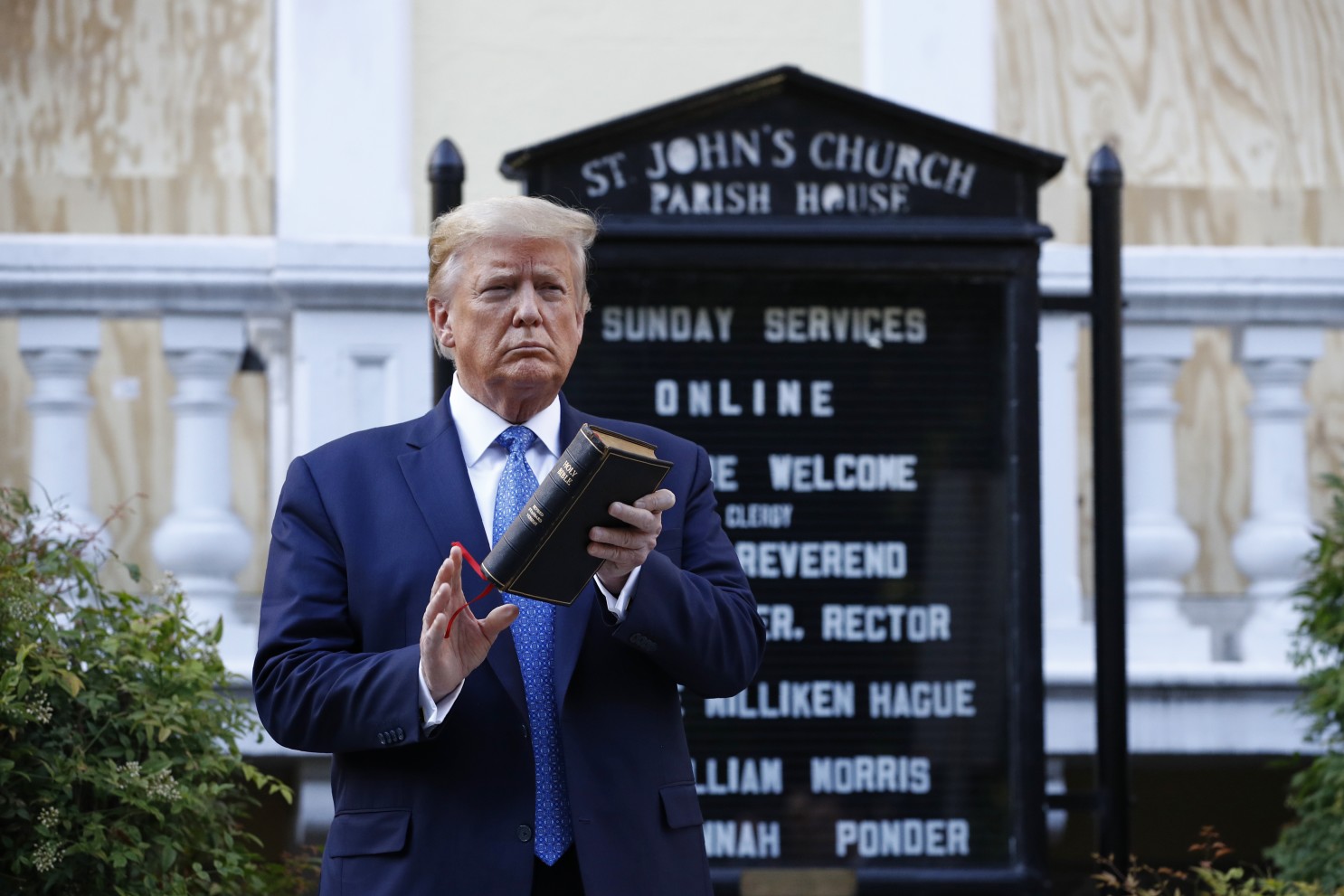
The gospel of Matthew records, “It is not what goes into the mouth that defiles a person, but what comes out of the mouth; this defiles a person.” What we produce both reveals who we are and produces who we are becoming. We believed Donald Trump could act justly out of a corrupt character and while communicating with vileness. We were wrong.
Similarly, we believed we could engage each another in hostile arguments online without damaging “real life.” And many of us have realized the “real world” and the “virtual world” of social media are not easily separated. There are folks in church we don’t like so much anymore, people we take a wide path around in the parking lot because that social media confrontation has us wary of face-to-face interaction. Social media emboldens us to say things we would not in person. We are disembodied and fooled into thinking communication in virtual space gives us license to berate one another. Communication, action, and character are knotted up together.
Throughout the last four years, we have told ourselves time and time again that actions were more important than character and communication. Evangelicals accepted Donald Trump on the grounds that he would do our bidding, even if he did it in a vulgar manner, even if his past was tainted with vileness, even if he openly said vile things. We hung our hats on the argument that character and communication can be separated from action. As long as President Trump appoints conservative judges, stands up to China, and doesn’t raise our taxes, we don’t really care what he says or how he does it.
Every act is communication, to be is to communicate. As I sit in this coffee shop typing silently, I am communicating to those around me. My values, my tastes, my choice of clothing, my flavor of latte – we communicate through our presence in the world. In this way my communication is at once revealing who I am and creating who I will become. It is utterly foolish to believe communication can be untethered from identity. Joshua Gibbs said, “Every act of imitation is an act of becoming.” Yet somehow as the white evangelical church we were fooled into believing Trump’s positive actions could somehow outweigh his questionable character and reckless communication. It is not a matter of one “outweighing” any other – these elements of being are not separable. We act out what we are moving towards. You cannot act justly and communicate unjustly, nor act justly and maintain vile character.
The past week of mayhem serves as a culmination of the last few years and a final revelation of the absurdity of this notion. Donald Trump’s communication, character, and action cannot be untangled or essentialized. Who we are is fundamentally composed and expressed in each of these elements. A virtuous leader must display the integration of wisdom in communication, character, and action. Going one for three will get you into the baseball hall of fame – it makes for a really lousy leader.
2. We Believed Donald Trump Was a Christ Figure.
The church is a bride, and the white evangelical church wed itself to a man who was not Christ.
The language and symbolism of Trumpism casts Donald Trump as a Christ figure. He is said to have “come down the escalator to drain the swamp.” From his high position, Trump is said to have descended to lead the people. He enters into a realm said to be corrupted and dirty (a swamp) to do the work of making the land “great again.” This is clear language of a Christ figure. Jesus himself descended from heaven into a dark land to inaugurate a new kingdom.
In the Christian account, the hero is abandoned by all those closest to him in his final hours. This is significant because Christ is not simply on the side of truth, he is the truth incarnated. As Christ prays in the garden, his disciples fall asleep. At the last supper, the traitor leaves to do his work. After his arrest, Christ is denied by Peter, abandoned by his followers, and convicted by the court system. He goes to the cross alone.
We have been telling this story and replacing Christ with Trump, sometimes without realizing it, and sometimes intentionally. We have become so convinced of his righteousness that his words alone are truth. He has become the symbol of truth. He has been rejected by those near him, by the religious leaders, and by the court system. Yet many Evangelicals remain confident in his words. Trump has even coined a term for anyone who would deny him, “RINOs” Republicans in Name Only. Christ said “Whoever disowns me before others, I will disown before my Father in heaven. (Matthew 10:33)” Trump has said to be Republican is to stand with him to the bitter end. He has positioned himself as a Christ figure, and we have largely accepted him. Anyone who denies the “Christ” is anti-Christian.
In the days after the insurrection in which Trump supporters stormed the Capitol, scores of folks once loyal to Donald Trump have jumped ship. As of the writing of this article, more than nine members of the Trump administration have resigned from their posts including: Elaine Chao (transportation secretary). Betsy DeVos (education secretary). Mick Mulvaney (former chief of staff, current special envoy to northern Ireland). Mulvaney said, “You can’t look at that yesterday and say I want to be a part of that in any way shape or form.” Stephanie Grisham (First lady’s chief of staff). Sarah Matthews (deputy press secretary). Matt Pottinger (deputy national security advisor). Rickie Niceta (White house social secretary). Ryan Tully (National Security Council’s senior director for European and Russian affairs). Tyler Goodspeed (Chairmen of the white house council of economic advisors). Republican Senator Ben Sasse said, “Lies have consequences. This violence was the inevitable and ugly outcome of the President’s addiction to constantly stoking division.” Trump is being abandoned by those once loyal to him who realize how insanely he’s behaving, how dangerous his claims are, and how he’s “disregarded his oath of office.” These include Lindsey Graham and his own Vice President – and this is certainly for good reason.
The Court System
For months Donald Trump and lawyers have claimed the election was decided unfairly. They brought allegations in more than 50 lawsuits. However, as Russell Moore writes,
“It is not true – and it never was true – that this election was stolen. That’s why such a charge was never even made in any court of law, where perjury penalties would hold but only in social media streams and demagogic rallies.”
On every occasion (save possibly two) they either lost, had their case thrown out for lack of evidence, or withdrew. “At least 86 judges from across the political spectrum, including some appointed by Trump, have rejected at least one post-election lawsuit filed by Trump or supporters” writes the Washington Post. Donald Trump has lost time and time again even in courts where he appointed the judges. The Supreme Court, three members of which Trump appointed, has refused to hear his case for lack of evidence. In a personal call on which Trump groveled hoping to “find” more votes, Georgia’s Republican Secretary of State refused to be bullied and told him flatly he was wrong. Georgia had already undertaken multiple recounts.
The MAGA Faithful
Yet when we view Donald Trump as a Christ figure, it doesn’t matter how many staff resign, how many courts throw him out, how many leaders speak up to denounce him. Because he is not merely telling the truth; like Christ, he is the truth. Those at the Capitol were not there on behalf of the Republican party or conservatives. No. They were there on behalf of one man only; they flew his flag and marched in his name. They were whipped into a frenzy by his words. They went so shamefully far as to erect a gallows on which to execute the Vice President because he did not side with their Christ.
David French writes, “There was a giant wooden cross outside the Capitol. “Jesus saves” signs and other Christian signs were sprinkled through the crowd. I watched a man carry a Christian flag into an evacuated legislative chamber.” We Evangelicals were present there, like Peter in the garden, whipping out swords for our Christ. To our great shame, we have believed Donald Trump was our Christ figure, and some of us are adamant we will never deny him. No matter the cost: we would drive to D.C. – we would plunder the Capitol – we would die for Donald Trump, our Christ. God forgive us.
3. We Believed the End Was Nigh.
“If you argue that the very existence of the country is at stake, don’t be surprised if people start to act as if the very existence of the country is at stake.” – David French
Every four years Evangelicals are told the current election is all that stands between order and chaos, the 1st world and 3rd world, capitalism and socialism. Once again, for the umpteenth time, we bought the lie that if the Republican candidate didn’t defeat the more liberal challenger, the USA would delve into a socialist state. We think gas prices will soar, they’ll take our guns, our churches will be stormed, and we’ll be pumped full of vaccines. Yet somehow, each and every time, life just sort of goes on. And it will again this time. In four years from now, we’ll hear these same tired warnings, and they’ll be false again. Perhaps even more absurd than the claim that handing power to the opposing party will inaugurate the end times is the remedies we’ve concocted.
Folks on the ground at the Capitol riot say there was Christian music blasting and “Jesus Saves” flags flying. If all the Evangelicals storming the Capitol had been Muslims playing chants over speakers, we’d all be crying “terrorist attack!” MAGA supporters (Evangelical Christians among them) quite literally stormed the castle in a crazed last grab at power. And no, we cannot pin these acts on Anitfa. As helpful as that may be, it’s pretty clear that’s not what happened. When we raise the stakes of which party will lead us for the next four years to the level of apocalyptic existential crisis, we get an insurrection. We get confederate flags marched into our country’s most sacred building. We get those elected to represent the people of the 50 states ushered into bunkers while crazed rioters break through the doors. We get police trampled, beaten with American flags, and killed.
“The crowd showed him no mercy…immediately trampling him, bludgeoning him with objects and projectiles, dragging him down the steps they were storming — pretty much having their way with his limp body as his colleagues tried pulling him away.” (TMZ)
We need to stop reading the end-times prophecy manuals. We need to stop believing the bitter end is nigh every election cycle. It is not only faithless, it’s stupid and wrong and damaging.
We have believed these three lies. That communication was less important than character and action; that Donald Trump was our Christ figure; and that the end was nigh. My fellow Evangelicals, my neighbors, my friends, let us be people of Christ. Let us put this foolishness of Trumpism behind us. With every word and every act we are transformed into who we are becoming; let us speak and act in love that we might become love. May Jesus, through whom all things were made, be our only Christ. May we do the work of believing and put to rest these recurring fears of apocalypse.
“There have been many voices combating the lies of Donald Trump since he descended his golden escalator five years ago, but most have been easily dismissed by his supporters because the truth was coming from those outside the GOP/Conservative/MAGA community. If the country is to emerge from this dark season, it won’t happen simply because Mr. Trump leaves the White House. It will happen because virtuous leaders find the courage to tell the truth to their own followers.” – Skye Jethani
May these three lies, and the Trumpism which brought them, be left behind.
I have a tendency to update my goals as I go, which is good, but it makes it harder to realize how good the present really is. I remember wishing so badly for a “real” guitar to replace the rather chinsy, never-staying-in-tune, stringed piece of plywood I owned. And then I got one! But after a while you start noticing it also has a crooked neck, and the high “e” string tends to break when you tune it. And every time you get a new guitar, you just dream a new dream. It’s easy to never stop to relish the fact that a dream did come true.
I remember being 19 and visiting college campuses, trying to find the right school. This guy walked passed me carrying a leather shoulder bag, and he really seemed to have it together. I wondered what it would feel like to kind of know what was going on, to feel like I’d established myself at college, to have a great leather bag like that. And then it started to happen – I got enrolled, signed up for classes, and even carried a leather bag of my own. But it felt like I hadn’t quite gotten there yet. I wasn’t in the really interesting classes that would come later in my degree. I didn’t know that many people.
And then I got to those really interesting classes and people got to know who I was, and I wondered when I would get to apply the theories and systems of thought to “real” work, to writing that “really mattered.” This is good, but that will be better. I started a podcast with a friend, and we made tons of episodes and enjoyed ourselves greatly. But I always wondered what it’d be like to have a show where lots of people listened, one you even got paid to do. And I had some of my writing published. Yet, every time something good happens, there is a voice in me which soon suggests something else would be much better. I had a small epiphany driving home one day. All these things – this is it. It’s all happening.
This summer, I got married to my best friend. And we get to be together every single day. We have an apartment with all our stuff in it, and a wall painted golden yellow. I get to study communication and theology. I get to write whatever I want, and some of my work was just published by the Rebelution. I have a paid gig to shoot two promo videos for a nonprofit. I’m about to enter my last semester before graduating with a bachelor’s degree. In so many ways, I am now that guy I saw walking passed me when I was 19. It’s easy to miss that. The tendency is to update the dream before it can come true – to be persuaded by the voice who claims well that wasn’t really what we wanted; it could be much better. It’s better to recognize in all those small moments along the way that the dream was indeed becoming true. Billy Collins describes this recognition as the lion of contentment.
“But tonight, the lion on contentment
has placed a warm, heavy paw on my chest,
and I can only close my eyes and listen
to the drums of woe throbbing in the distance”
Billy Collins (“Osso Buco”)
Run Dry
To update out dreams, to cast what we want in new light, is a gift.
The Killers wrote a song, and in the second verse Brandon Flowers shouts, “We’re all gonna die!” Each time we selfishly refuse to see the good which has invaded our lives, we exercise the gift of the future – we’re banking on living longer. And not everyone has longer.
In my sophomore year, I was at Tri-County Technical College, still planning on an English degree. I remember taking a literature class with Melissa Blank, whom I always called “Ms.,” but it turns out she was married. She was a middle-aged woman, dark hair, kind of lively and always tired at once. After I passed her class and transferred to another school, I found out she had been diagnosed with brain cancer. Yesterday, I read her post, “5 rounds of chemo did not work, 30 treatments of radiation did not work, 3 brain surgeries did not work…Right now they feel the best option is in home hospice which I began on Monday.” Mrs. Blank is not very old, younger than my parents.
I remember taking the rough drafts of my essays to her office to ask for help. Once, she read over a draft and told me my writing was very good – another time she looked up from the stapled together pages and said, “This is hot trash.” I still laugh thinking about that. I never really expected to see her again after walking out ENG-102 for the last time, but I expected her to be out there, somewhere, doing whatever English teachers do when they’re not lecturing or browsing rough drafts. But she has brain cancer and hospice.
I also remember Mrs. Blank telling me to make a claim. I was prone in my writing to qualify statements: “I think the author may have been trying to say.” She taught me to not do that. Make a claim and stand by it. Say something. She even let me write about how much I hated The Handmaid’s Tale, the book she assigned us to read and write about. So Melissa, if you’re out there, perhaps it’s some small comfort to know that after you’re gone, from cancer or old age, I’ll carry that wisdom. I’ll be making claims. If it is, carry it out of here into whatever is next. And if it isn’t comfort of any match for news of dreams running dry – well, I’ll remember you nonetheless.
Either way, today I choose to recognize that my dreams are coming true. In small, significant ways. And I’ll update them and make my claims about the world keeping in mind we’re not here for all that long. You can’t reimagine what you want from life forever. “You get what anyone gets, you get a lifetime” – Neil Gaiman.
And we’ve got hope for the life to come. After all this has passed on.
a new heaven and a new earth, for the first heaven and the first earth had passed away, They will be his people, and God himself will be with them and be their God. He will wipe every tear from their eyes. There will be no more death or mourning or crying or pain, for the old order of things has passed away.
We’re all gonna die, And when they’re closin’ up the door Nobody wishin’ that they worked more (ha) Don’t bother with your suitcase And we’ll beat the birds Down to Acapulco Bay Or Honolulu on hearsay Running at our own pace,
And I’ll be on your side When the dreams run dry
– The Killers
You can contribute to Mrs. Blank’s GoFundMe with this link.
This piece was written for a class in which we were to examine a cultural phenomenon and identify possible narratives and identities being created.
A New Kind of Revival: Red Stripes in the Let Us Worship Movement
COM 363: Media and Society
October 31, 2020
Toccoa Falls College
ABSTRACT
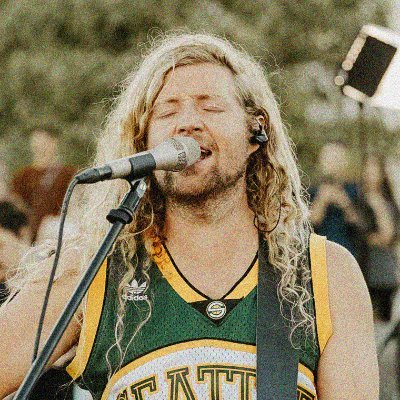
In the late 1960s the Jesus Movement swept across America and refigured the evangelical landscape. Larry Norman, called the Elvis Presley of Christian rock, wrote the soundtrack to a revival movement focused on personal, spiritual transformation and saving souls for eternity (Thornbury, 2018). Fifty years later, Sean Feucht emerged as a new long-haired, guitar wielding harbinger of revival. His Let Us Worship movement has organized events in cities across the United States, building momentum to its final gathering in Washington DC days before the presidential election. These two movements make use of many of the same symbols (male leader, worship music, baptism, etc.), but the narratives constructed in the call for revival are quite different. This paper will analytically juxtapose the two, noting key identities being constructed by Sean Feucht and the Let Us Worship movement. Using the circuit of culture as an investigative methodology, this paper seeks to understand the meaning of the revival called for in the Let Us Worship movement.
Let Us Worship: Production of a Narrative
In 2020, Sean Feucht launched a national movement organizing events in major cities across the United States in the days leading up to the 2020 presidential election. Feucht is a 37-year-old artist, politician, and author based in Redding, California. Let Us Worship comes after his successful stint as recording artist and worship leader with Bethel in California, and it’s just one of many movements begun by Feucht. Another of Feucht’s recently launched movements is called “Hold the Line.” This movement states its purpose as such, “Hold the Line is a political activist movement. Our goal is to engage with the church and with millennials in a way that charges them to become more politically active” (Feucht, 2020).
Feucht made a run for political office in the house of representatives as a republican candidate in the spring of 2020. In an interview he stated, “I believe the God-given mandate on the nation of America is still alive” (Tabatt, 2020). He was defeated in March in the primaries in California’s 3rd district after receiving 13.5% of the popular vote (BallotPedia, 2020). In the summer of 2020, Feucht launched the Let Us Worship movement. Implicit in the name is a victimized position – Christians are being oppressed. It’s a call for Christians to be able to continue meeting together in churches during the Coronavirus Pandemic despite opposition presented by governing authorities.
Feucht has been outspoken that believers must not be banned from attending services or singing, and began a petition against the “hypocrisy,” claiming governing officials had acted unjustly. Feucht’s video in July, 2020 titled “Let Us Worship,” encouraged supporters to be “obnoxiously patriotic” and rallied them to continue the fight against “big tech censorship.” He stated, “For the last several weeks, tens of thousands of people have been gathering outdoors in cities all across California, and they have been screaming and chanting and protesting. And all the while the state officials are encouraging them as they do this. And then now as the church wants to gather…they bring the hammer down against us…Can you see the hypocrisy?”(Feucht, 2020).
In a video aired by TBN and posted on Feucht’s YouTube account, Feucht says, “It’s the height of hypocrisy right now that they’re letting these cities succumb to rioting and burning and pillaging, and yet they’re targeting Christians. We have to rise up. We need bold and courageous pastors that are not only going to stand on our constitutional rights to worship, but that are going to stand up against the insanity of these laws that are targeting the church” (Feucht, 2020). Feucht has faced criticism from local pastors in the cities where he does events. After Let Us Worship made its Nashville stop, pastor Russ Ramsey and worship leader Carlos Whittaker expressed their frustration. Whittaker tweeted at Feucht, “Nobody is silencing the church is Nashville. Our church met today and had thousands show up for baptism in a nice socially distanced/masked way…I think it’s irresponsible to claim being silenced. Cause that’s not the cause (sic) in Nashville.” (Whittaker, 2020). Feucht received more volatile pushback after holding an event at the memorial for George Floyd and tweeting, “I HAVE NO WORDS FOR WHAT GOD IS DOING TONIGHT IN MINNEAPOLIS [19 crying-face emojis]” (Feucht, 2020) According to a news article by Melissa Turtinen, Feucht was playing fifty feet from the memorial which many claim he was “co-opting” (Turtinen, 2020).
The Mythic Narrative: What is the “Revival?”
At each worship event, Feucht and those he brings on stage call for revival. At an event held in Sacramento in September, pastor Jodie Kim stood on the stage beside Feucht, California’s capitol building looming over the stage behind them. Kim directed the crowd to raise their arms to the north, south, west, and then east over the capitol and give a “mighty roar by the name of Jesus.” Kim prophesied, “The Lion of the Tribe of Judah is about to reclaim this state as his inheritance.” The final “roar” was over the capital building. “And now over the capitol, over our legislators, over the offices right now in Jesus’ name, we declare a holy shift…that there’s a great reversal taking place, what the enemy meant for evil God meant for good” (Feucht, 2020).
The revival spoken of at Let Us Worship events has obvious political implications. In an interview, Feucht said, “The inability for the church to engage has led to the overrun of our cities by these horrendous, godless leaders that are releasing laws and really going against the constitution even of America, and our children are growing up under it.” (Feucht, 2020). The revival which Feucht and those at the events are crying out for seems to envision Christ as a savior who empowers the church to rise up and overtake its opposition in society. Therefore, the identity of the Christ follower being articulated is the Christian who is empowered to enter society and politics and realize the changes the Let Us Worship movement envisions. These changes seem to largely align with Republican party values, which Feucht associates himself with and ran for office under. At the concert in Sacramento, a man called “Pastor Andrew from Fresno” said, “God I thank you that that bill that’s sitting in on that table, you’re so serious about your children, that you came down to earth in a bodily form, to stomp on the devil. So, Devil we prophecy right now – you lost with Pharaoh, you lost with Herod, and you’re going to lose on (sic) November. And Lord we just declare, let your bride rise in the name of Jesus” (Feucht, 2020).
This rising, seen as a “third great awakening” is outward focused and entails very political consequences as it envisions the church regaining the power it once enjoyed (Feucht, 2020). Time and again Feucht, others on stage, and those in attendance prophecy and cry out for revival. At first glance, the implications are vague – proclaiming “Jesus” in all directions doesn’t reveal the ethos of the movement. However, when we examine the will of the “Jesus” articulated by Feucht, it becomes clear the savior is affiliated strongly with a political party. The movement’s identity, negotiated through its values, seems in harmony with Feucht’s own strong Republican affiliation.
Taking the Church to Town
2020 saw a large number of protests take place in the streets of cities across the U.S. Even while a highly contagious virus infects citizens across the country, protesters and demonstrators calling for change and social justice continue to march and gather in public. The Let Us Worship events have been referred to as “worship protests.” Like protests, these events are organic – there is no admission fee, and participants are free to come and go as they please. While Feucht’s events do resemble outdoor concerts, the lines between performer and audience are less clear. Those who come out are encouraged to get baptized, sing, pray, and voice their political concerns. In this way, the participant is given agency. This is critical to the success of the movement which seeks to see heightened involvement of Christians in the political sphere, which will lead to Christian values being made into public law. It is no accident that Feucht’s events are held in public squares and on the steps of capitol buildings rather than church lawns or auditoriums. He is taking the church to town, imposing the sacred upon the secular in an attempt to bring revival. This speaks to the regulation present. The proper use of the movement’s values is the imposition of Christianity upon political power structures.
The Jesus Movement
Fifty years before Feucht took to stages and streets throughout the country, there was another music-based revival movement sweeping across America. This movement had a long haired, guitar wielding frontman of its own. In an article titled, The Elvis Presley of Christian Rock, How Larry Norman Wrote the Soundtrack to the Jesus Movement, Gregory Alan Thornbury writes, “The Jesus Movement soon became a national phenomenon, and Norman was its poet laureate. Instead of violent protests, massive “Marches for Jesus” were held. Standing on the state capitol steps in Sacramento with his guitar strapped to his back, Norman addressed the thousands assembled before him: “Peace is not the absence of war; it’s the presence of happiness. You radicals want an all-out revolution? You’ve got it!” (Thornbury, 2018, p. 50)
The “revival” proclaimed by Larry Norman and the leaders of the Jesus Movement had very personal implications and focused on the promise of eternal life. In an article for the Trinity Journal, James Patterson writes, “The Jesus of the Jesus Revolution was…one who with power and authority rescues from bondage, drug addiction, meaningless sexual quests, acute personal dilemmas, anomie. He promises and delivers new life, meaning, purpose, joy, and ultimately eternal life in heaven” (Patterson, 2005, p. 273). Patterson claims most of the “Jesus Freaks” did not share the prominent evangelical passion for social action. “They emphasize individual conversion to the almost total neglect of the social dimension of the gospel…the revolutionary Liberator…was viewed as the soon-returning Lord.” (Paterson, 2005, p. 274). The narrative of the Jesus Movement was centered on the Lord’s return, and it focused on the liberation of souls before judgement – largely out of a pretribulation eschatology.
Both movements are centered on calls for the presence of Jesus, but the Jesus Movement envisioned this presence as the return of Christ which would save the remnant out of this world. The Let Us Worship movement sees the presence of Christ as a coronation in America, penetrating the darkness and all its political outgrowths. The Jesus Movement folks feared no one had time to go to college, for the return and judgement were nigh. The Let Us Worship movement’s own leader recently came off an unsuccessful run at political office in California. Sean Feucht articulates the saving presence of Jesus as having very tangible, positive effects for American Christians who are under siege in a dark culture. The power of the Jesus movement was envisioned as Christ recusing his bride out of the world as well as empowering them to overcome personal vices (drug abuse, meaningless sex, etc.).
Shared Iconography of the Movements
Much of the symbolic inventory is shared between these two movements. Larry Norman and Sean Feucht are both recognizable musicians, both use an acoustic guitar on stage, and have long blonde hair. Baptism is a hallmark feature of both movements. Both movements also focus on speaking to young people through popular media. In the 1960s, the Jesus Movement launched coffee shops, newspapers, and campus organizations. (Reid, 1995). In 2020, the Let Us Worship movement capitalizes on digital communication technology – short films are produced after events, and social media platforms like Facebook, Twitter, and Instagram are used to promote events and as a way for supporters to voice their approval.
Identities Constructed Through Visions of Christ
Larry Norman’s song “Outlaw” states five different ways Christ is envisioned: outlaw, sorcerer, poet, politician, and the son of God. He rejects the vision of Jesus as anything other than the son of God. In his song, “Why Don’t You Look Into Jesus,” Norman suggests the answer to personal ills is Jesus. He implores those who sip whiskey from paper cups, have fingers yellowed from cigarettes, have gonorrhea on Valentine’s Day, or shoot needles into their purple veins, saying “Why don’t you look into Jesus?” (Norman, 1974). For Norman and many in the Jesus Movement, Christ is identified as the savior who rescues persons from bondage and eventually saves all his people up out of the world. For Feucht and the Let Us Worship movement, Christ is identified as the answer to society’s political ills and the one who eventually gives Christians political power in America.
Fifty years after the Jesus Movement we find a second poet with long blonde hair standing under the California state capitol while violent protests go on throughout the country. This time though, the revival envisioned is not personal salvation which will set one right with God for eternity and grant freedom from the bondage of drugs and sex. This time Jesus is being called on to win power in the legislator; an image of Jesus as politician Norman rejected. The image of revival being produced by the Let Us Worship movement fits well within a conservative Republican schema. As such, it’s hard to see how this doesn’t make the hero of revival, Christ, a Republican too.
Conclusions
According to an article by NPR Music, Mike Pence gave his life to Christ at the 1978 Ichthus Music Festival in Wilmore, Kentucky where none other than Larry Norman was the headliner (Mccammon et. al, 2018). In 2020, Mike Pence is the Vice President of the United States, and there’s another man taking America’s stages and calling for revival. This time though the preacher isn’t calling Mike Pence to repent – he’s advocating on his behalf. The revival this worship leader calls for has attendees focused on legislators, court houses, and the Oval Office. Sean Feucht is calling on Jesus and proclaiming revival. Upon examination, it seems clear to me this revival is outward focused and concerned with gaining ground for conservatives in a culture war. The symbols employed and images constructed make sense from a conservative, Republican flavor of Christianity. This movement makes a red cocktail of the kingdom of heaven and right-wing values. There is a red stripe running through the center of the Let Us Worship movement.
The Jesus Larry Norman sang about was accessible through any perspective in which there was personal bondage. The Jesus Sean Feucht sings about only makes sense from a conservative, Republican standpoint. In this way, Feucht joins the throngs of those who wanted to make Jesus king in Rome, to subvert pagan rule by imposing Christian law. Feucht is a voice advocating Christian nationalism. The Let Us Worship movement pollutes the authentic power of the true gospel of Christ by encouraging believers to cast their lot with a political party in lieu of the kingdom of the heavens.
Norman, Larry. (1972) Why Don’t You Look Into Jesus. On Only Visiting This Planet. London: Verve.
Patterson, James A (2005). Revolution and the eschaton: images of Jesus in the Jesus movement. Trinity Journal. 26(2), 267-277.
Reid, Alvin L. (1995, January). The Effect of the Jesus Movement on Evangelism in the Southern Baptist Convention. Baptist History and Heritage. 30(1), 41-52.
Thornbury, Gregory A. (2018, March). The Elvis Presley of Christian Rock: How Larry Norman wrote the soundtrack to the Jesus Movement and launched a billion-dollar music Industry. Christianity Today. 62(2), 48-51.
Whittaker, C. [loswhit]. (2020, October 11). Hey buddy. Nobody is silencing the church in Nashville. Our church met today and had thousands show up for baptism in a nice socially distanced/masked way…Cause we are in a pandemic. I think it’s irresponsible to claim being silenced. Cause that’s not the cause in Nashville (black heart) [Tweet]. Retrieved from https://twitter.com/loswhit/status/1315500378801266691.










































 javen.bear.