“My Dear People” a project.

I’m ankle deep into a project that I’m really excited about.  I think it came from listening to Andrew Osenga’s podcast, “The Pivot”.

Here’s the skinny:

I’m going to sit down behind a microphone with six of my friends (and then myself), ranging in age from about 20 to 70, and have a conversation. It will be a discussion more than an interrogation, but it is an interview of sorts. These audios will be released daily for a week sometime in May (probably).

I’ll be asking them questions dealing with the season of life they’re in, the strengths and weaknesses of their personality, what scares them about their future, how disappointment has shaped their life, their favorite thing about America, their favorite thing about Jesus…and maybe more…or less…or other.

*If you have question ideas…I’m listening*

The idea is to converse with friends about things that we often talk around…and to have a good time.

And the cool part:

With each of the seven episodes, we’ll be giving away a book and an album of music which have been important to me and that you should have too. So you got like 14 chances to win.


If you’d like to make sure you don’t miss out, comment or message me your email address, and I’ll make sure they get to your inbox.

javen32@live.com

Cheers,

Javen.

*If you would like to sponsor some of the giveaway material, I would be open to that…*

Unnecessary.

This morning I left my Music Appreciation class 10 minutes early so I could be on time for a short meeting with my English teacher across campus. Dear Ms. Skaar gave me an absence for those ten minutes I wasn’t present. Bless her. 5 minutes later I flopped my 10 page rough draft down on the professor’s desk and asked for help. The assignment stated:

You will complete a cultural analysis of the source text. You must make some claim about the accuracy of the depiction of the culture in your source text, and support that claim with ample evidence from the source text as well as research from 6-8 appropriate academic sources.

Your multicultural essay must have a thesis statement that makes a comparison between the culture in the novel of your choice and the contemporary culture in the country in which the novel takes place, and you must analyze and support that claim with well-chosen evidence from 6-8 peer-reviewed academic sources. Essay must be 2300-2800 words.

I told her, “This is about the hardest thing I’ve ever had to write – I wrote all I wanted to say, and I still came up three hundred words short…I can’t find enough here to write about.”

*She tells me to close her office door and lowers her voice a bit*

“This essay is a complete pain in the butt. It’s necessary coursework, and I have to assign it. But it’s dumb, and it just shows whether or not you’re able to properly integrate sources. I put it at the beginning, that way we can do the fun stuff later.”

Not exactly comforting – but at least sympathetic. I can hardly think of anything more boring than writing pages and pages about whether or not Khaled Hosseini accurately depicted the culture of Afghanistan from 1960 – 2000 according to peer reviewed sources. Of course it’s accurate: the man grew up there, and the book is on the reading list. Even still, “It’s necessary”.

Later, as I was editing my rough draft during a free period, it occurred to me that maybe this is how most people feel about writing in general. If that’s the case, I can see why they hate it so much. This is no fun – it’s tedious, humorless, and totally required. I really don’t care about the things I’m writing. At all.

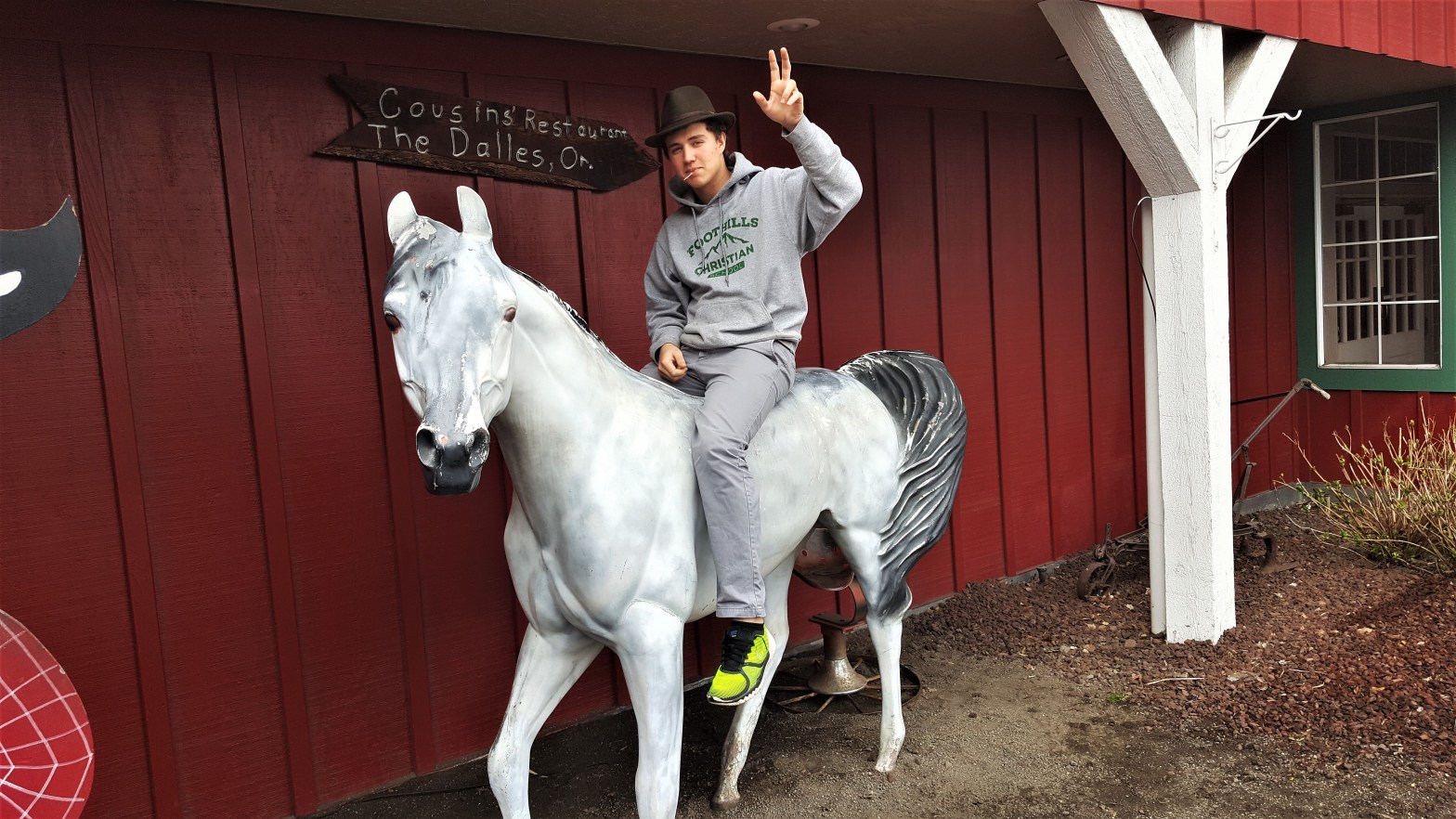
Sometimes I much prefer that which is unnecessary. So I bought a hat.

For the last several weeks I’ve been burning discs, cutting out inserts, and mailing off envelopes to anyone who had five bucks and wanted a CD. It’s been really fun. I’m so enthralled with the idea that I sat on my bed with a guitar for hours and hours and filled up notebooks with lyrics, and now I have a little something to show for it.

The song “Don’t Give Up on Me” is an example in particular. I remember sitting downstairs with my guitar one night after cell group and writing that song. No one told me to exactly, and no one was going to meet me in office hours to talk about it or give me a letter grade on the finished product. It was completely unnecessary, and yet I got the joy of giving it to the ones it was written for and then $52 when my friends decided to put it on their album.

Jon Foreman often describes music as totally unnecessary. He’ll play a sweaty rock and roll show and then after it’s done, take a guitar out behind the venue and sing songs with anyone who wants to sing along. There’s no money changing hands, no lights or confetti (or bubbles), and no incentive other than singing songs with other people. Songs for the sake of singing.

So after distributing my songs to those who wanted to hear them, and probably some who just felt bad for me, I wound up with something like $120 worth of profit. Pretty great. Profit is kind of a foggy word when you consider that I easily spent that much money on guitar stings alone to write those songs…but that’s not important.

So I gathered a goodly portion of my bounty and bought this lovely hat. When it came, my dad asked,

“When are you ever going to wear that?”

“That’s the thing” I quipped, “it’s versatile. Fishing on the river or banquet parties. It’s appropriate for all kinds of occasions.”

I guess that’s true. But more than anything it’s a symbol, a $60 piece of felt that says, “I stayed up into the lonely hours of the night scribbling stuff into a notebook, and now, by George, I have a this hat to show for it.”

So then, my friends, thank you for listening to my songs, reading my stuff, and putting a hat upon my head. It wasn’t necessary of you. But I do appreciate it.

2
1

Cheers.

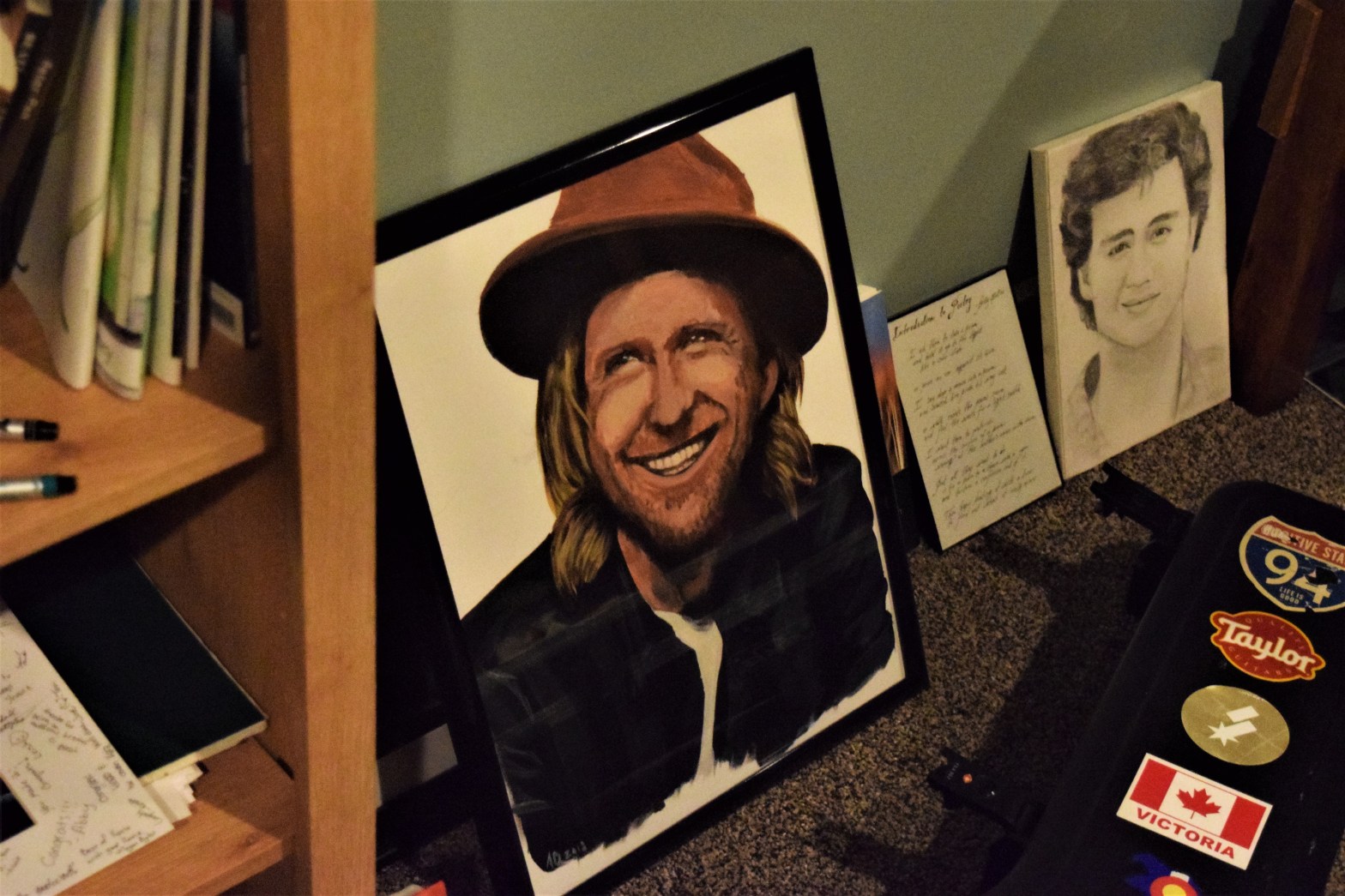
*the cover photo of this post is a wonderful painting of one of my heroes, Jon Foreman, which Ashley Dienner did for me.

*photos taken by my brother, Luke.

Today I Met a Professional

Two days ago I got a $50 parking ticket at school for backing into a space instead of pulling in. When you only work two days a week at a job that doesn’t pay very much, $50 is enough to make you write angry emails and vent to your mother.

Today as I was packing up my stuff to leave English class, I heard my name called and looked up to see a very large man in full security uniform waiting for me in the doorway. Ah yes, I know what this is about. It was none other than the chief of campus security, the man to whom I sent the email. He had looked up my schedule, figured out when I would be going to lunch, and sought me out in Oconee Hall. We walked to the cafeteria together, and he explained why I got the ticket…and heard my side of it. And as we stood in the cafe entrance, he told me that maybe I should indeed have gotten a warning and that he was going to waive the fine. (He also produced a piece of paper I had been given with my parking decal once upon a time which did say you shouldn’t back into spaces.) And he asked if I’d wanna serve on the committee that hears and decides the campus parking ticket appeals.

So here’s to you Chief Aman – the most professional and neighborly a man can be.

I’m not sure if this is legal…but this is the conversation between us.


From: Bear, Javen M.
Sent: Friday, January 19, 2018 4:32 PM
To: Aman, Edward J.
Subject: “Backing In”

 Dear Sir,

I’m a student at Tri-County in my second semester. Today, Friday the 19th, I was cited for having “backed in” to a parking spot as Officer Cullen put it. I have filed an appeal, which I doubt will do much good. I just wanted you, as the Director of Campus Police, to know how ridiculous I think it is that a student could get fined $50 for backing into a parking space. I would actually argue that backing in is a safer and more responsible way to park since, with more vision, you have a decreased chance of hitting someone upon exit. Parking theory aside, it’s unjust to cite students for violations they had no way of knowing about. The website’s Parking Rules and Regulations say nothing of this…I don’t think I’ve ever seen anything that would indicate I shouldn’t back into a spot. No signs – nothing.

I work at a coffee shop where I earn a wage of $8 an hour, and that’s how I pay my gas. Citing someone for 6 hours worth of wages (2 tanks of gas) is, in my estimation, an irresponsible a way of letting them know you’re going to be policing which end of their car faces the curb.

A warning with this information would have been appreciated.

Thanks for your time and consideration,

Respectfully,

Javen Bear.


From: Aman, Edward J.
Sent: Monday, January 22, 2018 12:28 PM
To: Bear, Javen M.
Subject: RE: “Backing In”

Javen,

 I will be glad to discuss this with you on an individual basis if you would like. I am located at Pickens 138, and my cell # is 318 3505.  I will try to catch you this afternoon as you are leaving class, if not perhaps you could come by during a break. I would also extend you an invitation to represent your fellow students with regards to parking issues by serving on our Ticket Appeal Committee. This group meets once a month and reviews all of the appeals from the prior period. The committee is made up of faculty, staff, students, and Campus Police to provide the most equitable outcome possible. Please take the time to reflect on this request, and you can let me know when we talk.

 Respectfully,

Chief Aman


From: Bear, Javen M.
Sent: Friday, January 22, 2018 11:54 PM
To: Aman, Edward J.
Subject: “Backing In”

Chief Aman,

I want to say thank you again for seeking me out and talking to me. It meant a lot that you were willing to look up my schedule and come find me in response to a frustrated email. In my eyes, it was the attitude of a professional who cares about his job and his neighbors.
I would be willing to serve on the committee you mentioned; it sounds like a cool opportunity. Hopefully it meets outside my class time, but I’m sure I can figure something out either way.
You have my email: and my cell is (864-985-8262)
Cheers,
Javen.
—————————————————————————————————————————————–

My faith in campus security is being restored.

Now if they could just upgrade the website…

The Girl From the Purple Hotel

I don’t write very many stories. But the other day I was riding down the rode and thought of this one. So here it is, a long rambling parable about what I’m not entirely sure.


1/18/18

10:24 p.m.

Westminster, SC

“Jesus spoke all these things to the crowds in parables. He did not tell them anything without using a parable.” – Matthew 13:34

And somewhere along the way his followers made up more of the parables he never got around to.

…………

There was one cold, dark night in the dead of winter which was brought to our attention on That Day. And at the word of our sister, our Lord smiled in the assembly.

In a small town there was a hotel with a reputation for shady dealings that sat on a street known for its dark temptations. As such the Christians of the town stayed away from both and set up their shops and stores on the other side of the main street. And in this hotel, with its cracking lavender staccato outer, there were was only one light on. The yellow light oozed out so that it looked like a dark monster with a hundred eyes was asleep except for one waking winking eye.

And Sarah walked down the dim hall towards that unblinking eye escorting her tired body and a glass of wine from the sleepy bar – both for the patron within the lighted window. She knocked once and entered the unlocked room. What came next was familiar, for a time. Until he suddenly grabbed her up off the bed, drug her down the stairs, and threw her into his truck. She was unclothed and horrified, miles outside of the routine. Sarah knew the nature of the men she dealt with and said nothing as they left the parking lot. And nothing as they made a right turn, and then a left. And nothing as the truck stopped and she was thrown out on the side of the highway into the bitter cold.

This came as an almost expected shock. Deep down she had always felt, almost, that she deserved some sort of retribution for the way she haunted that dark street – some repayment for the hell her profession had welcomed. And tonight along highway 23, naked, alone, and freezing cold, she knew it had come. What was there to do but walk back the way they’d come.

The pastor of the Christian church had been asleep when the phone rang, startled when it rocked in its cradle the second time, and groggy after the third ring when he said hello. The fellow who was to be the guest speaker the following morning had come into trouble. He had been delayed in leaving and then run into traffic still fifty miles out. And then ten miles out he blew a tire. The tire went out in the middle of a curve; there wasn’t time to correct, and the right side of the car smashed hard into the guardrail. So it was after the third ring and a quick explanation that he hurriedly got dressed and left the parsonage. It was a cold night to be left out beside the road. Before leaving he rang up Jerry, the town’s twenty-four hour tow man who was awake upon the first ring and answering upon the second. He was shortly up and dressed too; for a tow man hell comes calling at all hours of the day.

The pastor found his man standing beside a smashed-up Chrysler in the middle of a curve. The two laughed and tried to make light of the situation as they headed back towards town. “This ought to give me something interesting to talk about tomorrow” the un-stranded man jested. “I’m going to be preaching about staying alert – not letting the Devil take us off guard. The church today gets so distracted with worldly things, not paying attention, and then bam! the Devil swoops in and takes em out.” “Ah yes brother, I look forward to it. What is the text you’ll be using?” “1 Thessalonians 5:4-8 from the New Testament: But you, brethren, are not in darkness, that the day would overtake you like a thief; for you are all sons of light and sons of day We are not of night nor of darkness; so then let us not sleep as others do, but let us be alert and sober. And Habakkuk 2:1 from the Old Testament, “I will stand on my guard post and station myself on the rampart; and I will keep watch to see what He will speak to me, And how I may reply when I am reproved.” “Well I shall look forward to it then indeed.”

Not long after the two men left the scene of the crash they passed Jerry and the wrecker coming the other way. “It’s a shame having to call Jerry, but there isn’t another tow man for forty miles” the driver said. “I should like to deal with someone else…but a small-town man doesn’t have much choice.” “So I take it he’s not one of your flock then?” the man in the passenger seat said with a chuckle. “No sir, that he is not. Jerry’s a dirty old sinner, everybody knows it, but can’t nobody talk to him about it and get anywhere. He went to jail a few years back for rapin’ a girl. He’s a bad man – but like I say, he’s the only tow man for forty miles.”

As they came into town the pastor slowed down to thirty-five and then came to a stop at the red light. To their left they could see the yellow light coming out of the third-floor window of the purple hotel. The traffic light changed to green, and they started off again. The pastor suddenly wished he’d taken the overpass and come into town the other way – you never know what you might see over in this part. With a visitor in the passenger seat, he thought, it wouldn’t be a good time for the town to show its darker colors. As they continued down the grimy street lit dimly by tall yellow lamps, a figure started to take shape up ahead. Then, to the dear pastor’s horror, it became apparent she was indeed a painting of the dark colors he’d hoped so badly not to come upon. Sarah had walked all the way back, shivering and half froze to death, she’d made it back where this nightmare had started. But with no one to take her into a room for the night, she had nowhere to go. She just kept on walking. Our poor pastor was mortified. Embarrassed. He flicked off his headlights so as to guard his own eyes and that of his passenger and continued on the next hundred yards by the dim streetlights. Neither man said anything of the pale, quivering prostitute walking down the sidewalk.

As the two men entered the spare room of the parsonage beside the church, Jerry too was headed for his own house. In his groggy state he’d forgotten that the truck’s winch had gone out, and the part wasn’t getting in until Monday. When he saw the figure growing larger in the distance he put on his high beams, and then slowed to a stop. Our poor Sarah was by now so cold that she’d have climbed in with the Devil himself. Neither of them said a word as they jerked away from the curb the way that tow trucks do when they take off. When they reached the garage, Jerry pulled the truck into the lot and cut off the engine. With a wave of his hand he took her to his car, and they started back to his house. Upon arrival his stomach turned, and his heart leapt. There was a light coming from his own kitchen window, and a car was parked in his driveway. The business trip must have been cut short.

Jerry hugged his wife and then explained how he’d found the poor urchin freezing to death beside the road and couldn’t have just left her out there. So Sarah was fed and clothed and given the couch – a night for free.

Some time later in a place where time really has no meaning and space works indescribably differently than here, the Queen of Sheba was standing before a great assembly of men and women that seemed to Jerry and the two pastors to be anciently older and from some bygone time. And as she sat down, without knowing why they stood up and stepped forward. And there where the Queen of Sheba had been standing stood that old prostitute who had lived and then died in that purple hotel. Without a word she pointed at the tow man and smiled up at the judge. He was seated on a great throne almost too white to see and far too bright to stare at. And he looked down and smiled too.

For Christ plays in ten thousand places,

Lovely in limbs and lovely in eyes not his,

To the Father,

Through the features of men’s faces, – Gerard Manley Hopkins

Rambling Anthems


I wrote most of these songs while I lived in Oregon last year. It was a time in my life when I was a volunteer with Gospel Echoes and traveled all over the place playing music in prisons and churches. And while I did go out on the road and play music all the time, I think these are the songs that were really in my soul. They’re mine – they’re what I really cared about.

So listening to this collection is like being transported to the upstairs room of a white house on Pine Street. It’s got a hardwood floor, white attic truss ceilings, a few thrift store paintings on the walls, my bed, and a white desk with a white chair. You walk in quietly and sit down across from a nineteen year old kid with a guitar and listen. I wrote all of the songs, and all save one were recorded with a mic plugged into a box which was plugged into my computer and run through audacity. It’s not anything like what you hear on spotify – these are Rich Mullins in the church with the tape recorder type songs.

I made about 13 copies (I say ‘made’ because I bought CDs and cases, drew the cover page, cut them to fit….) and gave them to some friends. And now if anyone else should care to hear these songs, I’d be happy to send them your way. This is a finished, not perfect type of project – which I believe is a really important concept…for another time.


Rambling Anthems

  1. Blessing Song

2. For Your Morning

3. Pilgrim

4. What Love Is

5. Patiently

6. Evergreen

7. Mountain Song

8. I Love You More

9. Others Too

10. Gethsemane

11. A Lot Like You

12. Lullaby

13. Gravity


Cheers,

Javen.

Watermen

In a rather unmemorable scene of a fairly unremarkable movie called “Chasing Mavericks”, Frosty tells the young man he is training to surf about watermen. These surfers, he says, are deeply acquainted with the ocean; they know that when a wave comes at them they will be able to make something happen. It’s as if the saltwater has seeped into their bloodstream. They feel a connection to the water – almost as if they know what the sea will do even before she decides it herself. It wasn’t a masterpiece of a film: I do love it though. I loved how Jay crushed on the same girl for a long long time and then got to kiss her at the end after she ran into the pizza place were he worked to get out of the rain. Maybe it’s the reason I work at a coffee shop and rent surf boards when I’m on the coast. I guess I’m still waiting for a good rainstorm.

A few months ago I was taking my Fall semester midterms in college. Honestly, none of them were very hard. Sometimes I feel a little like a geek when I catch myself feeling disappointed about how juvenile some of my classes are. It’s like I’m back in high school and re-learning all that stuff again. Except here the teachers don’t tell your parents if you cuss or don’t show up for class. In fact, I think my one teacher really gets a kick out of cussing. She’s told me twice that she is a deacon at her church; cussing during English does seem to thrill her though. I remember walking into the classroom the day of the midterm with a backpack and a pencil and water bottle and whatever else I might have been bearing and feeling totally at ease. The midterm was an in-class essay. I can’t do just a whole lot of things in this life, but if you give me sixty minutes, I’ll write you an essay. That I can do.

Every Monday I have to attend a science lab class in Fulp building on campus. It’s a three hour slot of time and really drags out a Monday. The teacher is a Russian guy with a formidable last name no one dares attempt. I discovered that while things like Newton’s laws and how to graph data is pretty universal, explaining such things is not. I have little doubt that my Russian and Nepalian science teachers grasp such things, tightly, explaining them to your average American college kid is another thing though. So usually we just read the directions, do the best we can to complete the experiment, ask as few questions as possible, and try to get done and get out.

One Monday the lab concerned electrical circuits. The instructions were vague at best. I couldn’t make heads or tails of what was supposed to be happening on the board in front of me. The lab group is a pristine example of what my psychology class has taught me is termed social loafing. Simply put, my friend and I do all the work, and everyone gets an A and has a good time. But not today. It soon became quite apparent that Chase, a classic loafer, actually knew quite a bit about circuits. I just took a pencil and the sheet and kept telling him to slow down so I could record as he went. He knew exactly what to do, and did it perfectly. This is Chase, the kid who has previously proven himself quite lousy at anything intellectual. The professor set up his own circuit board beside ours and struggled to make it work. When he walked away to answer a question, Chase, walked over to the end of the table and fixed it for him, just like that. Our group finished in less than an hour. As we were packing up, I sat and watched as he lent a hand to the girls to our left who didn’t have a clue about circuits. I marveled. The man was in his element.

Just about everybody has a thing or two which they know, if given sixty minutes, they can execute. If you go fishing with my dad, he will catch more fish than you. It doesn’t matter where or what or when – he will out-fish you. If you stand my mother in a kitchen before an empty table, she can fill it masterfully, tastefully. My brother Luke is about the best fire starter I’ve ever known. If you give him a single match and something remotely flammable, he will make you a fire. We used to come home from school and build a fire everyday just for the heck of it. If you give Springsteen a room of people and a guitar, he will make the magic happen. If you give Chesterton a piece of chalk a few yards of wallpaper, he will write you a newspaper article. These gifts are, I think, a mingling of the divine with the carnal. It’s something that we are even if we can’t necessarily explain it on paper. Watermen in a thousand different oceans.

Inside our spaces, the places where know we can excel, we feel something that feels right. Buechner said that your calling, what you were made for, is “Where the world’s deep hunger and your deep gladness meet”. I have felt that gladness sometimes. Fishing, photographing, communicating, these things bring me joy. The struggle comes I think when I see a world which seems without an appetite; she is in no need of me, and she has no deep hunger for any gladness of mine. I must elbow my way through the crowd and deprive her, drive her to hunger. That is the temptation, the doubt. Jon Foreman says that doubt and faith are equally logical options. I’ve seen them both and chosen likewise.

I want to believe that somewhere in the world, apart from this website and the dozen people who kindly read its content, there’s a place for me. That sometime, maybe not too far off, I’ll make my way to a place in an ocean that is hungry for my gladness. Aye, even hungry enough to pay my rent. If not, maybe I’ll hitchhike to California and buy a surfboard – a waterman one way or another.

The Island

Javen Bear

Professor Boyter

English Composition

9/29/17

The Island

We all have certain places that draw us back time and time again, or at least we ought to. These are the things in life that call us out of the routine and beg to be experienced. And we answer the call by going back time and time again hoping there is still more to be taken from the giver. Someday, when I am old and withered, someone will ask me what my life was about, and these are the stories I shall tell them. These are the times of I heard the call and followed it into the dark woods, or in this case, a small island.

A few years ago my family was given two kayaks by some friends of ours. A kayak is hardly more than a floating piece of plastic with a hole in the middle long and wide enough for you to sit in. These were that. I remember the maiden voyage; my brother and I shoved off into a small lake a few miles from our house, and there, that first evening, we were hooked. We loved the feeling of sitting an inch above the water and gliding over the surface. As it often does, one thing led to another, and before long several of our friends had also come about crafts of their own. This was all backstory to our finding “The Island”.

To date we’ve camped out on that island more times than I can remember. There’s a core group of about five of us and a smattering of less hardcore friends who come along only sometimes. The island has come to hold a place in our minds such as that when we see other campers out there on the beaches, they are imposters, trespassers. I think it’s because of the library of things that have gone down there that we feel so possessive of the thing. We have gathered firewood from its corners, taken captive the offspring of its geese, slaughtered an entire generation of its frogs, bore its driving rain under a tiny tarp, and one rather perilous time, pretty nearly burnt the whole thing down. It was an experiment with fire that was interrupted by the catching of a gar which was then returned to and extinguished before we got arrested for arson. One might venture to say that the connection we feel rivals that of the Indians who were driven from their tribal lands by the white man; or one may not.

The unofficial name of this small, pine covered beach that rises up out of Lake Hartwell is The Cape of Pretty Good Hope. My brother deemed it that one time, and we thought it a good name. Pretty Good Hope because there have been cold, miserable nights that we’ve kept each other’s company wondering what on earth drove us to paddle across just to sleep under the stars; this is exactly the kind of thing Patrick McManus expounds on in his book, A Fine and Pleasant Misery.

There is one night from last summer in particular that really stands out in the memory of our expeditions. “It was not a silent night” as Andrew Peterson sings, not indeed. As I recall there were about seven of us going out that night. And for whatever reason we weren’t able to make our way across until after dark, which ended up being a pertinent detail in this episode. Because of the larger number of friends going out, some of them had decided to take a john boat out in lieu of kayaks. A john boat is a piece of metal with a larger hole in the middle. So there were a couple people already out on the island, a few people putting the john boat into the water at the boat ramp, and my friend Samuel and I were loading up some stuff back at my house getting ready to head for the lake. It was about then I got an urgent call from the crew at the boat dock requesting a truck and a length of chain. As is standard with these types of calls, the necessary details are hardly given so that you really don’t have a good idea of what you’re about to walk into when you arrive with the truck and the chain. For hours after the fact we sat on lawn chairs in the sand and hashed out the facts of the situation. To the best of my knowledge, it went something like this.

Being dark as it was, it was difficult to see to unload the boat off the trailer. Dustin, one of the comes along sometimes members of the group, offered to park his manual car at the top of the boat ramp and shine his headlights down the slope. The important words here are manual and slope. A manual vehicle cannot be left running while it is in gear – meaning that the only thing holding her back was the parking break. It was at some time between Dustin leaving the car at the top of the left lane of the boat ramp and the removal of the boat from the trailer that the parking break went MIA, and the car, which was borrowed, started making its way towards the drink. As it picked up speed coming down the hill, it veered to the right and jumped the barrier, went through the other boat ramp lane, trounced over the rocks beside the ramp, and landed on the wet sand, all the while gaining speed with one unquestionable destination in the headlights. In what has to be one of the most incredible car entries in the history of Oconee County, Dustin ran alongside the car, and somewhere between the changing lanes and the trouncing, jumped in and slammed the brake. Not a moment too soon. The car slid into the lake up to about the floorboards so that he couldn’t even open the door to get out until the truck had pulled him back up the hill. It was later said by the others present that during this period they heard words coming from the car they’d never heard him say before, a real exercise in vocabulary for sure.

It’s events like the ones of that night that keep us going back. There’s no doubt that waking up in a small hammock eleven times during the cold dark night is less comfortable than your own bed. But you also know that you cannot open yourself up to the adventure, the what if, when you’re lying beneath air conditioned drywall. The comradery, the freedom, the possibility that someone’s car could go sailing into the lake, it’s enough to keep a boy coming back.


Works Cited

McManus, Patrick F. A Fine And Pleasant Misery. New York, NY.: Holt Paperbacks, 1981. Print.

Andrew Peterson. “Labor of Love.” Behold the Lamb of God. Fervent Records, 2004. MP3.

The Man in Black

This is a research essay I wrote for Ms. Boyter during the final days of my first semester.

The picture was taken with a 35mm film camera and a self timer.


Javen Bear

Professor Boyter

English Composition 101

12 December, 2017

Atop the Shoulders of the Man in Black

The shoulders of Johnny Cash were strong; they were strong because they held him up under the weight of all the trouble he walked into. And they were strong enough for the thousands of people who needed a bridge and walked across by way of the man in black. There was by no means one choice or one decision that propelled him to the place that he holds in history. But after fifty years of doing what he believed he was put on the earth to do, be a singer, he has a corner in the halls of fame and in the hearts of the Americans who heard his deep baritone come up from the records and out of the airwaves and down from the stages on which he sang.

Johnny Cash wrote songs he believed in. From love songs like, “I Walk the Line” to commentaries on society like “What Is Truth” to songs that pleaded the case of the downtrodden like “Man in Black”, he sang about something bigger than himself, something he believed the people needed to hear. In an interview Cash said, “Country music to me is not beer drinking, you done me wrong, darling, I’m gonna bust your head kind of songs. It does have a social conscious. My songs do. It’s the music of the people. So it’s got to point out, from time to time, some of the problem of the people.” (I Am Johnny Cash) These songs that he spoke of live on to be learned by new generations years after he is gone from us. Some of them seem almost more than country western songs written by a boy from the farmlands of Arkansas. Like Leonard Cohen’s “Hallelujah”, they feel like anthems that he was born to give to us.

J.R. Cash was born on February 26, 1932 in Kingsland Arkansas to Ray and Carrie Cash. He was fourth in the line of seven children that lived and worked on the Cash farm where they picked cotton and lived poor. Music, gospel soul music, was with Cash from the time he was born. He later said, “The music and the songs were what carried us up and above the drudgery of the cotton fields. It took us away. It carried our spirits away, away from the hard work, away from the pain, away from the grief. If we couldn’t sing, I don’t think we could’ve made it.” (I Am Johnny Cash) His father Ray was a very hard-working man who expected nothing less from his children. Things like listening to the radio didn’t strike him as very productive or worthwhile. In some ways Johnny’s older brother Jack mentored him and wrapped his arms around him in a way that his father was never able to do. And it was one day when he was twelve that Johnny’s father drove up beside him, picked him up, and broke to him news that would imprint his young life with a sorrow he would have to carry for a long time. While he was fishing that day, Jack was working in the school’s woodshop. Jack fell into the saw blade he was using to cut lumber and opened himself up almost from his belt to his neck. In the days that followed, Ray could only say that the wrong son was taken, that it should have been Johnny.

In 1950, at the age of eighteen, Cash joined the Air Force. He wasn’t allowed to enlist with his initials J.R. as his first name, so he changed his name to John R. Cash – the name the world would someday know. During his stay in the Air Force, Cash and his girlfriend, Vivian Liberto, exchanged volumes of love letters. In August of 1954, a few months after his return from the Air Force, the two were married. Johnny had been playing music for several years around the Air Force base, but it was in 1954 that he took the first real steps towards a career in music. According to an article published by Sun Records, the small label where Cash first approached a producer about cutting a record,

In 1954, the Cash [sic] moved to Memphis, Tennessee, where he sold appliances, while studying to be a radio announcer. At night, he played with guitarist Luther Perkins and bassist Marshall Grant. Perkins and Grant were known as the Tennessee Two. Cash worked up the courage to visit the Sun Records studio, hoping to get a recording contract. After auditioning for Sam Phillips, singing mostly gospel songs, Phillips told him to “go home and sin, then come back with a song I can sell.” Cash eventually won over Phillips with new songs delivered in his early frenetic style. His first recordings at Sun, “Hey Porter” and “Cry Cry Cry,” were released in 1955 and met with reasonable success on the country hit parade. (Sun Records)

Some say that Sam Phillips never mentioned anything about going home and sinning. It is clear though that Cash showed up at the studio hoping to become a recording artist performing the kind of gospel music that he grew up on: black southern gospel, Sister Rosetta Tharpe, and the Carter Family. His own songs though were what grabbed the interest of the label. Johnny Cash formed a band called The Tennessee Three, and they played their first concert as an added attraction to an Elvis Presley show in Memphis. Later Sun Records cut his first record, “Johnny Cash With His Hot and Blue Guitar”.

Songs from his first album, “Johnny Cash With His Hot and Blue Guitar” included: “Cry Cry Cry”, “I Walk the Line”, and “Folsom Prison Blues” which was a song Cash was inspired to write after watching a documentary about Folsom Prison while in the Air Force. He stole the opening melody lines and words from Gordon Jenkins’ song, “Crescent City Blues” and crafted something he would continue to sing his whole career. “I Walk the Line” was written backstage one night in Gladewater, Texas and stayed at the number one spot on the charts for six weeks.

It’s important to realize that Cash’s life and career, like that of the vast majority, were not catapulted into stardom as a result of one right decision. It was, as it often is, a string of hard work and choices a hundred miles long that took the boy from the Arkansas delta country to Country Music Hall of Fame. The Tennessee Three featured Luther Perkins on the electric guitar, Marshall Grant on the upright bass, and Johnny Cash playing acoustic guitar and singing. The famous sound that emerged from the three men playing together, often referred to as the “train-track bass”, came not from ingenuity but from lack of a drummer. Much in the same way that Ringo Starr of the Beatles originated unique drum patterns because he was left handed and to play a right-handed kit, so the Tennessee Three stumbled upon an iconic sound that would be recognizable fifty years later.

After the huge commercial success of his first album, Cash took to the road to tour his songs. And while “I Walk the Line” was enjoying its time on the charts, Johnny’s wife Vivian was at home growing more and more worried about the life her husband was being pulled into. Being a successful touring musician meant long absences and brutal schedules. Her doubts were not unfounded. Somewhere along the way, someone introduced Cash to amphetamines; they were a way that he and many other performers in the late fifties managed to keep going on the road. For Johnny Cash it was a step down a very dark road, a step that would leave scars on him and the ones he loved. It was said that, “Ordinarily with an amphetamine you take one tablet. Johnny was taking a hundred tablets a week, sometimes more. Sometimes he wouldn’t sleep for three days. And then the fourth day he’d have to take a downer of some kind, maybe sleep for eighteen hours. He was ruining his life.” (I Am Johnny Cash)

By the time Cash signed with Columbia records in 1958, where he’d stay for twenty-six years, he was seriously addicted to the drugs. He had lost weight and earned lines down his face. But up on the stage, away from the noise of the road and the guilt of a marriage going wrong, he was free and on fire. His daughter Rosanne said, “The way he related to an audience when he was on stage was his best self.” (I Am Johnny Cash) It was clear, regardless of the hell that he had walked himself into, Johnny Cash was born to perform – the stage was his element. Yet despite his deft stage presence, his life was in shambles. Johnny Cash during the sixties was truly something to behold.

Although he was in many ways spiraling out of control, Johnny Cash’s frenetic creativity was still delivering hits. His rendition of “Ring of Fire” was a crossover hit, reaching No. 1 on the country charts and entering the Top 20 on the pop charts… In June 1965, his camper caught fire during a fishing trip . . . in California, triggering a forest fire that burnt several hundred acres and nearly killed Cash. When the judge asked Cash why he did it, Cash said, “I didn’t do it, my truck did, and it’s dead, so you can’t question it.” The fire destroyed 508 acres (206 ha), burning the foliage off three mountains and driving off forty-nine of the refuge’s 53 endangered condors. Cash was unrepentant and claimed, “I don’t care about your damn yellow buzzards.” (Patrick)

Then on October 4, 1965 Cash was arrested in El Paso, Texas after crossing the boarder and buying about one thousand amphetamines which he stuffed into the sound-hole of his guitar.

When he was a little boy, he heard the Carter family sing on the radio, and he said that he was going to grow up and marry June Carter. And as he began to come in contact with June in the touring world, the two fell in love. Both were already married, but they were magic on the stage together. His first wife Vivian could see that she had lost Johnny to the road and to another woman, and in 1966 she filed for divorce. In 1968 Cash and Carter were married, and the two stayed together till death.

Somehow through the addiction and insanity of touring life Cash was able to continue to stay at the top of his game musically. In 1968 he recorded his live prison albums in Folsom and San Quentin Prisons. These albums took him from a country music star to an international celebrity. “At Folsom Prison” won the CMA’s album of the year, and in 1969 Johnny Cash sold more albums than all other Columbia artists combined.

It is quite hard to know at what times in his life Johnny Cash was addicted to drugs. As he wandered through the endless cycles of rehab and relapse, it’s doubtful whether he knew himself. Sometime though, near the end of the sixties with the help of his wife, he was able to get clean for a period of time. Maybe it was not in spite of but because of the fact that he knew what it was to be a slave to substance and live in constant sorrow that he was able to be such an advocate and catalyst for people whom he saw needing change. In his song “Man in Black” Cash sings,

I wear the black for the poor and the beaten down,

Livin’ in the hopeless, hungry side of town,

I wear it for the prisoner who has long paid for his crime,

But is there because he’s a victim of the times.

I wear it for the sick and lonely old,

For the reckless ones whose bad trip left them cold,

I wear the black in mournin’ for the lives that could have been,

Each week we lose a hundred fine young men.

And, I wear it for the thousands who have died,

Believin’ that the Lord was on their side,

I wear it for another hundred thousand who have died,

Believin’ that we all were on their side.

Ah, I’d love to wear a rainbow every day,

And tell the world that everything’s OK,

But I’ll try to carry off a little darkness on my back,

‘Till things are brighter, I’m the Man In Black. (Man in Black)

You cannot say that Johnny Cash had a dark side and a good side, for he had a thousand sides. He was an incredible songwriter, a wavering husband and father, a devout Christian, a drug addict, and certainly a man with a strong back. He had a fierce love and passion for the people he seen that were downtrodden and couldn’t get back on their feet, and for many years he lobbied for prison reform and on behalf of Native Americans. His daughter Rosanne said,

He made me feel really safe. Like there was this person on the earth who really understood who I was. When I was twelve years old, I wrote him about how I wanted to do something big and important with my life. How I longed to do good things and great things and that I loved poetry and music. And he wrote back, “I see that you see as I see.” His capacity for love was really deep. (I Am Johnny Cash)

In 1969 ABC gave Cash an opportunity to host a television show. It was called The Johnny Cash Show, and featured Johnny and June Cash along with many other musicians who were chosen as special guests. The show, which was mostly filmed at the Grand Ole Opry in Nashville, was a great success over its three years of run time. It gave Cash a platform which he used to promote artists who otherwise would have never gotten air time. For many people like Bob Dylan and Glen Sherley, it was a medium which showed their faces to America and propelled their careers.

Richard Nixon invited Cash to perform at the White House in 1972 and requested that he perform “Welfare Cadillac” and “Okie from Muskogee”. Cash wasn’t comfortable with singing songs that poked fun at the poor and instead played for the President songs of a very different nature including, “What Is Truth”, “Man in Black”, and “The Ballad of Ira Hayes”. Each of these songs spoke on behalf of those whom Cash seen as marginalized during Nixon’s presidency.

In the late seventies Johnny Cash’s renown started to wear off. His record sales dipped drastically and, come 1986, Columbia decided to drop him from the recording label. Cash took to the road again. But this time it was for lesser crowds in smaller venues. Cash was fifty-four years old at this point, and it wasn’t until Rick Rubin of American Recordings approached him with the idea of a new record that Cash gained the attention of America again. It was the eighty-first album of Cash’s career and was composed mostly of covers and songs he’d written years earlier. The stripped down, man and his guitar sound were received well, and the album received critical acclaim.

Then in 2002, the year before his death, Cash made a music video in which he covered “Hurt”, a song written by Trent Reznor of Nine Inch Nails. It would be one of his most important works. Speaking of the music video which would win 2003 music video of the year, A.J. Samuels said,

The track serves as epithet for a man whose life was equally brilliant and tormented. Pain – “the only thing that’s real” – was more often than not Cash’s reference material. Whether it was his own, or that of others (Cash is often credited for giving voice to the voiceless: prisoners, the poor, the hungry, and the old), Cash’s willingness to bare his fallibility for all to see ensures we believe the stories he chose to tell us, and keeps us carryin’ on, listening. (Samuels)

There is a line in Thorton Wilder’s play “The Angel That Troubled the Waters” which goes, “In love’s service only wounded soldiers can serve.” (Wilder) Johnny Cash was a man who got beaten down time and time again, often by his own choosing. He ran to the wrong places for love and sinned grievously against what he believed in. But now, years after he is dead, we look back and try to come to terms with what his life meant. For Vivian his first wife, he was a broken dream. For the men at San Quentin and Folsom Prison, he was a brother who shone a light of hope on them. For the Native Americans trying to find their place, he was an advocate. For all those whom he promoted on ABC, he was a guidepost. And perhaps for everyone else, he is what it looks like to get beaten down, get back up, and go on. He is both the prodigal son and the defender of the quartet of the vulnerable. He is forever Johnny Cash, the man in black.


Works Cited and References:

“I Am Johnny Cash (Full Documentary).” Youtube, 22 March 2017,

http://www.youtube.com/watch?v=phjxntuErsw.

“Johnny Cash.” Sun Record Company, http://www.sunrecords.com/artists/johnny-cash.

Patrick, Neil. “Johnny Cash accidentally started a wildfire that destroyed over 500 acres and killed 49 endangered condors.” The Vintage News, 4 Oct. 2016, m.thevintagenews.com/2016/09/05/priority-johnny-cash-accidentally-started-wildfire-destroyed-500-acres-killed-49-refuges-53-endangered-condors/.

Johnny Cash. “Man in Black.” Man in Black, Columbia, 1971. MP3.

Samuels, A. J. “The Good, The Bad, And The Real Johnny Cash.” Culture Trip, 26 July 2013, theculturetrip.com/north-america/usa/arkansas/articles/the-good-the-bad-and-the-real-johnny-cash/.

“The Angel that Troubled the Waters.” The Official Website of the Thornton Wilder Family. http://www.thorntonwilder.com/drama/playlets/the-angel-that-troubled-the-waters/.

Whiteside, Jonny. “The Time Johnny Cash Set Fire to a National Forest.” L.A. Weekly, 6 Apr. 2016, http://www.laweekly.com/music/the-time-johnny-cash-set-fire-to-a-national-forest-4777925.

Johnson, Brett. “Johnny Cash’s first wife tells of romance, heartbreak.” Ventura County Star, Ventura, 21 July 2017, http://www.vcstar.com/story/entertainment/2016/10/26/johnny-cashs-first-wife-tells-of-romance-heartbreak-june-carter-vivian-cash-/92772320/.

Demain, Bill. “The Time Johnny Cash Met Richard Nixon.” When Johnny Cash Met Richard Nixon | Mental Floss, 14 July 2014, mentalfloss.com/article/30142/when-johnny-cash-met-richard-nixon.

Diehl, Matt. “Remembering Johnny.” Rolling Stone, Rolling Stone, 16 Oct. 2003, http://www.rollingstone.com/music/news/remembering-johnny-20031016.

Dawson, George. “Johnny Cash On Doctors And Chronic Pain”, 1 Jan. 1970, real-psychiatry.blogspot.com/2015/06/johnny-cash-on-doctors-and-chronic-pain.html.

Cross, Alan. “Johnny Cash’s “Hurt” – The Saddest Music Video Ever Made.” A Journal of Musical Things, 16 Apr. 2017, ajournalofmusicalthings.com/johnny-cashs-hurt-saddest-music-video-ever-made/.

Time Takes Its Toll On Us

Ms. Boyter assigned us a cause and effect essay.


Javen Bear

Professor Boyter

English Composition 1

10/11/17

Time Takes Its Toll On Us

From essays to songs to cinematic dramatizations to social media, we are lovers of art and stories. It has been this way for a very long time. I’ll bet from the first day Eve met Adam she was hearing stories from the only lips that could tell them. A story takes us somewhere; it moves us. Whether we’re hearing the reiteration of a historical event or a depiction of what goes on in a fictional reality, the story is the device someone uses to allow you to see or hear or feel as they have. Jon Foreman of Switchfoot said that songs are vehicles used to get from one place to another. Maybe the songwriter is the only one in the car, or maybe there are twenty-thousand screaming people all riding in the backseat. Either way, the song, the story, the art is what picks us up and takes us.

Artists create out of their storyline. When the storyline changes, the things they make also change. In light of this, it’s interesting to observe an artist who has had a long career, an expanded storyline. The songs that bands were writing when they were in their twenties often look and sound very different than the records they’re making in their forties. If the art is honest, then the changes that necessarily act on an artist will effect a change in the art being made.

In 1993 Derek Webb dropped out of college to join a band called Caedmon’s Call. In 2001 he married Sandra McCracken. Around 2003 Webb parted ways with the band to pursue a solo career. Then in 2014, after thirteen years together, Webb and McCracken divorced when it became apparent that he had been unfaithful to his wife and had gotten caught.

About two weeks ago my sister, two friends, and I drove down to Decatur, Georgia to hear him play at a small venue called Eddie’s Attic. He was shorter than I’d imagined and had tattoos covering a large portion of his arms. During the set Derek described what it’s like to play songs that he wrote twenty years ago. He said that it’s more like he’s covering another man’s songs than singing his own. He went so far as to claim that you shouldn’t trust anyone who still sees the world the same way they did even five years ago. The making of art, the writing of songs he said, is like two separate, oscillating objects observing and interacting with each other – the world and the song writer describing it. Over the course of time both certainly change. And thus the content and tone of the art are likely to change too.

As I sat and listened to him playing songs from his newest album on a nylon string guitar, I couldn’t help but think about the Derek Webb who played with Caedmon’s Call back even before I was born. I almost had to agree with him; the man standing there in front of me didn’t sound a whole lot like the man who made it big on the Contemporary Christian Music scene in the late nineties. I remembered the man who wrote lines like:

Peace of conscience peace of rest,

Be obtained through Jesus’ blood,

Jesus’ blood speaks solid rest,

We believe and we are blessed,

We believe and we are blessed, (She Must and Shall Go Free)

And then I heard him sing lines from his new album like:

I either sin as I resist you,

Or I do it as I’m doing my part,

So all my empathy,

To Judas and the Devil,

They were yours as much in light as in the dark, (Chasing Empty Mangers)

It seemed like the man I was watching on the stage was indeed a different man. It looked as if the last ten years had taken a hard toll and had a powerful effect. In the last ten years the world had shifted, and Derek Web had too. There is no way to live in this world and not be changed by the things that go on here. The world is always changing, and it’s children are always changing too. It follows that, for better or worse, the things they create will also have to change.

Switchfoot is a band that has been around for about as long as Webb has. They too formed at least partially as a result of the lead singer dropping out of college to pursue music. While the ideology of the songs that Jon Foreman and Switchfoot have been writing for the past twenty years hasn’t changed too much, the tone, feel, and quality certainly has. It took the band about four albums to find their voice, and since then they have consistently written songs that deal with real life and often sing like anthems. While there hasn’t been a noticeable shift in the beliefs the band holds, you can track the different seasons they have lived through in their records. Albums like Nothing Is Sound and Oh! Gravity earned Switchfoot a name for playing post grunge, rock and roll songs with passion. In 2012 the Vice Verses tour took them all over the world. During this time they wrote songs and filmed a documentary which would be called Fading West. The album has an energetic, joyful vibe that was undoubtedly influenced by the sounds of other cultures. Their latest album deals with the turmoil the songwriter sees both inside himself and in his country. Even twenty years in, the guys at Switchfoot are still figuring out who they are and what they want to sound like.

Who we are and the things we make change when our storyline changes. I’ve never heard it put better than when Pearl Bailey speaks through Big Mama, the motherly owl in The Fox and the Hound, and says, “Forever is a long time. And time has a way of changing things.”


Bibliography

University of California Television. “Switchfoot Unplugged 2008.” (video file), Available from https://www.youtube.com/watch?v=-rcZI8xFlqY [13 October 2017].

Derek Webb. “She Must and Shall Go Free.” She Must and Shall Go Free. INO, 2003. MP3.

Derek Webb. “Empty Mangers.” Fingers Crossed. Derek Webb, 2017. MP3

Switchfoot. The Legend of Chin. Rethink. 1997. MP3

Switchfoot. The Beautiful Letdown. Columbia/Sony BMG, 2003. MP3

Switchfoot. Nothing Is Sound. EMI, 2005. MP3

Switchfoot. Oh! Gravity. Columbia/Sony BMG. 2006. MP3

Switchfoot. Hello Hurricane. lowercase people. 2009. MP3

Switchfoot. Vice Verses. lowercase people. 2011. MP3

Switchfoot. Fading West. lowercase people. 2014. MP3

Switchfoot. Where the Light Shines Through. Vangaurd. 2016. MP3

The Fox and the Hound. Dir. Richard Rich, Ted Berman, and Art Stevens. Perf. Kurt Russell, Mickey Rooney, Pearl Bailey, Jack Albertson, and Jeanette Nolan. 1981. Film.

Bebo Norman. “Time Takes Its Toll On Us.” Between the Dreaming and the Coming True. Essential, 2006. MP3

Old Friends

7/19/17

12:45 p.m.

Between Red Mesa, Arizona and the Grand Canyon

On Friday the fourteenth we drove from Post, Texas to Canon City, Colorado where the long lost Stoltzfus’s live in a nice house with a great view and a gravel yard. They kindly put us up for about four days. For some reason all three of us had crazy dreams while we slumbered on their couches. On Saturday we went to the Royal Gorge. On Sunday we went to church and then to the river. I’m not really sure what the others did, but Patrick and I traipsed off down the road and caught a slew of tiny panfish in a mucky, overgrown pond. We took one poor victim back down the trail as proof of our success, of course stopping to let him breathe every now and then. Ashton gave us the grand tour of the thrift store on Monday morning. It pretty much puts every other thrift store I’ve been in to bitter shame. We scored some cool books by Donald Milller and Louis L’amour and Longfellow along with a pair of sweet green Nikes. Ashton will probably getting home about the same time we do. She and Katie took us out to their favorite Sushi place Monday night. After battling chopsticks the duration of an exquisite meal, we met Randall and Patrick and the theater, which shows the same movie for a week straight on its single screen, for the finale of the Planet of the Apes trilogy. That’s a pretty awesome series.

As I type this I feel like a cowboy riding a crazy horse, which is a pretty good description of Talulah trouncing and jerking while Colson pilots her over, around, and through everything between us and that huge crack in the earth. The rain and hail have begun to beat mercilessly upon our graffitied steed. We have two leaks that we know of: the emergency hatch and the back door. But she rolls on faithfully.

Yesterday morning around ten we left Mahlon’s place. It was really great to see all of them again. The night before we left Randall said that it’s always good to see friends from your childhood because it seems like you can never make that kind of friend again. I think that’s true. It’s almost like all the growing up you do together in your youth binds you together. We left, returning shortly after to retrieve my forgotten cosmetics bag and hat, and drove to Four Corners and then finally set up shop in a pull out somewhere around Red Mesa, Arizona. Last night was the first that it’s been bearable enough to sit outside and make a meal. We heated three cans of soup over a propane burner and dined in the desert. It was awesome.

Javen.