Communion

“Communion”

They’re all coming up the aisle eagerly,

Red dress, navy shirt,

Blue blouse, black skirt,

Sisters – brothers – saints – neighbors,

And the music plays:

“I dare not trust the sweetest frame,

But wholly trust in Jesus’ name,”

An old man slowly staggers toward the bread and wine,

Then the young girls who sit together in groups,

And the boys with their slumped shoulders,

Doing this in remembrance of the master,

And the music plays:

“Christ alone, cornerstone,

Weak made strong in the Savior’s love,”

The carpenter comes beside his wife,

The teacher walks behind the student,

A deacon follows the worship leader,

A secretary leads a counselor,

And the music plays:

“Through the storm, He is Lord,

Lord of all,”

A man brushes by my sleeve,

He lied to me once,

Out of the corner of my eye I see an old friend,

I wish I could take back my sins against him,

And the music plays:

“My hope is built on nothing less,

Than Jesus’ blood and righteousness,”

And the children of God are coming still,

Everyone, from the greatest to the least,

All are fed from the same table,

They take the bread, the broken body,

They take the wine, the blood on Christ,

All are heirs to the same King,

He told them, “Do this in remembrance of me,”

So they’ll keep on coming down the aisle,

And keep on taking the bread and wine,

Until one day, coming – coming,

They’ll go to sleep inside their city,

And wake up on the streets of gold,

And the music plays:

“When he shall come, with trumpet sound,

Oh may I then in him be found,

Dressed in his righteousness alone,

Faultless to stand before the throne,”

Amen. Come, Lord Jesus.

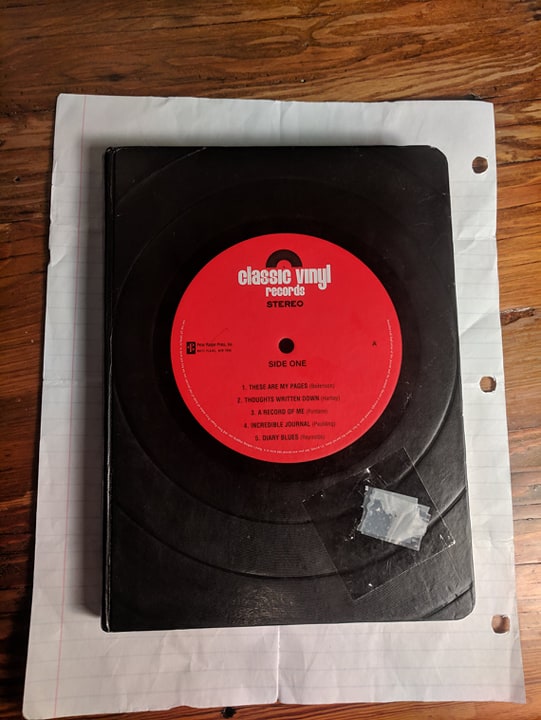
Songs for the Springtime -side A-

I am pleased to present to you, good friends, the top side of this collection of demos. These first five songs (side A) were all written for people right around me. *use headphones.

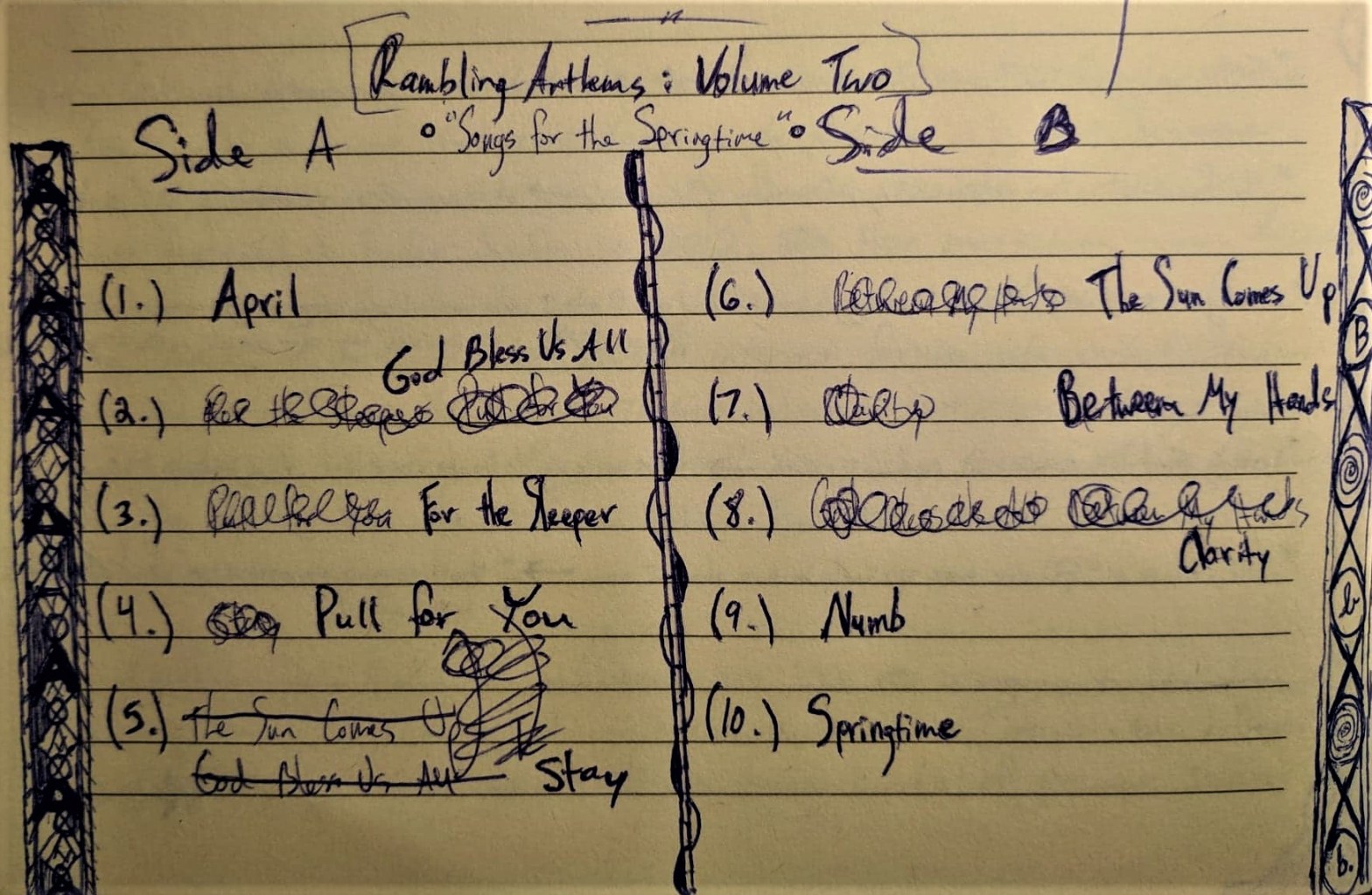
Rambling Anthems: Volume Two – Songs for the Springtime

if the Lord should tarry,

let the springtime come,

songs for the springtime

– tracks –

(1.) April

(2.) God Bless Us All

(3.) For the Sleeper

(4.) Pull for You

(5.) Stay

this one eresided

– lyrics –

Click on these words to view lyrics.


cheers.

Another Year and Some New Songs

And about once a year I fill up a notebook. By the end, it’ll have pages and pages of random lyrics, choruses, and unfinished songs. But there are always a few actual, coherent pieces I deem worthy of making into a demo with a recording mic or my phone. After I filled up the second book, I made a sort of album (called “Rambling Anthems”) out of the demos.

1
2
3

I have come to the end of book three, and I’ve decided to post the recordings here. Otherwise, they’ll forever sit in a folder on my computer called “songs”. There’s a line in ““The Sounds of Silence” – Simon and Garfunkel” that goes,

And in the naked light I saw, ten thousand people maybe more,

People talking without speaking, people hearing without listening,

People writing songs that voices never shared, cause no one dared,

Disturb the sounds of silence,

I think that on some level, if you’re making things, you need to share them with people – lest you become part of Paul Simon’s restless nightmare.

All of these songs have a very rough quality. It sounds like someone wrote something, then sat down in front of a mic plugged into a laptop and played it – cause that’s exactly what happened.

This first song is one that I did not write. It’s a cover of  “Ryan’s Song” which is written in “Boyhood”, my second favorite movie of all time. I encourage you to listen to that version by clicking on these words. I’m still finishing up the uploads – the rest of the songs will be posted before too long. You can click on the *follow button to make sure you get an email when they’re posted.

*like most everything in life, it’s better with headphones.

 “Ryan’s Song”

Well, I want for us to be together forever, But to wander wherever I may,

I want you to be easy and casual, But still demand I stay,

I want for you to know me completely, But still remain mysterious,

Consider everything deeply, But still remain fearless,

Climb to the top, look over the ledge,

Dance barefoot on a razor’s edge,

Reach for the stars, grab the tiger by the tail,

If I don’t try, I’ll never fail,

If you go home, you’re rolling the dice, Can’t step in the same river twice,

If you love too much, it’ll turn to hate,

If you never leave home, you’ll never be late,

If you eat too much, you’re gonna get fat,

If you buy a dog, you’ll piss off your cat,

Take a deep breath and enjoy the ride,

Cause arrivals and departures run side by side,

Wine and Ball and Rock n Roll

I’m about half-way through Hemingway’s “The Sun Also Rises,” a novel from which I’ve gathered, if nothing else, that the French sure like their wine. They’ll stop twice for drinks on the way to dinner where they’ll drink again before heading to a drinking party. They speak a language of wine and liturgically share the communion of smashed grapes as a fundamental part of their lives. I was in Florida for the past week, and I’ve noticed how fundamental these shared communions are in holding us up –- binding us together.

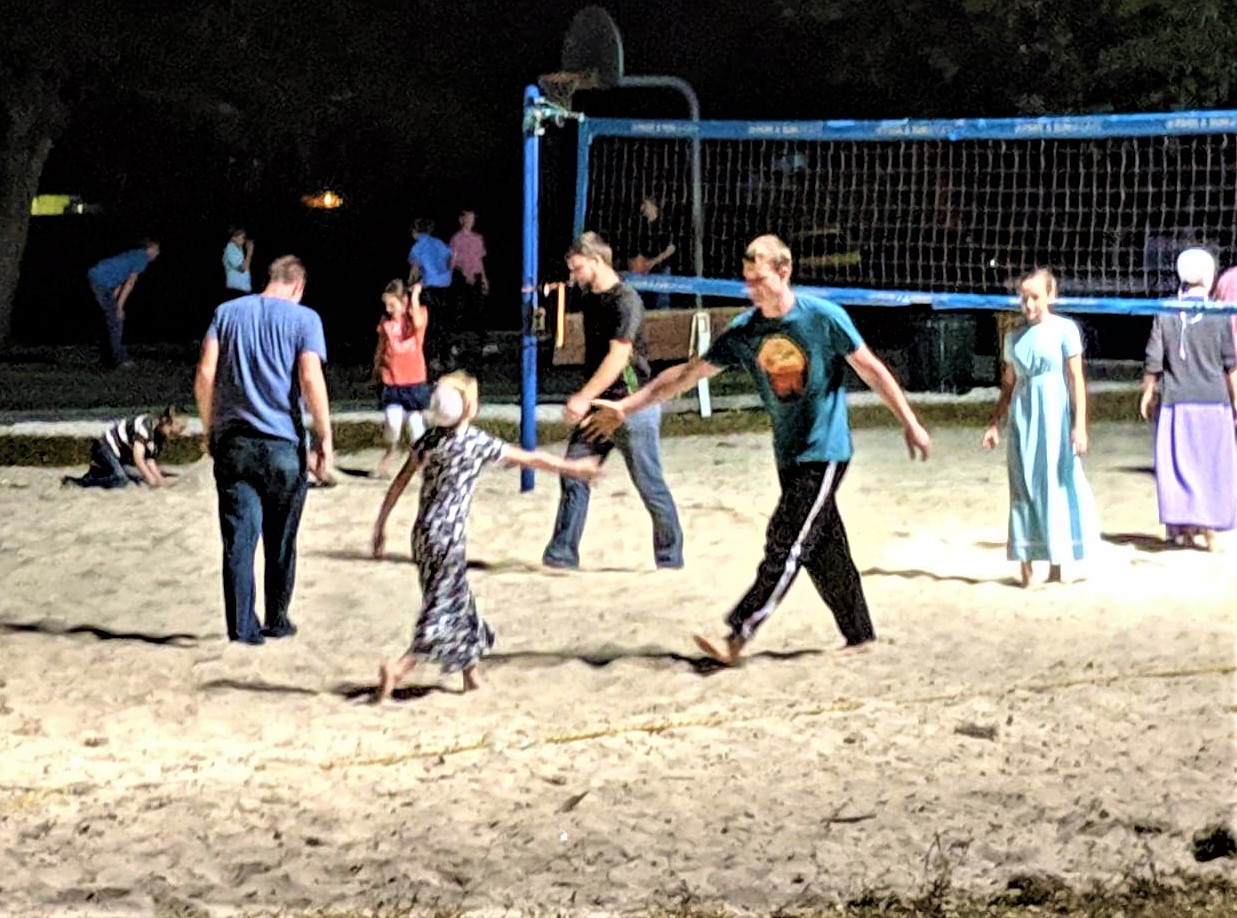
Pinecraft, in Sarasota Florida, is a very unique place. You have hundreds, probably thousands, of very conservative Christians coming together in a very specific location every winter. One of my friends observed that it’s borderline cultish. Throughout the rest of the year, these people live within their communities as a very small minority in the country. You’ve got little pockets of people living, dressing, and existing in a way the nation as a whole finds very strange. Heck, I find it pretty strange. But then for a week or a month, they congregate into a new society, one where they’ve built the institutions and run them, where the world operates on their terms. They are no longer minorities but princes and citizens in a kingdom of about 10 sq. miles. An Amish boy walks down the street or sits in the bleachers wearing homemade clothes and rocking a bowl cut over crocks –- but now so is mostly everyone else. Temporary solidarity.

I think it’s something of an escape, but I don’t think that it’s wrong…I go down there every year. I think it’s a quaint little vision of heaven on earth. Still, whenever you have hundreds and thousands of people sharing time and space, there are necessarily differences and uniqueness. So then emerges these shared languages that I’ve seen.

*Wine

bridge and wine

After arriving in this pseudo promised land, I realize the air-chuck fittings on my bike’s flat tires were missing. So on Thursday I rolled it over to the driveway where a sign proclaimed “Bike rentals and repairs.” Inside the garage, which had been converted into a workshop,  I found Sam and three other Amish people watching him work on a three-wheeler. Sam aired up my tires and then said my wheel bearing was loose and tightened it up too. I had figured on being there about two minutes instead of twelve, so I hadn’t even brought my wallet. (I also hadn’t asked him to tighten the bearing.) I shook his hand and peddled happily away. That night about 12:30 a.m., inspired by Hemmingway’s characters in the book, I left a thank-you note taped to a bottle of sparkling apple-cider on his front step. I chose Martinelli’s sparkling over money because that stuff is amazing regardless of what you believe about righteousness – and because I was humored by the idea of an Amish man opening his door to find a bottle that looked like wine. Money is perhaps the commonest of languages, and I could have left that. But it’s so tasteless. Gifting rich people with money is like paying a mechanic with a wrench – the only thing in the world he obviously doesn’t need from you. But a bottle of bubbly…

*Ball.

girl bump

Sam fixed my bike in the afternoon. That night I peddled down to the park where the locals congregate until precisely 9:38 p.m. when someone turns off the lights and kills the party. I stopped by the basketball court and saw something wonderful and hilarious. It was a game of half-court, three on three. They were kids about 12 – 15 years old. But there, as one of the six, was an Amish man. He was probably 60 years old with a full beard, homemade pants, suspenders, and a green shirt –- ballin’ out. They weren’t talking much, only battling for position, raising their arms to call for the ball, driving to the basket, squaring their hips to defend, rebounding, laying it back up off the glass. And this old guy was holding his own. Sports are sets rules and objectives where very little verbal language is required, and it doesn’t matter what anyone looks like if they can pull their weight, do their job, play their position. You don’t need to hold much in common to share something. And if three on three is that something, then you ought to play.

*Rock n Roll.

llamas wide

The reason my friends and I go to Florida is mainly for the outdoor volleyball tournament that happens every year. It is the mother of all Mennonite/Amish gatherings with about fifty teams and literally thousands of people – playing, watching, milling around. I played on a team called the volley-llamas and had never met four out of five of them. But everyone there has mutual friends. The night after the tournament, I found myself crammed in a tiny living room with about ten friends, new and old, from South Carolina, Indiana, and Missouri. And we rocked and rolled to every childhood song we could think of. I’m not talking about singing along; I mean raise the neighbors from their handcrafted furniture jamming. It was pretty much the best night I’ve had in a while.

It’s crazy how much music we share in common in spite of growing up thousands of miles apart. It’s transcendent. When someone played TobyMac’s “Lose My Soul” in that cracker-box living room, it wasn’t like singing along to a vaguely remembered tune. If you were born when we were born, that song is something that made you who you are. And somehow you know every phrase, MR. FRANKLIN STEP UP TO THE MIC SIR, even though you probably haven’t actually heard it in years. Music is powerful in that I already share something with the millions I’ve never met but who’ve heard and loved Coldplay or Maroon 5 or U2 or Springsteen or Fountains of Wayne or whatever.

girl high five

It can be tempting to disassociate with people because they look or speak differently than you do. But as long as Walmart sells Martinelli’s sparkling cider, you can still leave it on doorsteps. Where two or more are gathered, you can play half-court basketball. And as long as “Lose My Soul” is available on Spotify, you can pretend to be Kirk Franklin alongside anyone born within ten years of you. These are simple, deep languages binding us together. In 2019, I hope to remember that we don’t have to hold much in common to share something. And if we can, we really ought to.

descending from the city on a hill

This video depicts a Wednesday at Tri-County.

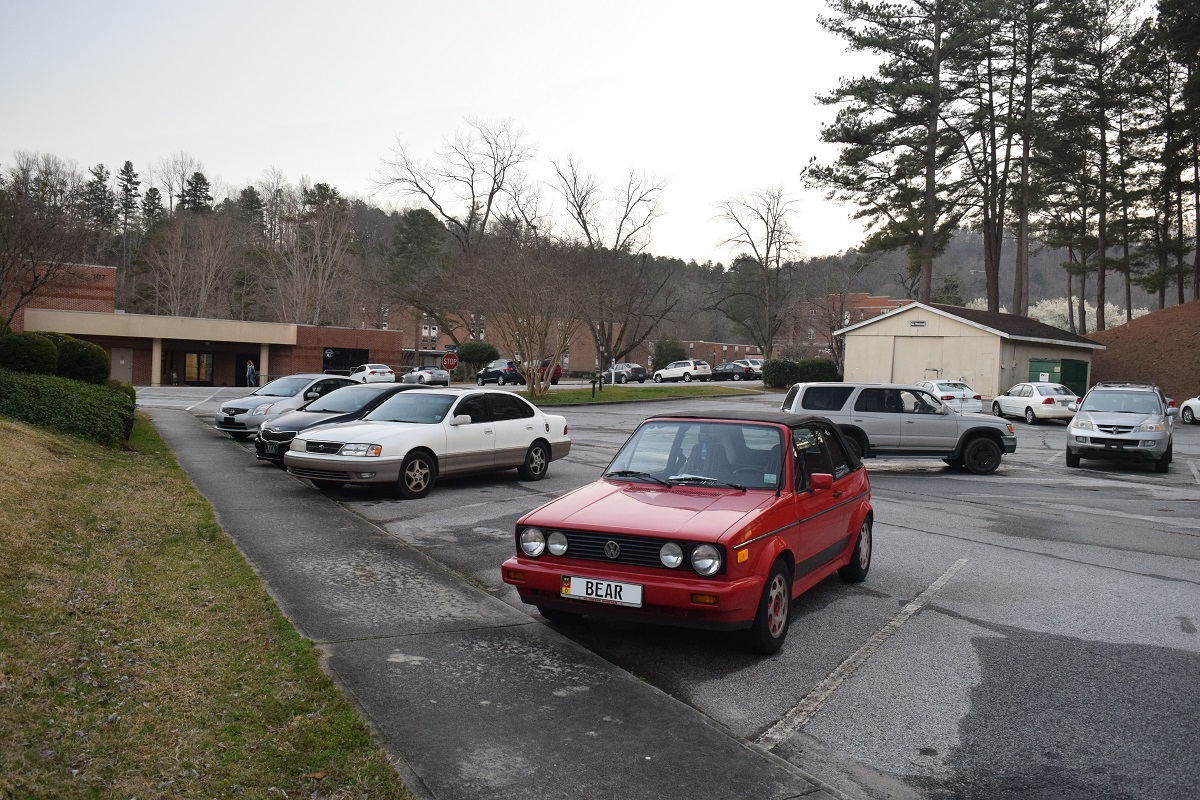
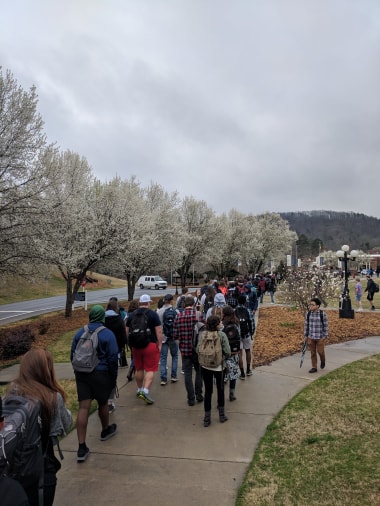
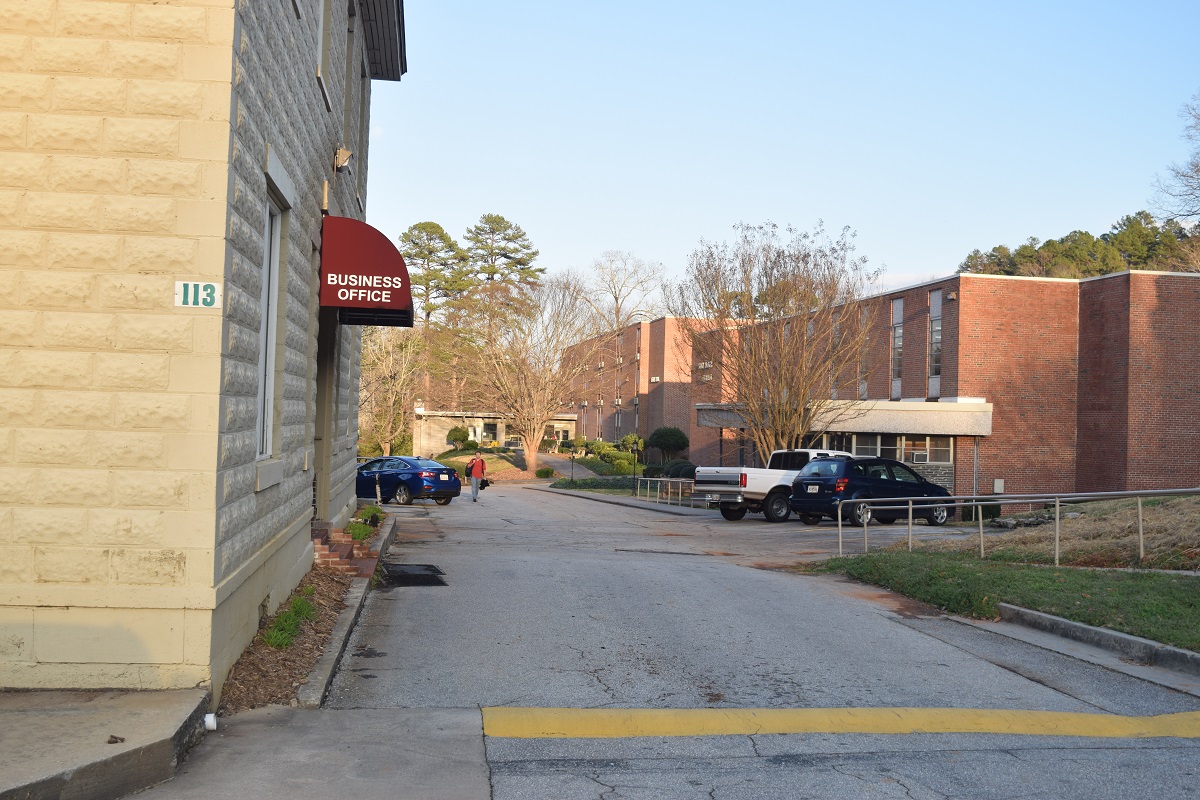
As of Tuesday a week a ago, I have given my last presentation at Tri-County Technical. I have climbed and descended those great flights of steps for the last time.

Tri-County is something of a city on a hill. I’ve told friends that if disaster strikes, that’s where I’m headed. Whether it’s an invasion or a flood, Tech is something of a fortress – easily defended and about two hundred feet above parking level. And I was just a little sad to leave her for the last time.

After I graduated from high-school, I spent the next two years entertaining thoughts about higher education. Deep down, in about three places, I was always afraid of it. I was afraid that even though I got good grades at my old school, I would be inadequate as a college student. I was worried that it would cost a fortune. And finally, I wasn’t easily able to see its practical purpose.

Inadequacy

I was afraid that maybe I’d go to college, try as hard as I could, and just not be able to succeed. Basically, I was afraid that I wasn’t smart enough to be educated – which is really silly if you think about it. I don’t know if other people feel like that – I tend to feel that way a lot. But it didn’t last long. It became apparent pretty quickly that, as a general rule, the kids who did well were the ones who were willing to try. I think anyone with self-discipline and the ability to read can do quite well at Tri-County. It’s really a lot like high-school, except that no one calls your parents if you don’t read the material, do homework, or show up to class. As it turns out that’s actually more than most kids are willing to do. My classes were not all easy, but I think that as a you can succeed here if you want to.

Money

When I first started applying and getting things in order to start at Tri-County, the whole financial thing was kind of indefinite. As it turned out, I never ended up paying any tuition. The first two semesters I spent a couple hundred bucks on books. But I learned that the South Carolina Life Scholarship is available to anyone who graduates high-school in S.C., becomes a full-time student, and can maintain a 3.0 GPA (or an 80). Since I was really unsure about what degree I was going to get, I was afraid I’d be sinking money into wasted time. After three semesters, I’ve probably spent about $600 on books, parking decals, and transcript fees. I got the Life Scholarship and applied to the general list of available scholarships and got one of those each year. College thus far has cost me about as much as having a gym membership and a Netflix account for 15 months.

Pragmatism.

My experience in my community and culture has taught me to be very pragmatic. This means that everything serves a definite purpose, is undertaken to produce a result. We often read the Bible looking for life lessons: how does this apply to my life…what is the moral of the story…where’s the important principle? Going to school has helped me unlearn some of this mindset.

There are different views about education and its purpose. Some see it as a pragmatic means to a monetary ends. Go to school, get that piece of paper, then can get out in the real world and make good money. I think that’s a pretty lousy ideology. It’s also why there were so many lazy, pathetic students sitting beside me. Education was their means to monetary ends, nothing more.

There is another view of education, the one held by Socrates and the one I prefer, which says education is a turning of the mind, a re-direction. Socrates calls it a turn from becoming and towards being.

“The power to learn is present in everyone’s soul and the instrument with which each learns is like an eye that cannot be turned around from darkness to light without turning the whole body…until it is able to study (the brightest of things), namely, the good. Education is not the craft of putting sight into the soul. It takes for granted that sight is already there but that it isn’t turned the right way or looking where it ought to look, and it tries to redirect it appropriately” – Socrates (The Republic).

Some Christians get squeamish because they think going to college will fill your head with false information – you’ll get brainwashed by atheists. I was surprised to find that most professors were intent not on teaching me what to think, but instead, how to think. Most of my professors were quite reserved in giving their beliefs out. They were teaching to equip students to think well about important things, not indoctrinating them. Except of course for math classes – they’re pretty dogmatic.

So then my fears and hesitations, about insufficiency, money, and purpose, have proved to be mostly unfounded. It’s been worth it.

This spring, I’ll be going to Toccoa Falls College over in Georgia. There are many things about Tri-County I shall miss – the dried out burgers and flights of stairs are not among them.

If you ever have to choose between classes, I’d be happy to give advice. Here’s what I’ve taken, from most to least favorite:

(1.) Sociology (2.) Philosophy. (3.) English 202 (4.) English 101 (5.) English 102 (6.) Spanish (7.) Psychology (8.) Early American History (9.) Music Appreciation (10.) Speech (11.) Western Civ. (12.) Psychics/Chemistry (13.) Technology in Society (14.) Probability and Statistics (15.) Astronomy.

the sun comes up

I try to stay writing. And it’s funny how what I write goes in cycles. For a long time, I’ve had a general goal of writing at least one song every month. Some months I’ve written many more…and some none at all. Recently, I’ve been missing the mark. I haven’t felt much like writing songs, haven’t found any.

This week has been the most charged week I’ve been through in a while:
(Act 1)

The first few days were not good, not good. I worry about the future a lot. How the heck am I going to pay for college? What exactly am I aiming for out here: relationships, career, spirituality? Some bad choices and the last push at the end of the semester had me feeling really heavy.

Wednesday morning, on the way to school, the verse of the day app *dinged* a notification. I played the audio from the chapter – Jeremiah 33. (And no, it’s not “I know the plans I have for you”). Towards the end, it goes like this,

“The word of the Lord came to Jeremiah; “This is what the Lord says: ‘If you can break my covenant with the day and my covenant with the night, so that day and night no longer come at their appointed time, then my covenant with David my servant…can be broken. . . . This is what the Lord says: ‘If I have not established my covenant with day and night and the fixed laws of heaven and earth, then I will reject the descendants of Jacob and David my servant. For I will restore their fortunes and have compassion on them.” – Jeremiah 33:19-21, 25-26

And I was driving through the bitterly cold morning in a small red car thinking, wow – that’s quite a statement. His promise to these people, that he would restore them and have compassion on them, was as sure as the day coming after the night – as sure as the laws of gravity. He said if you can break that covenant: the one that says the sun always comes up after the cold dark night – that a ball will come back down if you toss it up, if you can break that one, only then do have cause to fear his rejection.


(Act 2)

Wednesday afternoon, after I finished my last class of the day and met with two professors, I walked down the hill and sat on the hood of my car to eat a bag of Doritos in the sunshine. I got a phone call from the college admission lady I’m assigned to. Her number crunching has proven quite suspect…but if she was right this time, it looked like tuition was going to be $2,000 cheaper than we had thought – knocking it down to right around my target number of $7,500 a year. Math not being her forte, I was hesitant to leap for joy…but this was potentially great news.


(Act 3)

Today (Thursday) at work, I got the pretty much official email saying that it was true. Glory! I will be less broke next year. I printed it out and stashed it in the pocket of my bag, protected by a blue folder. At 4:35, I started walking home from work. And I reckon is was about 4:40 when I checked the mailbox. There I found a letter from an old friend. It was the most beautiful letter I’ve read in a long time. Something like folded arms opened wide. And it reminded me of a song I wrote back in April, back when I felt like writing songs – a month that I wrote three. I had already made a demo of it…and I don’t reckon I could play it any better in November than April anyway.

1

It’s been quite a week. And it’s only Thursday night. Whatever goes down, I’m bettin’ on the sun coming up again.

sunshine

cheers.

Colin Kaepernick’s Protest (an essay)

The following paper represents many hours me being hunched over a table, squinting at a screen, books and papers splayed about – writing, reading, and re-writing. It was assigned as a paper about a current ‘social problem’ in society. In the process of writing, I read Dr. Martin Luther King Jr.’s “I Have a Dream” speech. I’d never realized how incredibly good it is. If you don’t feel like reading my paper, you should read his speech. It’s a wonderful piece of writing.

“On Behalf of the Common Man – Whomever He May Be” (paper)

*click to read

kaepernick

“I Have a Dream” – Dr. Martin Luther King Jr. (the speech)

*click to read

i have a dream

“I have a dream that one day every valley shall be exalted, every hill and mountain shall be made low, the rough places will be made plain, and the crooked places will be made straight, and the glory of the Lord shall be revealed, and all flesh shall see it together.”

An Ode to the Unspoken Arts

There is such a great ruckus made about “the arts”, that celebrated pursuit of beauty. And rightly so. In another year I’ll have an associate’s degree in arts, whatever that means. There is music, dancing, poetry, painting, filming, flailing…and a million more. But I have uncovered some others too. Lesser known, but quite useful and not to be overlooked, forms of art.


1. Making Yourself at Home:

I begin with the art of making yourself at home. This one might be taught, but I reckon it’s mostly born.

jugging

I was in Pennsylvania once in the height of summer. While passing through, we were staying with some relatives of a friend. I found myself assigned to a room adjacent to the garage and bordering the kitchen. These people didn’t have air conditioning in their home. I guess they thought, like many people of the northwest, that the few weeks of high heat aren’t worth the price of A/C. So they (and any resident guests) just crank up the fans and bear it out. In my room beside the kitchen it was positively sweltering. No amount of turning the pillow over could make me comfortable. What was there to do but find relief? I quietly made my way out to the dark kitchen and peered into the light of the refrigerator. Juice. Now a self-conscious guest might have gone banging around the place, slamming through cabinets until he inevitably found the glasses in the last place left to look. But not me. Me and my associate’s degree, we drink from the jug – leave no trace, wake no hosts. This is a small sample of the art of making yourself at home. If unfamiliar, one might start with helping himself to bathroom toiletries or pantry snacks before tipping back the jug.


2. Looking the Part:

Secondly, there is the art of looking the part. To keep peace inside, you’ll need to align your actions with your beliefs about the world. However, if for an evening it is advantageous to be someone else, it can be done.

stage of white and black 9999.jpg

I remember playing baseball as a young lad and vastly overestimating opponents. In little league, prior to the game, each team takes a side of the field to warm up. Sometimes I would hold the ball a few seconds and gaze across the field at the giants who were pretending to be ten-year-olds. We’re about to get destroyed. Then, more often than not, they were just too tall for their own good – and clumsy too. We’d beat the tar out of them. But the next week, my senses would fool me again.

We can all recount times when we judged someone to be more than they were, fooled by appearance. I myself had to practice this art for months at a time on stages across the country. I became part of a band (of sorts) one week, and then the next week found myself on tour trying to play songs I’d barely heard. But what can you do? I stood up straight, put the guitar strap over my head, and played like I knew what the heck we were singing. And people bought it, most times. The art of looking the part can be a lifesaver. And while I wouldn’t consider myself good at it, I’m inspired by masters such as Frank Abagale who wrote “Catch Me if You Can” and Jimmy from ”Better Call Saul”. If you’re good at looking the part, you can bluff your way out of just about anything.


3. Laughing at Bad Jokes:

Aren’t there times when the whole truth is just not appropriate? “Your opinion on this matter is literally the dumbest thing I’ve heard all week.” “That was your casserole? What, did you make it on the way over here?” “I would rather spend my eternity eating shards of broken glass than hear this story one more time.”

lauging

It takes a certain awareness to be able to discern the nature of social situations. Sometimes it is appropriate to let fly the truth – and sometimes it’s better to just laugh at the bad joke, choke down the casserole, or settle in for another retelling of a tired story. My favorite application of this delicate art comes from a prison chaplain who’s name and state I don’t recall. Prison chaplains are often the unfortunate victims of prison food. This food, I can attest, makes fasting seem more desirable. This guy said he was sometimes asked on the spot how the food was. His response, no matter how good or how awful, was to smile and say, “It’s very tasty.” Which is actually true. Very bad food usually has a very bad taste…and is therefore quite tasty. The art of laughing at bad jokes is a good one to keep in your pocket. And, if I’m honest, one I hope my friends are willingly to use on me too.


This has only been a small sampling of the art forms not taught but ever useful. I don’t have time to tell of making lemonade at restaurants for free, or speaking eloquently about that which you have no idea, or reading at the speed of light, or eating a meal and changing clothes while driving. Jonathon Rodgers says that if we were to simultaneously rid the world of plumbers and writers, we would miss the plumbers much more quickly. And I reckon that if we rid ourselves of both the arts taught in the universities and the unspoken ones, we’d miss that second kind much more.

concerning dreams

10/17/18

11:11 p.m.


It’s 11:11 and I can write anything I like – I can wish upon the stars that whirl above October.

They always ask us what we could be if we could be anything we like. Well that’s kind of hard I think. But if you say it like this, like, “What would you be if you could be the best at anything in the world?” Then I should be able to answer with a smile – I’d like to be the speech writer for the president of the United States of America. The voice of POTUS. When tragedy fell, I would rouse the nation up and bolster their spirits. When victory was a crown about our heads, I wouldn’t let him beat his chest. With my words in his mouth, the leader would be the picture of dignity on the wall of diplomacy. There would be alliterations and prose that the editors would try to cross out, but I wouldn’t let them. And the jokes would be good; we’d have the opposition laughing with us.

Toby Ziegler thought there were probably only nine people alive who were good enough to write for the president. I can see the stars, but I don’t have a fancy telescope. So I suppose I’d like to write for someone, even if you don’t stand up when they walk in the room. Because at the end of the day, I’ve always been more the speech writer than the orator. Someone told me once that talking to me is very different than reading me, and I’ve spent the last four years trying to figure out if that was a complement. The last time I stood behind a podium it went alright until my vocal chords went bone dry and stopped forming words. It took me a few seconds to draw enough spittle out of my throat to get everything lubricated again. That never happens behind a keyboard.

Next week I’m scheduled to talk to someone named Taylor about where I go from here: what degree I’m gonna get and how much it’ll cost me. While I was giving plasma today I talked to a guy who’s out a hundred and fifty grand for his bachelor’s. Hopefully my Taylor is better than his. I hope that in twenty years things are somewhat the same as they are now. I hope I can still drive the dog down to the lake and that flowers still grow down the sides of the road. And I hope I can play softball, and stay up late reading and writing, and that they’ll still stock trout in the river. I hope I have friends like I do now. And I reckon there’ll be other things too, things “too wonderful for me to know.”

But tonight it’s 11:11 and I can write anything I like, under the stars that whirl above October.

3

*photo by Mike Dienner (probably)

The Philosopher King

This is an essay I wrote for philosophy class. We’ve just finished reading Plato’s Republic, which is basically Socrates and friends sitting around trying to figure out what justice looks like. It’s crazy to think that colleges are still teaching a book written before Christ was born – we’re talking 2300 hundred years ago. That’s a pretty solid shelf-life. This book has taught me about as much as anything I’ve ever read. So maybe this essay will be a preview, and you’ll decide to read it for yourself.

The assignment entailed giving answers to about 12 questions, which is why the paper reads the way it does.


The Philosopher King

The Philosopher King (or Queen) is a person who has demonstrated excellence in every area of training; they have what Socrates refers to as a golden soul and, most importantly, a definite knowledge of the good. This knowledge of the good, as well as a nature of “philosophy, spirit, speed, and strength”, is what makes the Philosopher King a just person and the best choice for ruler of the just city (376, c). Socrates says this person will be compelled to rule because, “the greatest punishment . . . is to be ruled by someone worse than oneself” (347, c).

Socrates proposes that the just city is made up of three kinds of citizens: craftsmen, auxiliaries, and guardians (415, a-b). Similarly, the soul consists of three parts: appetite, spiritedness, and reason (435, e). Socrates’s definition of justice is tightly interwoven with the theme of moderation. Each thing, within the city and the soul, must do that which it is intended for if justice is to be achieved. For moderation to be achieved, it also means that the city must be ruled by the guardians, and that the soul must be ruled by reason. It is when, as P.G. Wodehouse says, “reason. . . wobbled on its throne” that chaos ensues (Wodehouse 42). Socrates says that the city and the soul are just when “each of the three classes in it [do their] own work” (441, d). The appetitive part of the soul must inform reason as to the needs of the body. And the spirited part of the soul must ally with reason to enforce its dictates.

According to Socrates, philosophers must be without falsehood; they must “refuse to accept what is false, hate it, and have a love for the truth” (485, c). The nature of the Philosopher King is one that is completely without and opposed to “true” falsehood. He even goes as far as to claim that “true” falsehoods are hated by every god and human (382, a). The distinction that we must make here is between falsehoods which are told maliciously with the intent to corrupt and those, like the parables of Christ, which are told in order to spur towards the truth or prevent destruction. Socrates says that, “No one is willing to tell falsehoods to the most important part of himself about the most important things” (382, a), but a short time later he says that some falsehoods may be useful to prevent people from doing something bad through madness or ignorance (382, c).

The goal of the educational system is to turn the soul around by directing its desires away from becoming and towards being. The thing the soul loves and values above all else is what will determine the different classes of people. Socrates says that, “What we need to consider is whether the greater and more advanced part of it (areas of study) tends to make it easier to see the form of the good. And we say that anything has that tendency if it compels the soul to turn itself around towards the. . .[things] the soul must see at any cost. (526, d-e) The knowledge-loving nature of the Philosopher King becomes evident as he excels at every turn in the educational system. From birth, all the children in the city are provided with the same educational opportunities. They advance (if they are able) through music and poetry, physical training, calculation, geometry, solid geometry, astronomy, harmonics, and dialectic. Each of these fields of study shapes the understanding and appeals to the nature of the one who is to be a Philosopher King. Then it will become apparent, through close observation of the children in their roles of small responsibility, which ones are suited for which tasks. The ones who are to be philosophers and someday rule must be exemplary in everything, the golden souls. And only the ones who will become guardians of the city will ever be allowed to know the truth about their own society and origin. This is a sort of brainwashing, even if it does produce a desirable outcome.

The Philosopher King, whose soul is bent on being and who knows the good, is compelled to tell medicinal lies to the people whose souls do not love knowledge above all else. Socrates is adamant that “the majority cannot be philosophic” (494, a). Because their souls are bent on becoming and not being, they will never reach the level of thought of the Philosopher King. And even the ones who will someday be philosophers will not immediately be capable of high-level reasoning and understanding. In this way medicinal lies must be told as a crutch for lower intellect. As mentioned, these “lies” are comparable to the parables that Christ told when he wanted to communicate a truth or idea to his disciples. He knew that they would be more able to understand a story woven to illustrate than an intellectual dialogue of the thing itself.

The allegory of the cave illustrates the point that not everyone can be philosophic. In the illustration, the masses are chained up inside the dark cave looking at illusions which they mistake for clear depictions of reality. Because the philosopher has been up and out of the cave and seen by the light of the sun, he has a knowledge and truth unattainable by everyone who remains in the cave. Because the Philosopher King desires the best for the city and the people therein, he re-enters the cave with the hope of sharing his knowledge with those still in the chains of ignorance. Yet it is apparent that they will not be able to understand him or the foreign things he tells them about. Socrates asks, “Wouldn’t it be said of him that he’d returned from his upward journey with his eyesight ruined and that it isn’t worthwhile even to try to travel upward?” (517, a). This necessitates the telling of medicinal lies, a sort of weight hung upon truth to bring it down to the level of the cave dwellers. The Philosopher King’s love and pursuit of knowledge is what led him up and out of the cave, and those who remained were held there by the chief desires of their souls which will also compel them to kill the philosopher if they are able.

This type of lying is compatible with the Philosopher King’s nature and being a philosopher. His nature is that which loves knowledge, and as a philosopher, he wants to make the best decisions for the city’s best outcome. These lies are what Socrates describes as medicinal lies and are not deserving of hatred. They are told to prevent harm from coming on the city by the “[attempt], through madness or ignorance, to do something bad” (382, c). The Philosopher King’s knowledge of the good allows him to recognize these attempts to do something bad. In keeping with his own nature, he must try to prevent them from successfully perpetrating bad things through madness and ignorance.

In my estimation, if a man such as Socrates dreams of were to come about, one who truly knew the good, it would not be unjust for him to use medicinal lies to promote the health of the city and prevent bad decisions from being made. I think that if he did know what the good is, then he would be able to do what he is compelled to do with goodness. As the Philosopher King, he is compelled to rule justly, and the medicinal lies, or parables, or children’s tales, or whatever you may call them are necessary for the Philosopher King in his attempt to communicate the truth to the masses who are not philosophic.

Additionally, I believe that the greatest problem with Socrates’s system lies upon the basic premise that the knowledge of the good can be fully attained by careful study. These rulers are supposed to have intimate knowledge of the good, to be so well acquainted with what is good, that they can choose it and make laws which promote it in all circumstances. Socrates allows these philosophers fifty years of education to develop an understanding of goodness. Yet, I believe that if you were to ask a practitioner of medicine or math or astronomy who had been in the field for fifty years whether he had grasped the highest handholds of knowledge, he would be inclined to say he’d only begun to climb. I don’t think true knowledge of the good is at the top of a staircase which starts on earth; it appears to me that Socrates is constructing a tower of Babel. I tend to agree with George Bernard Shaw who, at a celebratory dinner in honor of Albert Einstein, raised up a toast and said, “Science is always wrong. It never solves a problem without creating ten more.” And I reckon that if you gave a man two hundred years of schooling in Socrates’s education system, he would be inclined, after his centuries of learning, to confess that his finite mind and human hands still did not hold the keys to justice and her great mother, goodness.


Works Cited

Firestein, Stuart. “The Pursuit of Ignorance.” TED: Ideas Worth Spreading, Sept. 2014, http://www.ted.com/talks/stuart_firestein_the_pursuit_of_ignorance

Plato. Republic. Translated by G.M.A Grube, Revised by C.D.C Reeve, Hackett Publishing Company, 1992, Indianapolis, Indiana.

Wodehouse, P.G. Uneasy Money. Penguin Books, 1958, London, England.