Tuesday

Welcome to Tuesday,


Tonight I had a conversation with my friend Emily Smucker beside a drum set in a Missouri basement. Emily lives in Oregon, so most of the time she is about as far away from my interviewing apparatus as one can be. But on this weekend we met in the middle for the wedding of a dear friend. After the pictures had been taken, vows had been spoken, and pizza had been eaten (catered pizza at a wedding – no joke), we sat down and talked about methods of communication, our heroes, and why getting a degree can make choosing a career path more difficult.

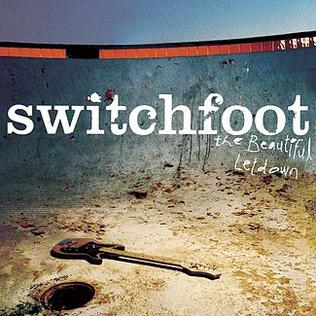
Today we’re giving away Bridge to Terabithia – Katherine Paterson and The Beautiful Letdown – Switchfoot.

BTT
TBL

Here’s a link to the book Emily wrote.

And here is Emily’s blog where she posts cool stuff.


Congratulations to Monday’s winners: Simone Smucker (Over and Underneathe) and Steve Chupp (Peter Pan).

Cheers.

Monday

Over the past several weeks I’ve been interviewing friends and talking with them about all kinds of different stuff. It’s been really fun…and I’ve been learning my way around Audacity. It started as an idea I had one night while trying to go to sleep. I hope you enjoy today’s edition,

Welcome to Monday.


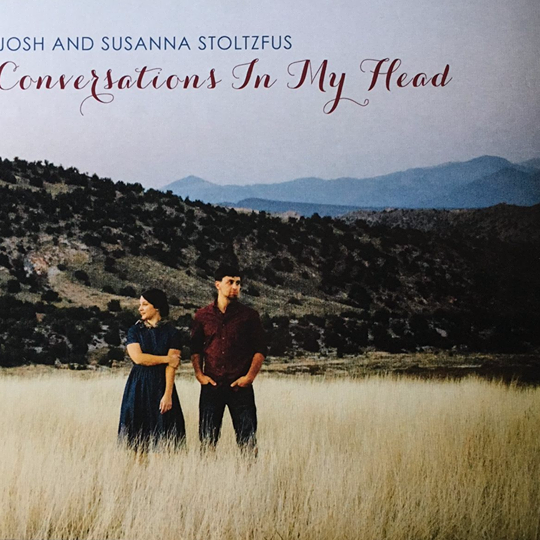
Today I sat down behind a microphone with Susanna Stoltzfus in the church auditorium. Whenever I’m in church on a weekday I’m always struck by the emptiness and silence. Su is a dear friend from way back who now lives in Canon City, Colorado, so when she walked through the doors it was the first time I’d seen her since last summer I believe. But she’s the kind of person with whom you can pick up wherever it was you left off months ago. In our conversation we discussed the album she made with her brother Josh, the faithfulness of Jesus, what it means to use the gifts we’ve been given, and why Tenth Avenue North has been an important part of both our lives.

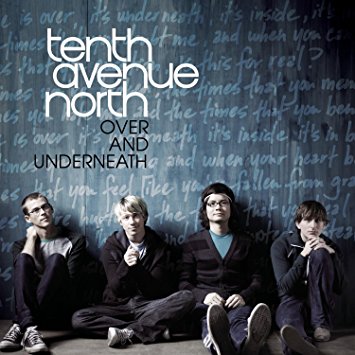
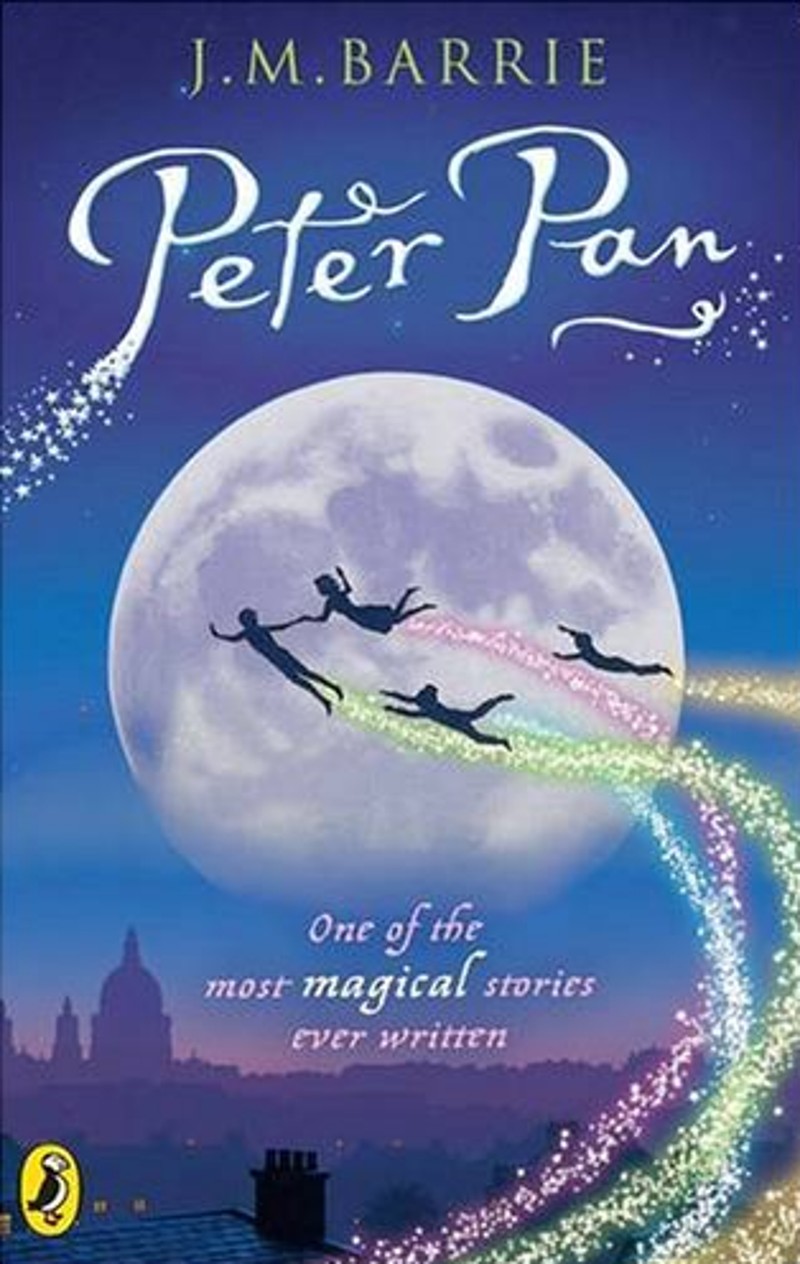
Today we’re giving away Over and Underneathe – Tenth Avenue North as well as Peter Pan – J.M. Barrie.

over and underneathe
peter pan

You can find Josh and Susanna’s album, Conversations in My Headhere.

conversations in my head

Cheers.

CRAZYTALK

CRAZYTALK – Mat Kearney

When Mat Kearney gave us his fifth album, JUST KIDS, in February of 2015, it surprised me. I distinctly remember listening through the whole album on a long ride home from Pennsylvania in March. The sounds on that album were starkly different than what I was used to hearing from him – but it was good. From the first song on the record, Heartbreak Dreamer, all the way through the hometown anthem, Oregon, it’s stylishly Mat Kearny, well-written and groovy. JUST KIDS did feel somewhat experimental; there were sounds, even words, I’d never heard before. Yet it didn’t feel like a stylistic left turn but a new flavor of tried and true.

Earlier this month Mat Kearney released CRAZYTALK. After listening through, the only world that comes to mind is ‘uninspired’. It’s been three years since Mat Kearney put out an album, and CRAZYTALK was not worth the wait.

Mat-Kearney-CRAZYTALK-CCM-Cov-400x400

Face to Face, Kings and Queens, and Wanted Man are the only songs I might be tempted to revisit when scrolling through Spotify. It’s unfair to expect an artist to reproduce another version of past material – but you always hope they continue to flesh out new ideas and melodies in a creative way. That’s what Mat Kearney has been doing for a long time, but I felt like that only happened a few times in this newest record.

Mat Kearney’s writing has always been pretty simple, his lines make it seem like writing a song is something anyone could do – which is pretty cool. That approach doesn’t change in CRAZYTALK. His subject matter has also been fairly uniform over the years. Usually songs are written for or about his wife or personal reflection with the occasional Rochester. This doesn’t change, but these lines are less eloquent than they’ve ever been. When looking for lyrics online, I had to make sure to add his name to the track title because almost every song shared a title with another artist’s work. Once again, it’s not fair to expect reproduction, but as my brother Luke said of By Your Side, “It’s no Shasta”.

mmmmmmmmmmmm

CRAZYTALK feels like a bout of writer’s block forged into a sixth album. It’s the kind of album that you hope the artist leaves off the set-list if you’re going to a live show. I’m not sure what the train of thought behind the album art was, but the neon pink is, uh, not attractive. In I Can’t Wait for You to Get Here, he writes,

We were picking rings and riding trains,

Now we’re picking paint and middle names,”

It seems, unfortunately, that the former made for better songs. I have some problems with the writing on this album.  I found the incorporation of pop-culture language into songs very obnoxious. The words Netflix, Kanye, Beyonce, latte, ‘vacay’, chill days, and Coldplay all show up in my least favorite song on the album, Money; it’s cringworthy. There are far more endearing terms to describe your girl than U.S. currency. Maybe his well of love songs has run dry.

I’m still puzzled by the tonal choices used in many of the tracks. The choice of guitar to drive Kings and Queens and Wanted Man doesn’t seem right to me. Then I don’t even know what’s happening in Fortress, but it ain’t working. I love Mat Kearney’s piano ballads like New York to California and In the Middle, but no such appearances were made here.

All told, I was greatly disappointed by CRAZYTALK; I think it’s his least impressive record thus far. The reviews by CCM and Jesusfreakhideout somehow give it four stars – I’d give it two. If you listen through and some of the better songs sort of strike your fancy, you might say, “Ah, it isn’t so bad.” But as Sir Percy Blakeney said in The Scarlet Pimpernel, “Nothing in the world is so bad as something that is not so bad.” So throw down the needle on Young Love again, and here’s to album number seven.

Springtime

Part 1:

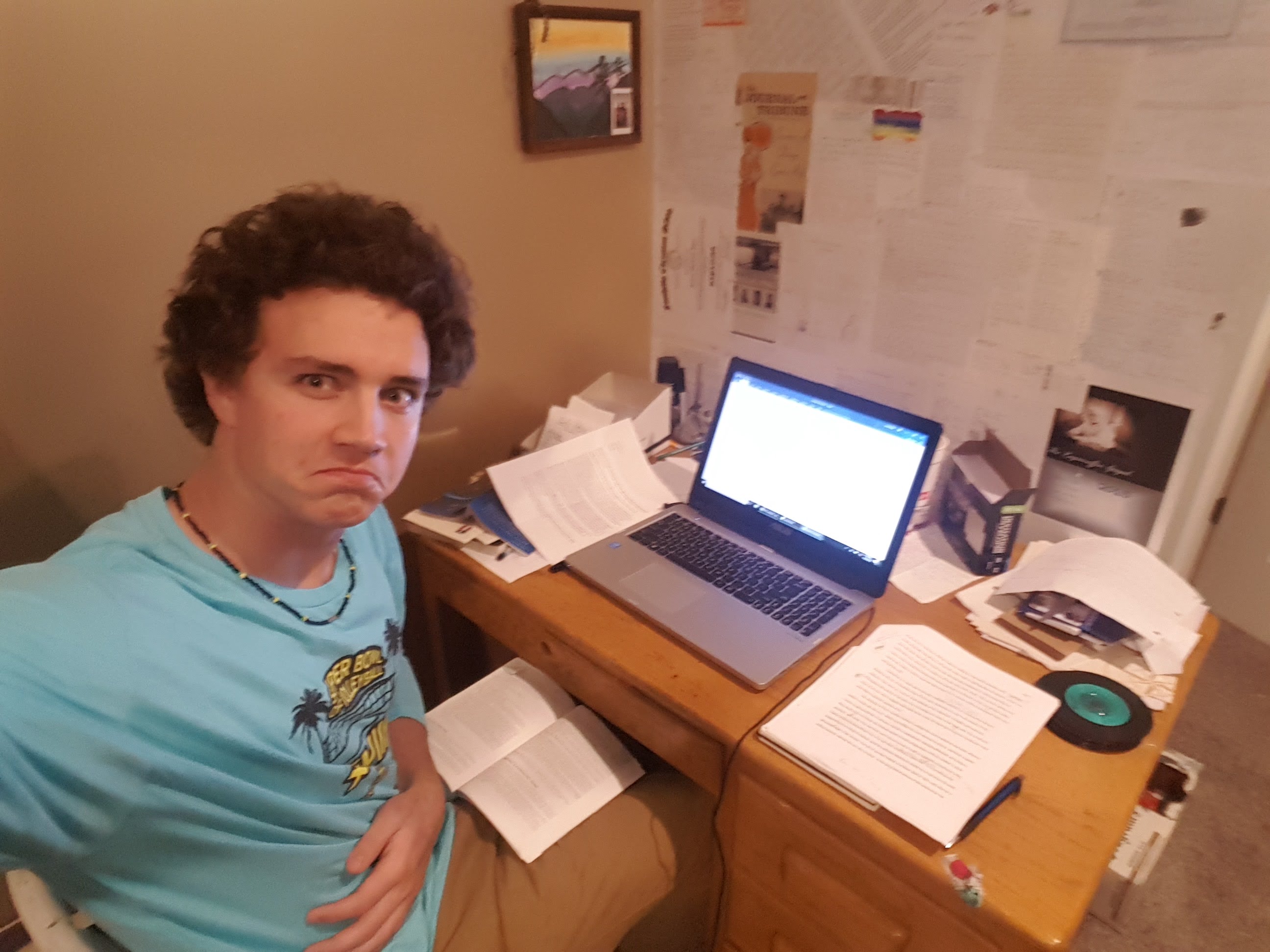
A few months ago I got the idea that I needed a work desk, a better one. I have a desk in my room, but it’s the one that Dad had at his mini-barn office…and my knees are always hitting the top…and it’s pretty ugly. So I decided I’d make a better one. One that would span the whole length of a wall and have enough surface area for all the papers I need to lay somewhere.

20180129_233059.jpg
the old desk

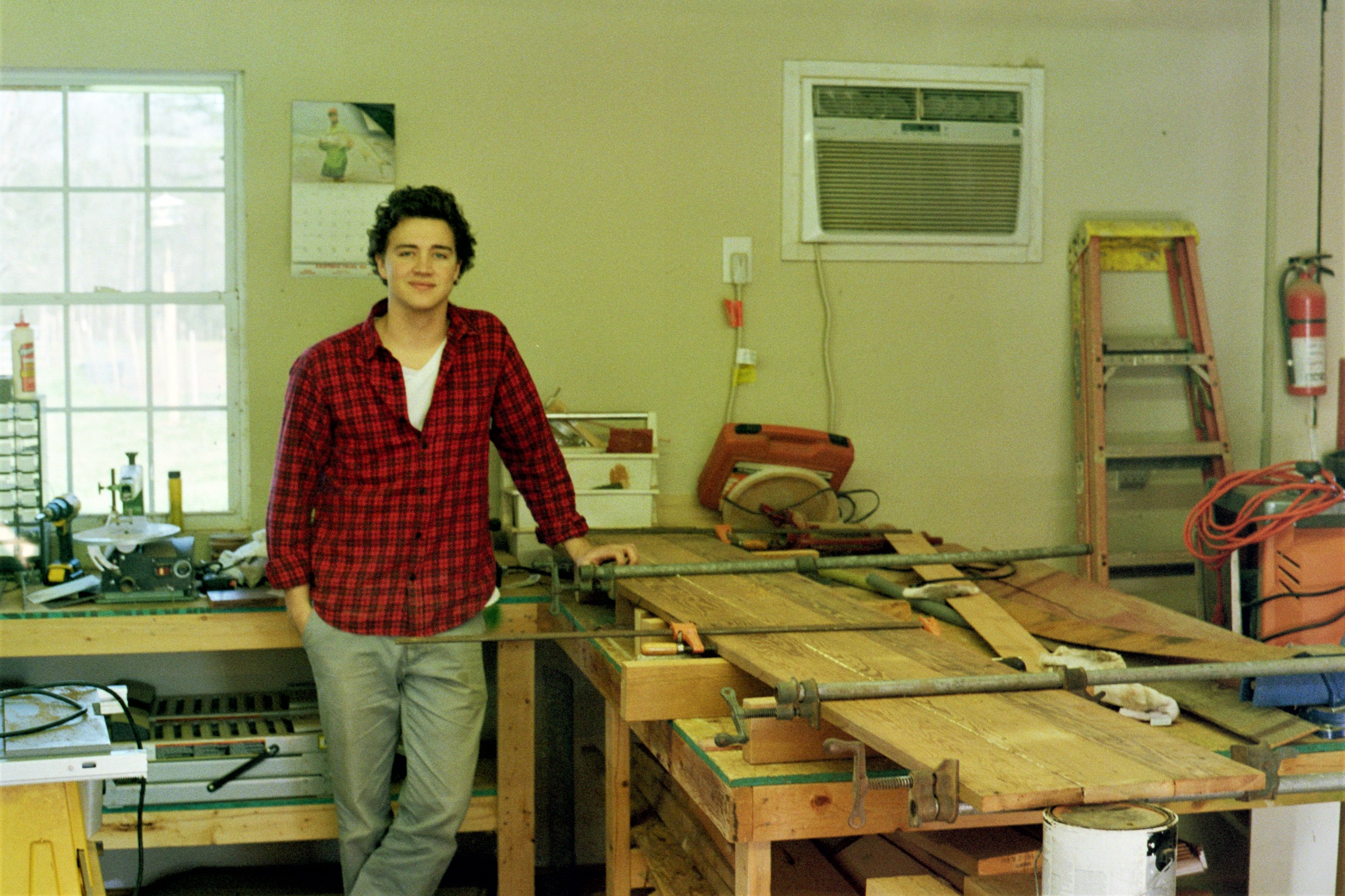
I’m not really much of a woodworker, but my grandpa is. So I knocked some siding off of the old, fallen in barn out beside our driveway and began making trips to grandpa’s house. We planed down three heartpine (probably) boards and glued them together. Then, with much lovingkindness, sanded and varnished and sanded and varnished. This was easily the most fun I’ve ever had working with wood. Grandpa had everything I needed at his shop…so, minus a pack of sandpaper and some mineral spirits, it was totally free. I bought a sweet wooden chair at the Orange Horse, and now I write English 102 essays with a view of the backyard and plenty of legroom. Dream come true.

021_16a
020_17a
35 mm film
20180324_015125.jpg
phone camera
DSC_3863
nikon D3300
DSC_3866
DSC_3871

So a toast to my grandpa, Vernon, for helping me do this.


Part 2:

I think the changing of the seasons is one of the coolest parts about living in America. We get four, and that’s really more than can be said of much of the world (and Minnesota). I was really anticipating spring this year. Winter is too cold to camp and play softball and fish. It’s April now, and I’ve done all three.

Yes indeed.

If the Lord should tarry, let the springtime come,

Here’s a song I wrote in February, the great month of cold anticipation.


I’ve got two tests and an essay, and they’re all due tomorrow,

I’ve got few friends to speak of, they’re all out with their girlfriends,

It’s been a long February, and I’m waiting for the springtime,

It’s raining in this parking lot, and old strings on this guitar,

It’s lonely on a Sunday, and five days till the weekend,

and I wonder, 

If things will get better come springtime, better come March

Better come springtime this year,

Maybe the flowers will grow over my fears, maybe showers will wash them away,

Maybe the warm days will thaw out my insides,

And things will get better come springtime this year,


Spanish Class

The evolution of the internet is truly an incredible thing. For the past several weeks my friend Taylor and I have been working on a little project together. We were able to send ideas, lyrics, and bits of recording back and forth until finally we arrived at a finished song. Not tremendous, but finished.

And I say we made a song together. Basically I just gave him some lyrics and ideas, and he did all the vocals, instrumental recording, and mixing. That boy can play.

And here is what we came up with: “Spanish Class”

————————————————————————————————————————

Javen.

The Oil Rigs

*cover photo is not my own.

Yesterday in English class our teacher asked us to think of a movie that we watched as a child and then re-watched later and interpreted differently. And no, she said, I don’t mean that you just watched it again and got all the jokes that went over your head. One guy said Forrest Gump, and a girl mentioned Gossip Girls; I hadn’t seen either. I jotted Peter Pan down on my notebook page, but I figured there must be a better example that I wasn’t remembering.

Then today I thought back to The Rookie, maybe that’s a better example. As a kid, one of the exciting parts about going to other people’s houses was their movie collection. Grandma had The Rookie. I remember watching it several times. There are a few scenes in that movie that are really beautiful. This one is my favorite:

I’m no movie critic, but that is magic in my eyes.

But anyway, there’s another scene, a short one, that I’ve also never forgotten. It goes like this in the transcript,

Kael:

What are those things?

Jimmy: What?

Those things moving up

and down?

Oil rigs.

When those things

are moving up and down,

it means times are good.

Looks like times are good.

And let me tell you friends, I saw a few oil rigs today.

I saw receipts on which people added a tip out of generosity – they chose to pay more than was required of them. And I watched a lady across the counter donate seven American dollars to an organization that helps Asian kids get a college education. I went to a free jazz concert, where the kids played for the love of music and got an encore. And I talked with a girl who started a campus piano club to teach music to anyone who wanted to learn. I ate a meal at The Cookout for $3.62, a twentieth of a day’s wages. And I drove past establishments with self-checkouts, where companies trust their patrons to pay fairly, un-supervised. This afternoon I was surprised to learn that the other five people in the room were Christians too. And tonight I left my car unlocked in our driveway, walked inside, and wrote these words. Tomorrow at 9:05 a.m. I’ll walk into history class and learn about a time when these things were not so.

Say what you will about hell in a hand-basket, but the oil rigs are still moving up and down.

“If It’s Broke, Fix it” – a story for you.

This past weekend I went in the company of three good friends to see our buddy Gabe at bible school in Pennsylvania (SMBI). Right after we turned out the lounge room lights on the second night of our stay, someone mentioned Olan Rodgers. And soon thereafter his face was on a smartphone screen telling us a story. His stories, such as “An Odd Way to Die” are great – he’s not there to teach you a lesson or convince you of an ideology, just tell you a story; that’s refreshing sometimes. So, in that unencumbered spirit, here is a story for you.


One day last year, in the fall semester, my friend Collin and I were walking through the Tri-County parking lot after another day of classes. As we searched the parking lot for the vehicle we came in, we noticed this super-hipster looking white car. It had all kinds of bumper stickers on the back – including one that bore the Switchfoot insignia and one that said, “If it’s broke, fix it.”  There was also a copy of “The Ragamuffin Gospel” in the backseat. All things considered, I figured the owner of this worn out Honda must be an alright dude (or dudette). It is most unfortunate indeed that I had to bear witness to, and participate in, the eventful demise of such a lovely chariot.

The next time I took notice of this car was last week on Wednesday. Another day of classes was in the books. I had weathered another painstakingly boring Astronomy 101 class and was home free. After leaving the classroom, I ran into the chief of campus security in the hallway, and we talked for a few seconds as we walked together (this the same guy who got me out of the parking ticket a couple months ago). Once outside, I descended the stairs below Fulp Hall and took a right at the second parking level, eyes peeled for my car – it’s such a large parking lot. Without much difficulty I found it and was headed over when I noticed large plumes of white smoke pluming to and fro in the level above me.

These plumages were definitely coming from a certain white car, out both windows. I reckoned it was probably two people sitting in the car puffing away. I used to work with a guy who vaped, so I’m fully aware of the incredible clouds one person can produce. Dragon breathe caliber. Quite impressive. With this in mind, I decided I’d casually meander up to the first level and make sure everything was good. As I approached, a few things became quickly apparent. First, the plumages were still billowing forth steadily – like these people weren’t even pausing to breathe. Secondly, this was that same car I’d seen last semester: dilapidated white Honda with the back-glass full of bumper stickers. Thirdly, there was no one in the car.

I quickly dropped my backpack on the grass. And then moved it back a bit farther. I don’t need my laptop and textbooks getting charred if this thing blows up. A quick assessment revealed that there were orange flames coming from between the two front seats. The windows were cracked, and all the doors were locked. There were cars parked on each side of this flaming mobile, all of which were also locked.

I’d like to just pause a moment here to point out that if these people had been on board with my theory of driving a not-so-nice car and never locking it, their vehicles could have been removed from impending danger. And the fire could possible have been stomped out. But that would have been less exciting I guess.

So with no way to move any nearby cars or get to the fire, which was starting to produce a blacker smoke, I began digging through my backpack and  produced my phone. I quickly dialed up the security chief whom I had just passed in the hall.

I’m down in the parking lot below Fulp, and there’s a car that’s on fire. You need to come down here and check it out.”

“Oh! Uh, Ok. I’m right behind you. Be there in two minutes.”

Chief Aman rolled up in hardly anytime at all. Then we stood there for a few seconds, each unsure of what to do. He got on the phone to request a fire truck and sent me running to the Fulp lobby for a fire extinguisher. I tore back up the hill and into the big brick building. Inside, I ran over to a glass case, opened the door, and headed for the exit….as I moved for the door it occurred to me that I’d never seen a fire extinguisher of this sort before. Then I read the label – something about AED assisted breathing….not a fire extinguisher. I slammed it back into the case, which made the beeping noise stop, and found a real extinguisher in the next room.

Halfway back down the hill I saw Collin walking to his Jeep. “Hey dude, come check this out!” I ran down to the still flaming car, extinguisher in hand. It occurred to me then that I’d never used one of these things before, and really hadn’t been shown how. It’s easy though. I broke off the blue plastic thingy, pulled the pin like a Marine arming a grenade, and went to town. I stuck the hose into the cracked window and let fly the yellow dust. I couldn’t really see what I was shooting at through the smoke and blackened window. But boy did I torch them flames. Extinguish them I did. I put the whole bottle in through the windows: a lot through the driver’s side…and a lot through the passenger’s side. Like I said, I hadn’t ever got to use one of these before, and the chance wasn’t likely to come again soon.

By this time another officer had arrived as well as a faculty member. The senior members of our group decided we ought to break the window and get inside. In hindsight, this probably wasn’t really necessary. But a body tends to get caught up in a moment of glorious public service. Officer number 2 took my expended extinguisher and bludgeoned with all his might. No good. Then faculty member produced a hammer. Smash!  Glass everywhere. Window no more. Yep, sure enough the flames had been put out. Completely. And there was so so much yellow dust everywhere. I daresay if the flames didn’t destroy the poor guy’s interior, the extinguishing agent probably did.

Collin and I shook hands with the security guys. “Well good luck boys. We’re gonna head home.”

They had to stick around and inform some poor student that he would not have a ride to bomb around in over spring break. At least not one in which you could roll up the window…or breathe inside of.

As I climbed into my unlocked car and drove away, I seen the firetruck coming down the hill behind me. I smiled, feeling like something of a public servant. Heh heh, we already got the job done boys. It was broke and we fixed it…sort of. Butt-slaps all around.


And that’s how it went down. I hope one day you all get the thrill of pulling the pin and letting fly the yellow cloud. Now treat yourself to a truly masterful storyteller by clicking the link in the first paragraph.

Cheers,

Javen.

Seven Wonders of Ancient Ideology

I’ve been listening to Stephen West’s podcast Philosophize This! some lately. In Western Civilization 101 we were tasked with writing a seven ish page essay describing our own picks for the seven wonders of the ancient world. I decided to pick seven important philosophers. *Pro tip: use block quotes.

(photo by David Krabill)


*Pick 7 wonders from the time period of pre-history to 1683/Religious Reformation to make your own list*


Seven Wonders of Ancient Ideology

When examining the time period spanning from the earliest human civilization to the religious reformation in 1683, one finds an innumerable collection of men and women who shaped the course of history in important ways. From the time of Noah and Abraham through the emperors of Rome and rulers of ancient Africa, people have lived remarkable lives in which their decisions and actions left impressions upon not only their own time but also that which came after. Yet of all these great rulers, citizens, warriors, and nobility, perhaps none have been so fundamentally important as the ancient philosophers. In this essay I will examine seven ancient proponents of ideology who live on in history books, whose legacies and contributions to modern thought live on thousands of years after they are gone from the earth.

Democritus (7.)

Democritus was a Greek philosopher who lived from 460 to 370 B.C. and is considered a part of the atomist pluralist school of philosophers. He appears on this list of seven influential thinkers because of his ideas concerning atoms. Democritus was far ahead of his time, even if the people of his day weren’t able to see so. There is an ancient riddle that proposes the situation of a runner moving towards a finish line. The riddle supposes that there is a measurable distance between the runner’s starting position and the finish line, and that that distance can be covered in a certain, measurable amount of time. The riddle requires that we half the distance to the line, thereby halving the time it takes to reach the line. It follows then that you could also half that remaining distance and time, and divide it in half again, and so on. Eventually, there would be only an infinitesimally small space standing between the runner and the finish line. But as long as it is possible to continue dividing the remaining space in half, the runner can never quite reach his goal and the end of the race: it must go on indefinitely.

Democritus hypothesized that there indeed was a point at which the remaining space could no longer be cut in half. He said that there was a unit in nature which was the substance of everything, a very small building block of sorts. Stephen West from the podcast Philosophize This! says that,

Democritus is the guy that believed that everything we see in the world consists of atoms and void. [He didn’t] think that that process of cutting things in half can go on forever…and there must be some fundamental, unchanging, eternal building block of stuff that can explain the uniformity of the world and everything in it. That building block is the atom. (West)

This theory, proposed in its rough form in around 400 B.C., would lay the foundation for great advancements in metaphysics and science in general. Although Democritus could obviously not grasp the full importance of his idea and the weight it would carry for thousands of years, he was able to articulate the basis of atomic theory.

Pythagoras (6.)

Pythagoras lived from 582 to 507 B.C. and is said to have coined the term philosophy meaning love of wisdom. He is the founder of the Pythagorean school and often attributed with the discovery of what is referred to as the Pythagorean Theorem which states that in every right triangle: a2 + b2 = c2. According to an article titled “Pythagoras” in The Columbia Encyclopedia,

He . . . established a secret religious society or order similar to, and possibly influenced by, the earlier Orphic cult. Since his disciples came to worship him as a demigod and to attribute all the doctrines of their order to its founder, it is virtually impossible to distinguish his teachings from those of his followers. The Pythagoreans are best known for two teachings: the transmigration of souls and the theory that numbers constitute the true nature of things. The Pythagoreans were influential mathematicians and geometricians, and the theorem that bears their name is witness to their influence on the initial part of Euclidian geometry. They made important contributions to medicine and astronomy and were among the first to teach that the earth was a spherical planet, revolving about a fixed point.

While it is not clear exactly who ought to be credited with these great discoveries, we can be sure that the ideas put forward by Pythagoras and his group of followers have been significant for the world of thought. It is interesting to note that, “Pythagoras and his followers really innovated the idea of studying mathematics solely for the sake of intellectual satisfaction” (West). Pythagoras not only coined the word philosophy, he also lived a life which led him in a pursuit of that love of knowledge.

Hippocrates (5.)

Hippocrates is recognized as the father of medicine (“Hippocrates”). He was born in 460 B.C. on the island of Cos in Greece and died in 370 B.C. Remembered less for his actual practices than his ideology, Hippocrates is thought to be the first to separate superstition from scientific observation in the field of medicine. He is revered also for the Hippocratic Oath, a document which he probably did not write, but one that lives on in the modern medical world and serves as an accepted ethical code for the field of medicine. Whether or not he was the author does not change the importance of this work, an oath that is still quoted at graduations and taken by those who practice medicine. Plato was a peer of Hippocrates and mentioned him at least twice in his works. An article written by Wesley Smith states that, “Plato’s second reference occurs in the Phaedrus, in which Hippocrates is referred to as a famous Asclepiad who had a philosophical approach to medicine” (Smith).

Hippocrates believed that, “…the goal of medicine should be to build the patient’s strength through appropriate diet and hygienic measures, resorting to more drastic treatment only when the symptoms showed this to be necessary” (“Hippocrates”). The movement away from the belief that sickness was of a completely divine cause is a very important aspect of the evolution of modern medicine. By seeking rational explanations for widely observed but not understood health problems, men and women like Hippocrates have been able to better understand how the body works and the diseases which plague it. Searching of this kind was what led to Alexander Flemming’s groundbreaking discovery of penicillin in 1928.

Aristotle (4.)

Aristotle was born in Stagiros in northeastern Greece in 384 B.C. He lived until 322 B.C. and is considered the father of the scientific method. At the age of seventeen he enrolled in Plato’s school in Athens where he remained for nearly twenty years, first as a student and then as a teacher (Howell). Around 343 B.C., Aristotle became a part of the court of King Phillip of Macedonia. Here he taught the king’s son, Alexander, who would inherit the throne a few years later after Phillip’s assassination.

An article called “Aristotle” written for the Encyclopedia of Political Communication says that,

Aristotle’s extant writings indicate that, like Plato, he was interested in the good life, which Aristotle defined as human happiness (eudaimonia) or human flourishing. However, Aristotle rejected Plato’s approach to gaining the knowledge (epistēmē) necessary to understand how to live the good life. Aristotle . . . insisted that only the knowledge gained through the human senses could be considered true knowledge. Thus, Aristotle’s pragmatic empiricism: collecting, classifying, and systematizing data that were accessible through the human senses. That which motivated Aristotle to study plants and animals . . . also apparently impelled him to examine the forms of reasoning men used in efforts to persuade others as well as the political systems men had created to govern their fellows (“Aristotle”).

Aristotle is also remembered for his idea of the golden mean. This is the idea that the good life meant living a moral life between excess and deficiency. He thought this approach of finding the middle ground ought to be applied to every aspect and dilemma of life (“Aristotle”).

Plato (3.)

Plato was born in Greece around 428 B.C. and died in the city of Athens around 348 B.C. He was the student of Socrates and teacher of Aristotle, yet he is best remembered The Republic, a story which proposes that humanity dwells within an intellectual cave and only a few ever succeed in freeing themselves to live in the “sunlight of reality” (Cumo). Plato founded the a school which became known as the Academy. According to an article concerning the life of Plato, “Over its years of operation, the Academy’s curriculum included astronomy, biology, mathematics, political theory and philosophy” (“Plato”).

Plato is remembered in part for his ability to synthesize different, seemingly unrelated ideas to form coherent, philosophically sound arguments. An article from the World History Encyclopedia states that,

Whereas Socrates seems to have concerned himself with learning how to live an ethical life, Plato wanted to understand how proper conduct related to politics, law, mathematics, and science. If all knowledge was part of a system, then every insight was related to every other insight no matter how disparate they might seem (Cumo).

Cumo’s article goes on to state that, “All subsequent philosophy owes a debt to Plato” and that, “[Plato] is arguably the best-known philosopher of antiquity and, with the possible exception of Jesus, the best-known person from the ancient world” (Cumo). It is clear that Plato’s work and the work which his life gave birth to has been essential for the success of democracy and rational thought in both the ancient and modern world. His commentaries on the use of reason for the furthering of fair and just societies which focus on the rights of their individual citizens has established a foundation upon which later generations have built their great democracies (“Plato”).

Socrates (2.)

Socrates is perhaps the most well-known philosopher of all time. His notoriety and influence is so vast that all other philosophers are categorized in terms of whether they lived before or after him; thus the term ‘Pre-Socratic’. Born to a Greek stone mason in 469 B.C., Socrates entered into a world where physical grace and beauty were glorified. Yet later he would be known as the man who walked through the city barefoot, long-haired, and unwashed. This refusal to accept the ideology and value system of his peers became the catalyst to a life of questioning that would change the world of philosophy forever. One article about Socrates suggests that, “His lifestyle—and eventually his death—embodied his spirit of questioning every assumption about virtue, wisdom and the good life. (History.com)”

In an episode concerning Socrates and the Sophists on his podcast Philosophize This!, Stephen West said,

He never started a university, he never lived in a castle, he never even wrote any of his thoughts down, he didn’t believe written text was the way to do philosophy anyway…to Socrates the ONLY thing philosophy was, was discussion, questioning and argument. His particular brand of it was called The Socratic Method (West).

In 399 B.C., Socrates was charges with corrupting the youth of Athens. A vote was taken among 500 jurors, and the narrow majority of 280 found him guilty. An article written about the death of Socrates says that,

Before drinking, without any protest, the cup of hemlock that would bring about his death, Socrates had one last philosophical conversation with his disciples, in which he argued for the immortality of the soul and the nature of human existence as a constant struggle between the body and the mind. The lasting value of this conversation, however, goes beyond the substance of Socrates’ arguments, as Plato’s Phaedo exalts the pattern of philosophic life consummated in Socrates’ death to a transcendent ideal for all people (Conrad et al.).

Socrates once said of an encounter with another man,

I am wiser than this man; it is likely that neither of us knows anything worthwhile, but he thinks he knows something when he does not, whereas when I do not know, neither do I think I know; so I am likely to be wiser than he to this small extent, that I do not think I know what I do not know (Socrates).

This knowledge of his own mortality and inability to know the full truth is what led Socrates to develop a method which would live thousands of years longer than him. His refusal to accept the widely held beliefs of his time is what has propelled Socrates into infamy and forever changed the field of philosophical thought.

Jesus Christ (1.)

Jesus was born in Bethlehem, a city about six miles south of Jerusalem, shortly before the death of Herod the Great (4 B.C.). In his later years he lived in Galilee where, after being baptized by his cousin, he began his ministry. While there are no records of any of Jesus’ writings, the accounts of his disciples, which recount many of his parables, teachings, and actions, remain central to Christianity. Because of the vast number of people worldwide who believe that Jesus Christ was the divine Son of God, He is undoubtedly the most influential character in ancient history. His birth, life, and death fulfilled the promise of the long-awaited Messiah as predicted in the Bible by writers thousands of years before his time (Isaiah 7:14, Micah 5:2, Isaiah 42:1-4, Jeremiah 31:31). Much about Jesus is still debated. An article titled “Jesus of Nazareth” states that, “Results [from studies done concerning his life] have varied widely, from the view that there never was any person called Jesus of Nazareth to the Christian confession that he was and is the Son of God” (Norris).

No summary can do justice to the importance of the life, death, and resurrection of Jesus Christ as portrayed in the accounts written by his disciples. His teachings were revolutionary in his day and remain so today. Ideas like loving your enemies and returning evil with kindness do not fit into any central ideologies at any point in history. He claimed that he had come to forgive the sins of those who would believe regardless of their social standing or moral depravity. Luke 4 records an account of Jesus in the temple,

And he stood up to read. The scroll of the prophet Isaiah was handed to him. Unrolling it, he found the place where it is written: “The Spirit of the Lord is on me, because he has anointed me to preach the good news to the poor. He has sent me to proclaim freedom for the prisoners and recovery of sight for the blind, to release the oppressed, to proclaim the year of the Lord’s favor.” Then he rolled up the scroll . . . and sat down. The eyes of everyone in the synagogue were fastened on him, and he began by saying to them, “Today this scripture is fulfilled in your hearing” (NIV Bible, Luke 4:16-21).

Christians today often quote the apostle Peter who, when asked about who he believed Jesus was, said, “You are the Christ, the Son of the living God” (NIV Bible, Matthew 16:16).


“My Dear People” a project.

I’m ankle deep into a project that I’m really excited about.  I think it came from listening to Andrew Osenga’s podcast, “The Pivot”.

Here’s the skinny:

I’m going to sit down behind a microphone with six of my friends (and then myself), ranging in age from about 20 to 70, and have a conversation. It will be a discussion more than an interrogation, but it is an interview of sorts. These audios will be released daily for a week sometime in May (probably).

I’ll be asking them questions dealing with the season of life they’re in, the strengths and weaknesses of their personality, what scares them about their future, how disappointment has shaped their life, their favorite thing about America, their favorite thing about Jesus…and maybe more…or less…or other.

*If you have question ideas…I’m listening*

The idea is to converse with friends about things that we often talk around…and to have a good time.

And the cool part:

With each of the seven episodes, we’ll be giving away a book and an album of music which have been important to me and that you should have too. So you got like 14 chances to win.


If you’d like to make sure you don’t miss out, comment or message me your email address, and I’ll make sure they get to your inbox.

javen32@live.com

Cheers,

Javen.

*If you would like to sponsor some of the giveaway material, I would be open to that…*

Unnecessary.

This morning I left my Music Appreciation class 10 minutes early so I could be on time for a short meeting with my English teacher across campus. Dear Ms. Skaar gave me an absence for those ten minutes I wasn’t present. Bless her. 5 minutes later I flopped my 10 page rough draft down on the professor’s desk and asked for help. The assignment stated:

You will complete a cultural analysis of the source text. You must make some claim about the accuracy of the depiction of the culture in your source text, and support that claim with ample evidence from the source text as well as research from 6-8 appropriate academic sources.

Your multicultural essay must have a thesis statement that makes a comparison between the culture in the novel of your choice and the contemporary culture in the country in which the novel takes place, and you must analyze and support that claim with well-chosen evidence from 6-8 peer-reviewed academic sources. Essay must be 2300-2800 words.

I told her, “This is about the hardest thing I’ve ever had to write – I wrote all I wanted to say, and I still came up three hundred words short…I can’t find enough here to write about.”

*She tells me to close her office door and lowers her voice a bit*

“This essay is a complete pain in the butt. It’s necessary coursework, and I have to assign it. But it’s dumb, and it just shows whether or not you’re able to properly integrate sources. I put it at the beginning, that way we can do the fun stuff later.”

Not exactly comforting – but at least sympathetic. I can hardly think of anything more boring than writing pages and pages about whether or not Khaled Hosseini accurately depicted the culture of Afghanistan from 1960 – 2000 according to peer reviewed sources. Of course it’s accurate: the man grew up there, and the book is on the reading list. Even still, “It’s necessary”.

Later, as I was editing my rough draft during a free period, it occurred to me that maybe this is how most people feel about writing in general. If that’s the case, I can see why they hate it so much. This is no fun – it’s tedious, humorless, and totally required. I really don’t care about the things I’m writing. At all.

Sometimes I much prefer that which is unnecessary. So I bought a hat.

For the last several weeks I’ve been burning discs, cutting out inserts, and mailing off envelopes to anyone who had five bucks and wanted a CD. It’s been really fun. I’m so enthralled with the idea that I sat on my bed with a guitar for hours and hours and filled up notebooks with lyrics, and now I have a little something to show for it.

The song “Don’t Give Up on Me” is an example in particular. I remember sitting downstairs with my guitar one night after cell group and writing that song. No one told me to exactly, and no one was going to meet me in office hours to talk about it or give me a letter grade on the finished product. It was completely unnecessary, and yet I got the joy of giving it to the ones it was written for and then $52 when my friends decided to put it on their album.

Jon Foreman often describes music as totally unnecessary. He’ll play a sweaty rock and roll show and then after it’s done, take a guitar out behind the venue and sing songs with anyone who wants to sing along. There’s no money changing hands, no lights or confetti (or bubbles), and no incentive other than singing songs with other people. Songs for the sake of singing.

So after distributing my songs to those who wanted to hear them, and probably some who just felt bad for me, I wound up with something like $120 worth of profit. Pretty great. Profit is kind of a foggy word when you consider that I easily spent that much money on guitar stings alone to write those songs…but that’s not important.

So I gathered a goodly portion of my bounty and bought this lovely hat. When it came, my dad asked,

“When are you ever going to wear that?”

“That’s the thing” I quipped, “it’s versatile. Fishing on the river or banquet parties. It’s appropriate for all kinds of occasions.”

I guess that’s true. But more than anything it’s a symbol, a $60 piece of felt that says, “I stayed up into the lonely hours of the night scribbling stuff into a notebook, and now, by George, I have a this hat to show for it.”

So then, my friends, thank you for listening to my songs, reading my stuff, and putting a hat upon my head. It wasn’t necessary of you. But I do appreciate it.

2
1

Cheers.

*the cover photo of this post is a wonderful painting of one of my heroes, Jon Foreman, which Ashley Dienner did for me.

*photos taken by my brother, Luke.